 When the Safety Culture is right…what do you see? What does Excellence look like?
- People helping each other;
- People looking out for others;
- People are committed to caring about people, the work, the success of the Business; Aligned, Cohesive.
- Few injuries;
- Full Reporting;
- Learning from all incidents; Collaborative.
- Safety is talked about all the time – integrated into the work and the conversation;
- Process safety management is respected and rules followed.
- People understand the need for enforcement of standards & rules.
- Good People treatment principles apply. (No bullies tolerated)
- Litter-free workplace; (people care)
- Problems are discussed openly; Differences are discussed, resolved.
- Training is fully completed;
- Employees regularly input what training is most important to their success.
- Improvements are made in timely fashion;
- Communications are open…up and down organizational lines.
- People fully understand that the success of the business is tied to making a profit. Safety excellence and business success go hand in hand.
- Safety excellence for business means that people understand safety and the business – information is shared; relationships are built; and people know the importance of their role to the Business.
- Processes for healthy discussion/communication are prevalent and used.
- Leaders are involved, inclusive, and open.
- People feel good about their roles, their coworkers, their business success.
How does your team, business, or organization measure up to these? It is worth doing a very simple analysis. On a straight line, along this measure, where does your team stand on many of the above items listed? What does that tell you about where your efforts should be placed?

Not too long ago, EHS Today had a neat article about Safety Culture and Training…worth a look. Here’s the link.
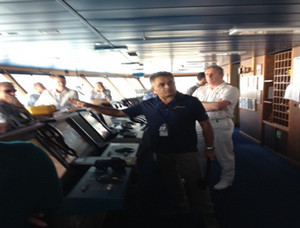
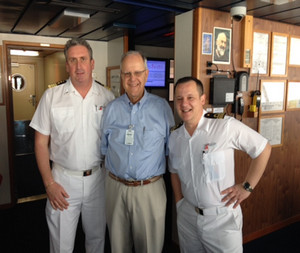 On December 16-18, 2015, I was able to attend the Cruise Line International Association Safety Conference in Miami. The focus was on improving the safety culture and Bridge Resource Management. This is a very interesting business for me to learn about. I was there to give some perspective from the chemical industry.
 There is a big need to be sure the managers of chemical plants are qualified so that their employees and neighboring communities do not suffer the consequences of chemical releases and spills. Many manufacturing businesses that do hazardous work, aside from chemical manufacturing, should heed this thinking too.
 I’m reminded about the organization that thought their safety performance was always good, because they were primarily an office environment. They scoffed over how bad could a paper cut be? Or, what’s the worst that could happen if someone fell off their chair? Little did they expect that one of their office workers, when on a healthy outdoor walk during her scheduled break time, tripped over some roped off tape that had been blown by the wind. She actually walked into it – not paying attention to her surroundings – got caught up in it as it wrapped about her feet. She fell, twisted her knee, required surgical repair, etc., etc. Try to explain that office worker lost-time injury! (The good: healthy walk; The bad: not paying attention; The ugly: lost time injury).
 We see organizations as complex adapting networks of people who are the vital keys to its success. When the people in the various parts of the network are sharing information and helping each other, all aspects of EHS Performance rapidly improves, resistance to change disappears and the energy bubbles up spilling over into all other parts of the work lifting the organization to new, higher levels of performance.
 In many places, the hunting season is underway or just beginning. This is always a time of change and hazard. Some years when I was a plant manager, we would have one or two serious hunting-related, off-job injuries – like falling from a tree stand or tripping over something and breaking a leg. There is a lot of change as people go into the woods and fields looking for game. Many have not done this for a while. Others may not be fully prepared for a sharp change in the weather where a heavy rain could come in or the temperatures drop below freezing and hypothermia becomes a worry. It is often dark and visibility is poor. I have read of hunters getting killed with their own weapon when they have tripped and accidentally shot themselves. Don’t load your gun until you are ready to use it.
 I have been talking about checklists in my previous newsletters and they can be useful as people go out hunting.
 I recently read of a fatal accident where a man was killed while working on a lathe. It was properly shielded and okay for the normal conditions, but the unexpected happened. The part he was working on exploded apart under the high rotating speed when he engaged the cutter. The parts from the exploding piece went right through the shield and gave him terrible, fatal wounds.
 Another thing that can happen around hunting season and the holidays is the need to hire temporary people to backfill for those who are out. These people need extra care and attention, but things are often so busy that it is hard to give it to them. These people just don’t know the hazards.
 In many of my newsletters, I have talked about the importance of sharing information abundantly, building relationships of trust and interdependence, and helping people to see the importance of their own work in building the success of the whole organization.
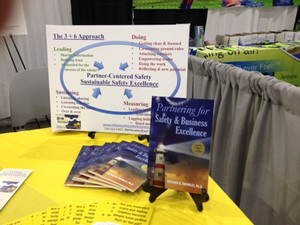 At our exhibit booth, Claire and I shared our Partner-Centered Leadership approach. We handed out brochures and other literature that can help organization’s achieve safety excellence and move towards their OSHA Star designation. We were there to share important information, including the need to be able to lift up and address one’s safety elephants that are preventing organizations from being the best they can be.
 The keys for addressing both of these concerns in building sustainability into their programs and in achieving the OSHA Star status is for the people at all levels and parts of the organization to talk together to get clear and aligned on just what they really want to do. How sincere and authentic is the desire to have safety excellence for the long-term? (This means Communication with a Capital C—requiring Co-creation, Clarity and Coherence.) In addition, together they must take the time to co-create a set of ground rules about how they agree to work together in order to achieve their safety goals and then hold each other accountable to live up to them. (That’s Partnership and Commitment!) The process to achieve this is available to you and your organizations now.
 This is all about having everyone go home in one piece and having a profitable business. Excellence in both the safety performance and business results are attainable.
 “
“ In my reading, studying and talking with many people, I have found that over half of the fatal accidents are often unanticipated and missed using our traditional approaches to accident prevention. The Heinrich Accident Triangle is very useful as we look at unsafe acts at the base of the triangle. Lots of slips, trips and falls are avoided as we do this.
 Talking together is one of the most important things we can do to help to improve the safety in our workplaces. Letting people know that you care about them and respect them. But too many times I have seen supervisors and managers talking down to their employees ordering them to do this or that.
 In reading the various, publicly-available reports, it looks as if all three of these big mistakes were probably made. The push for production was dominant, piping changes had been made without documentation, the safety procedures were modified or ignored, operating problems were not properly addressed and tolerated, previous practices allowed the draining of small quantities of material right into the room, and the communications were such that people probably could not or would not tell their management, who probably were not listening anyway, all the problems.