How Crisis Reveals the Power of Workplace Culture

When I came into a big chemical plant as the new Plant Manager, I found a deeply dysfunctional organization.

They were demonstrating the poorest performance in the entire company. The workplace culture and leadership were very dysfunctional.

During the first year, we had to work hard to re-establish the basic standards; things were difficult and intense. There was still a lot of bad behavior like cover-ups, lying, turf battles, and stifled flow of information. To survive, we had to turn this around.

One bright spot was that there were well-trained fire brigades on each shift. The shift supervisors were the incident commanders. They all went to fire school for a week each year and had much supplemental training and Hazmat training.

Late one morning the fire alarm went off (this is especially scary in a chemical plant). The fire brigade responded beautifully and had the fire out in about 30 minutes. Then the people came together, self-organizing around the needs to get things cleaned up, repaired and back into production. We had about a one-month inventory of finished product, so time was short. The clean-up post this fire was a huge effort.

Yet, note: During this incident and recovery, information was freely shared, so everyone knew what was going on. The various crafts like pipefitters and electricians helped each other cross craft lines as they were capable, people worked extra overtime without complaining. Those close to the work were making key decisions about what needed to be done and did it. It was an entirely different experience from what had been the norm (prior to this emergency). We were back into production in just over two weeks. We all celebrated.

Then, in no time at all, everyone went back to the former, bad behavior within the environment – it was a “negative norm.” As I watched, I was really perplexed. Why couldn’t we work like we did in the crisis all the time, helping each other, making decisions close to the work, sharing all information, working together as a team, and not covering things up and/or lying?
people in the workplace culture can change

We Can Do It!

Once people can “see” their own behavior, experience the better way to be,
and then decide that they’d prefer to work together,
they can voluntarily rise above old toxic ways!
Caring about each other and our future together is ultimately, a good thing!

So, that became my leadership focus. After working with the people, openly sharing information, listening to each other, learning together, working together, respecting and honoring the skills and knowledge of the people, we, indeed, learned to work this way together. We built a level of trust that enabled all of us to work differently and much more effectively.

I lead this effort by walking around among the people, holding conversations of meaning, sharing, listening, offering help, accepting criticism, respecting their deep knowledge and skills. I did this for about 5 hours a day, every day, for about 8 years – providing the stimulus to keep this changed way of working alive, while providing the safe structure for it to manifest.

People learned to self-organize around their work, identify the problems and fix them. The morale and creative energy grew and grew. People felt great satisfaction in being able to deal with and solve their own problems. These were the conditions that had emerged during the fire crisis, but now we could live them all the time. These were the conditions that led to excellence in performance.

My work as manager shifted from totally focusing on things, procedures, equipment, etc., (although I did these as needed and we kept the standards high) to working to be sure that the conditions for excellence were maintained and shared among all the people. These were not focused on just one area like safety, but they applied to everything we did. Our total performance greatly improved and as we learned how to do this better and better–the improvements grew and grew.

Analysis of the Workplace Culture and Leadership

When I arrived at the Plant and during the first year, I used the traditional top-down management approach. We had to get things fixed. But then with the shift to a participative approach where we all learned and worked together as partners, everything changed for the better.

Please think about these ideas and begin to apply them where you work. Yes – your team, your group, your organization can learn to work in principle-centered and partner-centered ways as described above. Call me (716-622-6467) if you want to chat about this.
never doubt that people in the workforce culture can change

I have been working with Sebastian Wolf Siebzehnruebl to write a new book about working this way. The manuscript was submitted to the publisher so the book should be ready before too long. This too might provide supplemental information for how to achieve extraordinary results. Stay tuned.
Writing a Book about the Process Enneagram

One of the unexpected pleasures of this season is knowing that my latest book endeavor (co-authored with Sebastian Wolf Siebzehnruebl) is soon to be on its way to a publisher.

I’m grateful for the opportunity to co-author this book about the process enneagram, not because it marks an ending, but because, at 91, it represents another step in a journey that has occupied much of my professional life and I enjoy lifelong learning.

For many years, my work has centered on a question that continues to challenge organizations everywhere: How do leaders solve problems that seem too complex, too interconnected, or too deeply rooted for conventional approaches to work?

That question led me to develop a practical framework for complex problem-solving – one designed to help leaders of organizations untangle issues that often resist traditional solutions. It is called the Process Enneagram. Time and again, I’ve seen leaders use this approach and facilitated framework to make progress on challenges that once felt overwhelming, producing results that are both meaningful and sustainable.

This new book brings together many of those years of learning, observation, and experience. My hope is that it will make these ideas more accessible to leaders and organizations seeking better ways to navigate complexity and address the “critical problems” that so often stand in the way of lasting success.

As the publication process unfolds, I’ll share more about the book and the ideas behind it. For now, I’m simply thankful for the opportunity to continue this conversation – and to contribute, in another way, to helping leaders solve the problems that matter most.

new book about the process enneagram

Some details on the book…

Sebastian Wolf Siebzehnruebl and I are co-authoring this new book, titled “Navigating Complexity: From Control to Flow Using the Process Enneagram.” We will be submitting the draft to Routledge Publishers in August.

Sebastian lives in Berlin, Germany and was the recent Curator of the International Federation of System Research which enabled him to know many of the leading thinkers in organizational development (OD) theory and ideas. When he became interested in the Process Enneagram, he realized that it provided a unique bridge between theory and practice.

The OD theory goes back in a continuous stream to Mary Parker Follett in about 1920. A large part of this theory, much of which has never been applied to practical situations, is supportive of and incorporated into the Process Enneagram helping us to understand how and why it works so well in helping organization to solve complex problems. The Process Enneagram is a very powerful, practical complexity tool.

My connection with the enneagram figure goes back to 1985, while I was a Plant Manager in the DuPont Company. My creation and unique development of the Process Enneagram occurred simultaneously with the development of chaos and complex adaptive systems theories, which I learned from Margaret Wheatley and others since 1996.

The Process Enneagram is very accessible to people in that it uses regular English; no technical language is used. I have used it successfully with people at all levels for over 30 years in many different kinds of organizations in many different countries, for solving complex problems.

(Note: The Process Enneagram is NOT the enneagram connected to or used in personality distinctions).

About the Process Enneagram

We see organizations as living systems with almost all the knowledge the people need to solve their problems is already there within. It is scattered among them, so when we open up the consequential conversations, they discover they know a lot and take the initiative to solve their own problems. They move from the top-down control of organizations treated as machines to the flow of self-organization systems in organizations treated as living system. Decisions are made by the people closest to the actual work.

I call the approach I take with organizations “Partner Centered Leadership.” In using the Process Enneagram with organizations, to help them solve their problems, I have seen them make big changes, sometimes in even just one day. These problems can be in arenas like safety, quality, effectiveness, innovation, turf wars, etc.

In looking at performance in 6-month after-workshop reviews, we see injury rates, for example, dropped sharply after several workshops beginning the day after the workshop was held. The process has to be sustained by the leaders, of course, after the facilitated workshop ends, and that follow-up is easily taught.

The safety, as well as all other dimensions of performance, improve. They move from compliance to excellence in their performance. However, our focus is not just safety; it is the whole system. The people discover that everything gets better when they see their system and decide to change how they work together.

lifelong learning keeps our minds sharp

Final Thoughts

“Every so often, we’re given an opportunity to look back and see how years of work have quietly come together.”

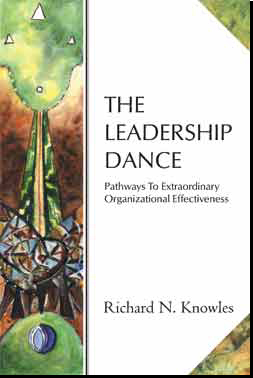
At 91, I’m overjoyed for this book development. Our new book will help you to learn more about this approach. My former book, “The Leadership Dance”, written in 2002, will also help you to understand this work. The Leadership Dance is available on Amazon.​

It will be interesting to see how our book project develops as we move forward. I’m excited for this to happen! Please stay tuned. I’ll let you know when this new book is ultimately published.

Beyond Compliance: Safer Workplace Culture

Our safety industry is huge and makes a lot of good contributions across millions of businesses to help to make workplaces safer.

There is no question that thousands of safety people are trying their best for a safer workplace.

It seems to me that with all this effort we should see fewer injuries and deaths, but over the last 10 years the number of people being killed and injured has not gone down and is stuck at about 5,200 fatalities and 2,500,000 injuries year (based on BLS statistics). Everyone agrees that this is NOT okay – yet even with focused effort there has been no breakthrough. Why?

The safety industry is currently working with organizations as if they are machines with linear work processes that can be taken apart and have the parts optimized. There have been thousands of change processes trying to do this, but successes have been limited. This approach is okay for simple situations, but our challenge is with complex systems where many people and parts are interacting all the time. In this situation, trying to fix a part like safety does not work because the whole system pushes back and spoils it.

a safer workplace is important to employees

When I was a plant manager, I found that in two different plants that shifting from seeing and working with the organizations as if they were a machine to seeing and working with them as if they were a living system made a huge difference. In learning to lead this way, the entire organization changes for the better.

This approach is based on the belief that most people want to do better and that they are intelligent and can make good decisions about their work. We created the conditions where it was safe to think and talk together, share information, and encourage them to make decisions close to their work. The whole system changed for the better, not just the safety (the injury rates dropped by over 90 %).

When I moved into my 30-year career of helping organizations to improve, I have seen similar progress. Not only did the performance improve, it happened quickly.

Making the Safety Shift…

Each organization can begin to make the shift and do this. The site managers and leaders need to be on board. The safety people can be a major help in this shift since they work across the organizations having access to many people at different levels. They can tell the success stories and encourage people to begin to work together in new ways.

This begins with treating people with respect, listening to them, and learning together. The people working close to the work have a lot of valuable information to share and build upon. Managers shift their focus from trying to control the work to trying to support the shift in culture.

Right now, for example, safety people can begin to work this way by having focused conversations with the people about how to handle heat stress in their workplaces. What ideas do they have to improve their working conditions? What can they do to make things better? You can encourage and support them to do the needed work.

work together to make a safer workplace

There is Help Available for a Safer Workplace…

I have developed a way of working with the people in organizations which I call Partner-Centered Leadership. My book, “The Leadership Dance,” available from Amazon, is a place to start. I also have some YouTube videos that will help.

You may also like to read this article, Faces of EHS: Richard Knowles on Being People-Focused.

If you concur that it is NOT okay for workplaces to be killing 5,200 people every year and injuring 2,500,000 people too, and want to make sure your workplace isn’t among the statistics, please connect with me at RNKnowles@aol.com or call me at 716-622-6467. I’ll share with you how your organization can achieve business and safety excellence at the same time.

YOU are the Reason…for safety in the workplace

There’s a reason – a very good reason for practicing Safety: YOU! Your life, your eyes, your ears, your fingers, your toes, your arms, your legs, your brain.

At its core, the purpose of safety is not compliance for its own sake. Compliance is a means to an end. The ultimate goal is to protect people – YOU… employees, supervisors, contractors, vendors, visitors and the public – from injury, illness, and fatality. It is about preventing serious incidents before they occur and ensuring that everyone returns home safely at the end of the day.

When an organization embraces this purpose, compliance becomes the foundation upon which a stronger culture of care, responsibility, and operational excellence is built.

Compliance establishes the minimum acceptable standard of performance. Safety excellence is achieved when people voluntarily do what is right, even when no one is watching, because protecting one another has become part of the organization’s culture and values.

safety in the workplace is for your safety

In a previous post, I shared how the number of fatalities (people being killed at work) is around 5,200 every year in the United States. Unfortunately, that number has fluctuated very little from year to year. If we have more safety professionals, more training, more audits, more regulations, more data, and more oversight than ever before, why do workplace fatalities remain relatively constant? What is being missed?

The next frontier in safety is not doing more safety activities; it is ensuring that safety activities influence the decisions, behaviors, and conditions are focused on the real outcomes we want.

The purpose of safety is not to create more safety programs – it is to prevent harm to people. So, to make sure that we’re really doing what we should be doing in the workplace, what are we really measuring?

  • Do workers trust management?
  • Do supervisors feel pressure to prioritize production over safety?
  • Are workers comfortable to stop work, for a valid safety concern?
  • Are critical hazards understood?
  • Are we watching for warning signs of a catastrophic event being ignored?
  • Why, after all our investment and effort, do serious injuries and fatalities continue to persist? What’s the root of this?
  • If our current approach is producing the results we see today, and the results are not good enough, then how should we be thinking differently now?

How about beginning to shift our focus:

  • Instead of asking if people are following the rules—how about, “Do people really understand the hazards?”
  • Instead of asking who made the mistake—how about, “What conditions made the mistake possible?”
  • Instead of asking how many audits we completed—how about, “What are the few things most likely to kill someone, and how certain are we that they are controlled?”

people need to practice working safely

Compliance seeks certainty through rules. Safety Excellence seeks resilience in the face of uncertainty.

For years I’ve been sharing about the Partner-Centered Leadership process because it works. It keeps people safe and fosters relationships, plus a healthy culture – Yes, your organization can become world-class in safety.

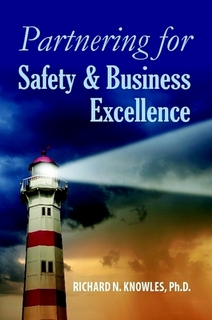
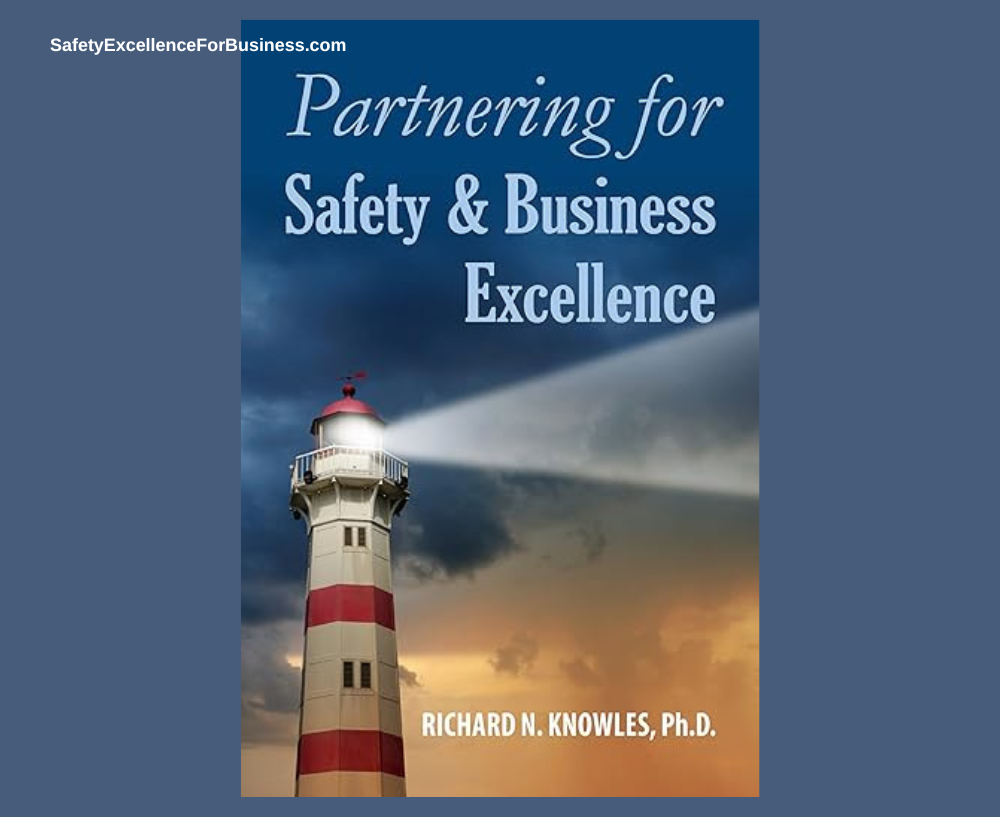
The Safety Leadership Process(TM) described in “Partnering for Safety and Business Excellence,” helps leaders to lead their respective organizations beyond compliance, to safety excellence, with virtually zero injuries. Huge costs are saved as the waste of human suffering, injuries, and lawsuits and bad press are avoided.

You can order a copy of “Partnering for Safety and Business Excellence” on Amazon and learn more about the five simple steps to get you there!


Teamwork in Action: Self-Organizing Teams

The most fun I ever had in leading organizations was when we had all learned to work together in self-organizing ways using Partner-Centered Leadership ideas and the Process Enneagram to guide our inquiries.

People were full of creative energy, coming up with good ideas about how to solve their problems and do better work. We shared information about all that was going on – feedback was straight forward and useful. We all learned together through teamwork, became more resourceful, and better able to handle the chaos and complexity of the world around us.

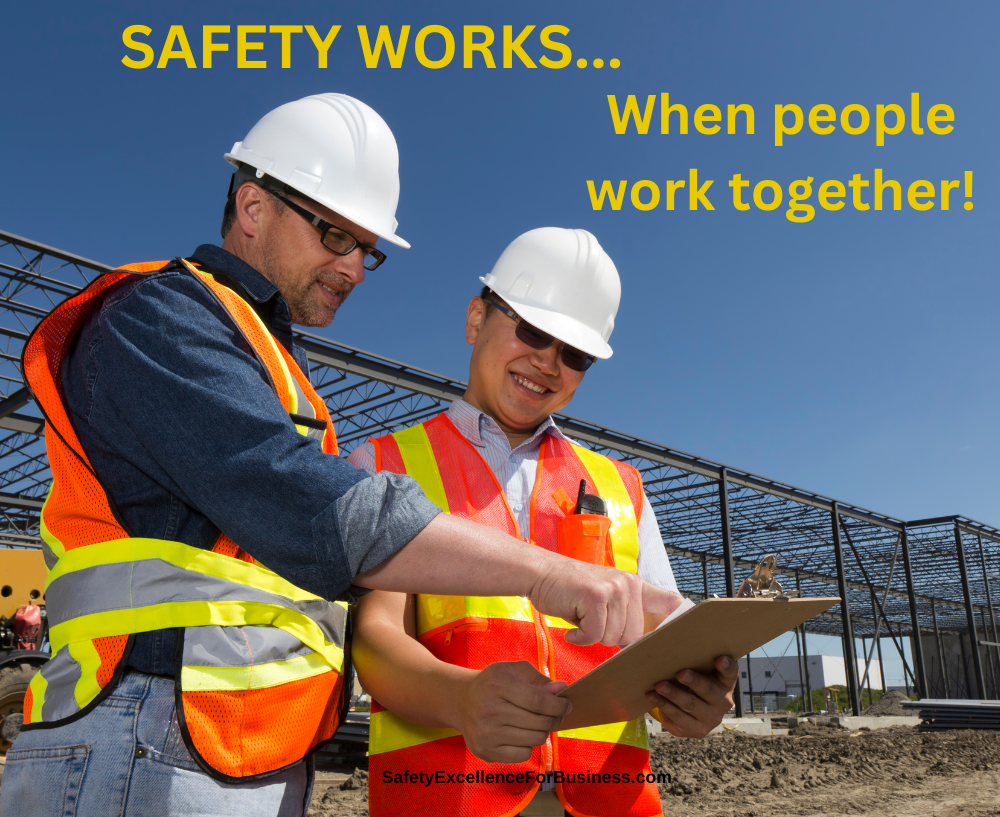
when people work together through teamwork safety works

In the old days, when I was driving the people from the top down, the work was hard and not a lot of fun. Many days I was just worn out with all the negative energy bring sucked out of me.

As we all learned to work this new way, my role shifted to being a cheerleader for all the great work that people were doing. The gift of their energy above the minimum made a huge, positive contribution.

Why Teamwork Works

Everything that happens within an organization depends on the agreements that the people co-create together about how to self-organize and do their work. Every part of the organization lives within these bounds and standards. In using the Process Enneagram, the people talk together, listen, share, learn and do the work. The people at all levels are engaged and participate in this work. They build together on their shared values.

Every part of the organization, including those at the top, those in research, sales, manufacturing, maintenance, purchasing, human resources, etc., have these ways of working together.

If someone tries to develop separate ways of working, the organization begins to crumble. For example, if I try to do things differently in safety that conflict with these shared ways of working, people get confused and trust drops. Over time this can lead to the sorts of dysfunctional organizations many of us know so well.

We all have a shared responsibility to nurture and develop this way of working together because the results that are achieved are so much better than dysfunctional organizations can achieve.

At one level, each part of the organization is engaged in different sorts of work, but at a deeper level everyone is engaged in this same way of working and building together. Trust levels got a whole lot better. Interdependence among the various groups became stronger. Disagreement and arguments were fewer because we had learned to talk together and listen for the best ideas.

Our organizations are full of people who are quite intelligent. As we worked and learned together, the collective intelligence of the entire organization got stronger, problem solving got stronger, cooperation and helping each other became more common. As we became more successful, we celebrated each other’s successes.

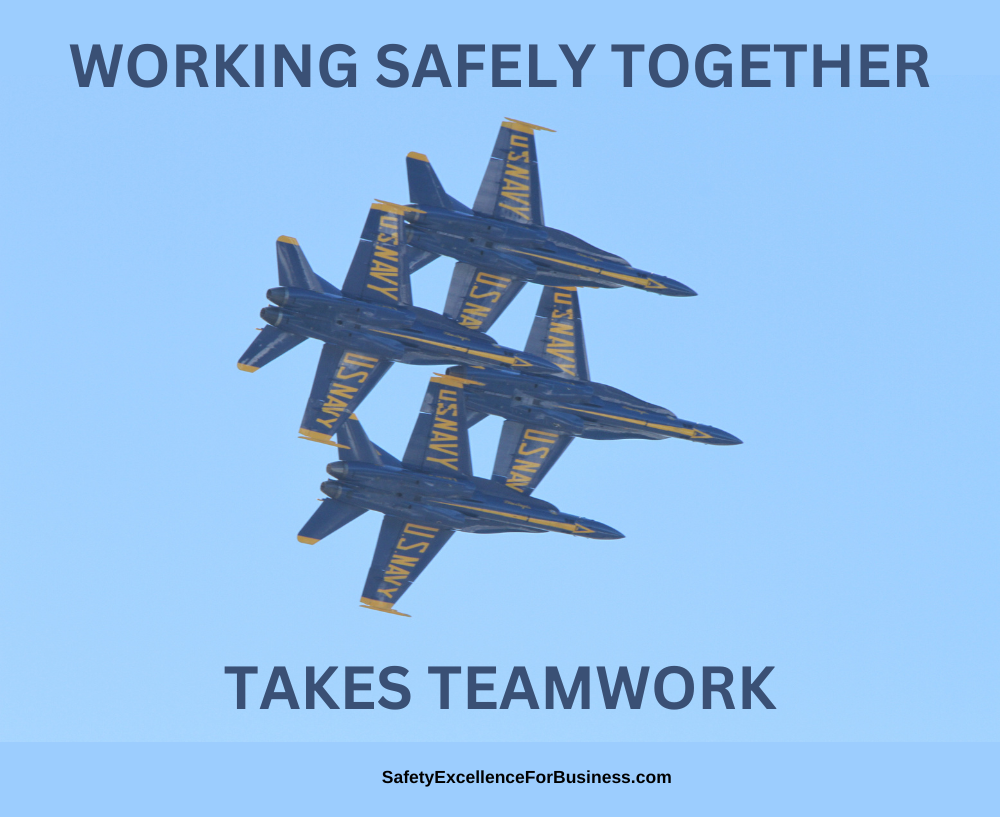
work safely together through teamwork

The Payoff of Teamwork

In one plant of over 1,000 people, in working this way, we went from one of the poorest performers to one of the best of all the 150 plants in the company in just four years.

That was a lot of work, but it was so much fun and satisfying. People are still talking about the experience 30 years later.

Path Forward

If you want to learn more about this way of working and learning together, please give me a call at 716-622-6467 between 10:00 am and 4:00 pm EST.

Opening a Big, Often Untapped, Resource…Communication

Most organizations rely on their research people, top management, and outside experts for the information they need to run their businesses and to solve their problems.

These people do their best to contribute to helping the organization – lending their expertise. A lot of money is spent on these resources; sometimes they are quite successful and sometimes they fail badly. Communication, however, is the most important.

look for solutions in communication

As a society, we honor Ph.D.’s, experts and professors for their great learning. They often develop fine theories about problem-solving and learning. Often, we defer to them to do our thinking and to solve our problems. This is okay for tough technical problems, but we depend on them too much. Now AI has come into this dynamic.

When I was a plant manager, I asked the engineers to go into the plant and to talk directly and openly with the people who were running the production operations. Their first reaction was to resist because the engineers said that those people did not know the technology. I pushed them further, pointing out that those running the processes live with the processes and have a lot of information that the engineers did not have, and the engineers could teach them the critical technology. As they talked together a lot of new information surfaced that was very helpful.

Not only did the operators of the processes learn more about the
technical aspects of what is happening and the “why” of the processes,
but the engineers learned a lot from the operators – how they have to
troubleshoot, for example, what different temperature and flow concerns
surface and how they have to respond, what alarms/alerts are
most difficult for them to address.

A big mistake many managers make is to ignore the huge amount of information and energy that the people across their organization actually have. Top management, engineers and experts have only half the information they need to successfully solve problems.

When they build trust among the people, they become willing to share what they know. As they all talk with each other, they discover that even more information emerges. The gap between work as imagined and work as done almost disappears. People open up and begin to use their discretionary energy to help to improve things. This discretionary energy is a gift the people will give in this environment.

Some Basic Keys… Relationships and Communication

Relationships are so important. We all need to be treating each other with respect, listening to each other, and learning together. Caring for and helping each other is also very important.

Being sincere with each other is also important. Telling the truth and respecting the ideas people bring up is also important. As people begin to speak up, it can feel quite risky so let’s make it safe for them.

Dedicating time each day to go into the organization, talking with the people about substantive issues, listening carefully, and helping people to solve their own problems is another important thing you can do. It is about learning how to hold “deliberate conversations of meaning – specifically looking for betterment.”

discretionary effort of the people

The Payoff

As these interactive, learning processes develop, the collective intelligence of the organization goes up, everyone gets smarter. More and more people begin to solve their own problems and find that this is quite satisfying and fun. As this spreads, the performance of the entire organization improves, problems get solved more quickly, close to the actual work and earnings improve.

Call me at 716-622-6467 and let’s discuss how focused conversations can help your organization make a huge difference too.

Safety Success in Your Workplace!

Let’s Not Keep it a Secret!

Our Industry’s Focus

As I read safety newsletters and various safety stories each day, I am struck that most people are focused on safety conferences and meetings, on developing better accident investigation procedures, and on withstanding OSHA audits.

These are important professional activities for sure, but I hardly ever see stories about successful safety work with our front-line people.

There about 5,200 people getting killed at work each year so this is not a trivial problem. We need to help more people go home to their families safely.

On LinkedIn, there are frequent arguments about the best investigation procedures or interpreting some new or old theory. For example, the “Bradley Curve,” which I was a part of creating, has received a lot of criticism and discussion with made up theory about it. That’s been useless, in my view. Apparently, the Curve has been used by different organizations in many ways. I hope they have been useful. Some of the theories discussed are way out there.

We, at the DuPont Belle, West Virginia Plant had been able to make terrific progress in talking together, listening and learning together. The Curve, now known as the Bradley Curve, was merely a simple way to illustrate what we had accomplished.

success in the workplace is built on safety

An Invitation…

I would like to publish some stories in my newsletter and website about safety successes in the workplace. Many of you know my passion for helping to make workplaces safer. I am sure that some of you also share this passion.

What successes can you share about reducing the number of injuries and incidents in your workplaces? How have you engaged the people to help them work with fewer injuries? What insights have you gained as you help to lead this work?

Sharing some success stories would be great to illustrate your work and provide ideas to others.

Many of you probably have some fine stories to share, which would help to provide ideas and guidance to others. Please send your story to me so I can put it into my newsletter and website, with attribution, of course.

individuals can thrive in the workplace with safety

Please Call Me

I would love to talk with you about your story and safety, in general, so please call me at 716-622-6467. I live in the Eastern Time Zone and calls between 10:00AM and 4:00PM are welcome.

Compliance with OSHA Standards is Important

As I study the safety publications like Professional Safety and EHS Today, there is a lot of effort in discussing new ways to achieve better safety performance, develop better ways to do hazards investigations, evaluate accidents, and being in compliance with OSHA standards.

When I have attended American Society for Safety Professionals and American Institute of Chemical Engineers meetings and conferences, there are lots of papers focused on improving various aspects of safety for the people at work and being in compliance with OSHA standards. There are thousands of really good safety professionals doing this work.

There is also a lot of effort in developing a better understanding of OSHA Standards and rules. There is good advice on how to work effectively with OSHA. None of us want to get OSHA citations after an audit.

I remember how nervous I was when we had our occasional OSHA audits. Most of the time we had successful audits (we had complied with the Standards), but now and then we’d get a citation which then brought down a lot of criticism from upper management. Being in compliance is really important from a career and publicity perspective, so we worked really hard to meet the OSHA Standards.

Surviving an OSHA investigation without any citations is one measure of success for safety professionals. I know that it takes a lot of work to have a successful audit.

keep employees safe

Moving Beyond Compliance is Important

Another way to see how well we are doing is to look at the people getting injured or killed at work. This is not a numbers game; we are working with real people.

This is important to our companies since these tragedies can cost a lot of money for health care or have to deal with lawsuits. It can also cause bad publicity, prompt an OSHA investigation, and suffer fines, and destroy families.

Fortunately, most of the millions of businesses in the USA don’t have these problems, which gives them a feeling of success. They are in compliance. This can lull them into thinking they are doing a great safety job; then something happens and everything hits the fan.

Unfortunately, a lot of businesses do have fatalities (5,200 a year) and injuries (about 2,500,000 a year). We can’t predict which businesses will have a tragedy so many may think that it will not happen to us, and feel compliance is good enough. But compliance is not good enough, in my view. A death or serious injury are devastating to those involved and the families and loved ones never got over the loss, EVER!

work together to stay in compliance with osha and keep everyone safe

A Path Forward

When I was managing operations where we could have a fatality or serious injury, I found that partnering with the people was extremely important.

We created an environment where we could all talk together about work, share our ideas and insights freely, and learn together – all of us at all levels, contributed and shared our knowledge. contributed and learned. The collective knowledge of our organization grew and strengthened as we co-created our future. We treated each other with respect and care, maintained high standards, and addressed problems together.

As we learned together, more and more people began to contribute. We did not just work on safety – we worked on all aspects of our work.

I spent about half of my time walking among the people in the plant, getting to know the people, and building our relationships and trust. I modeled how we needed to work together so people could see that I was genuinely interested and committed to improving all we did.

I had a safety mantra:

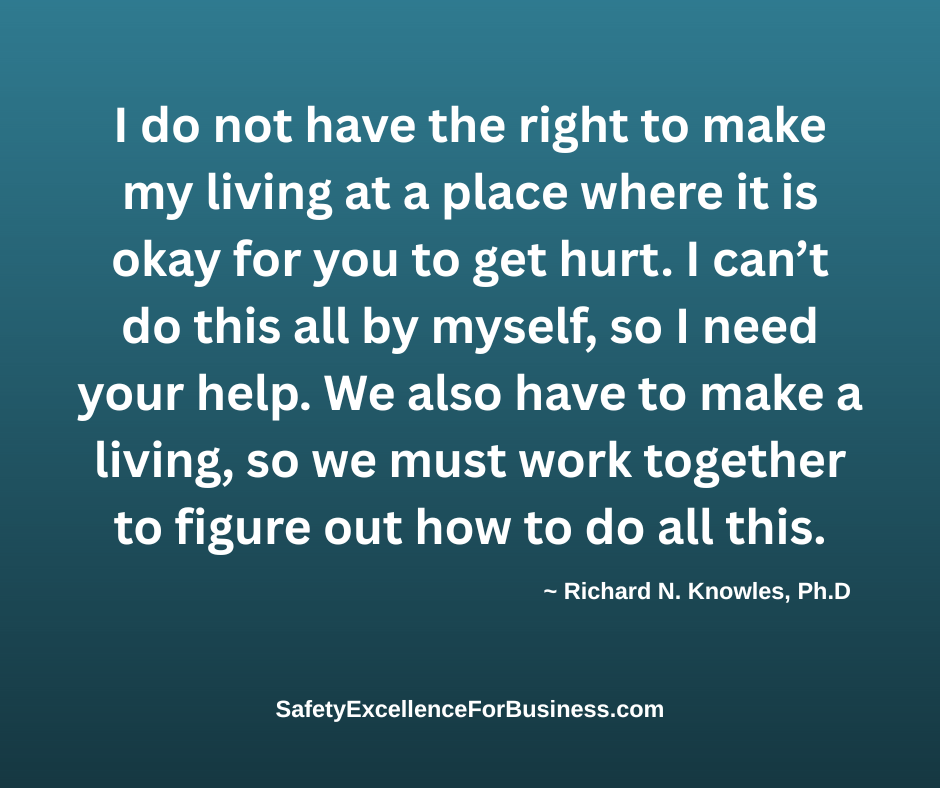
“I do not have the right to make my living at a place where it is okay for you to get hurt.
I can’t do this all by myself, so I need your help.
We also have to make a living, so we must work together to figure out how to do all this.
”

Our total performance made significant progress, people were more satisfied, we had more fun, and my job got a lot easier as we focused on our growing successes.

I would be pleased to talk with you if you would like to do this. We could do this with a Zoom or phone call. Call me (716-622-6467) to set up a meeting.

Leading Safety Through Partnership and Respect

The Alcoa Transformation: A Lesson in Leadership

In October 1988, Paul O’Neill became Chairman of Alcoa, a global aluminum producer facing challenges in safety, quality, and profitability.

O’Neill recognized that true, sustainable improvement required a cultural shift – one built on open communication, respect, and recognition. He championed what I call Partner Centered Leadership, where every voice matters and information flows freely.

To enable this change, O’Neill asked all managers and supervisors to regularly ask their teams three simple questions:

  • Does everyone have all the information and resources needed to do their best?
  • Does everyone treat you with respect and consideration, every day, at every level
  • Does everyone receive recognition and honor for their contribution?

He also invited employees from all levels to contact him directly with suggestions for improvement. The results were remarkable: within a few years, Alcoa’s earnings increased fivefold, and both safety and market evaluation improved dramatically.

partnering for safety and business excellence

My Experience: Partner Centered Leadership in Action

When I served as Plant Manager at DuPont’s Belle, West Virginia facility, I independently adopted a similar approach. By engaging with employees daily – walking the plant, asking questions, and listening – I witnessed dramatic improvements:

Our injury rates dropped by about 97%,
emissions to the air, water and land dropped by 95%,
productivity rose by 40%, and
earnings went up 300% in just four years.

These results were not achieved by imposing top-down directives, but by building trust, sharing information, and working together. Over time, our culture shifted organically – people contributed more, leadership became easier, and our values for safety, quality, and respect became the foundation of our success.

Building a Positive Workplace This Holiday Season

As we enter the Christmas holiday season, let’s bring cheer and positivity into our workplaces. Treat each other with kindness and consideration, keep divisive politics out of the workplace, and focus on building a supportive environment. Remember, even in diverse settings like the International Space Station, shared values and mutual respect enable people to thrive together. We can do the same.

approach the new year for safety and partnership

Key Takeaways on Safety and Partnership

  • Open communication, respect, and recognition are the foundation of a strong safety culture.
  • Simple, consistent questions can drive meaningful change.
  • Sustainable improvement comes from partnership, not top-down mandates.
  • A positive workplace is built by everyone, every day.

Reflection on Safety

What’s one thing you can do this week to foster a safer, more respectful workplace? You don’t have to wait until the new year – you can start right now! Call me to learn more. Ask me questions!

Cold times are here… Watch Out for Black Ice

The strong, fall winds are blowing hard. The temperatures are dropping.

With roads and driveways wet, and cold winds blowing, the risk of black ice becomes real. So it is timely to raise our awareness to this lurking risk.

expect the unexpected with black ice

When I was in college – about this time of year – one morning I set out on my bicycle to class. (Yes, bicycle!). Things went fine until I hit a patch of black ice, WOW! What a crash. Books and papers everywhere and me laying flat on my back wondering what hit me. Fortunately, I was not hurt.

Another time I was walking to work and we had a light dusting of snow. It was quite pretty with everything having a slight snow cover. As I was walking, I stepped onto a small patch of snow on the sidewalk. Under it was a sheet of black ice. I crashed so hard and fast that I was really shocked and had a good bump on my head. Fortunately, nothing came of the bump, but falls like this can be serious, even fatal.

I spun a car around early one morning as I drove onto a bridge. Fortunately, no other cars were there as it was very early morning, so nothing serious happened. I was lucky.

watch out for black ice

In all these stories, I was lucky that things were not more serious. In each of these, the black ice was a complete surprise. I was not expecting it at all. That is the way black ice is. It is almost invisible and very slippery, especially when covered in a dusting of snow. (I should have been more attentive to the potential risk of black ice.)

Please keep an eye out for yourselves as you get going in the morning, so you do not get into a black ice adventure.

I’m reminded how experiencing the surprise of black ice fits perfectly in the seasonal safety slogan of Expect the Unexpected.