Writing a Book about the Process Enneagram

One of the unexpected pleasures of this season is knowing that my latest book endeavor (co-authored with Sebastian Wolf Siebzehnruebl) is soon to be on its way to a publisher.

I’m grateful for the opportunity to co-author this book about the process enneagram, not because it marks an ending, but because, at 91, it represents another step in a journey that has occupied much of my professional life and I enjoy lifelong learning.

For many years, my work has centered on a question that continues to challenge organizations everywhere: How do leaders solve problems that seem too complex, too interconnected, or too deeply rooted for conventional approaches to work?

That question led me to develop a practical framework for complex problem-solving – one designed to help leaders of organizations untangle issues that often resist traditional solutions. It is called the Process Enneagram. Time and again, I’ve seen leaders use this approach and facilitated framework to make progress on challenges that once felt overwhelming, producing results that are both meaningful and sustainable.

This new book brings together many of those years of learning, observation, and experience. My hope is that it will make these ideas more accessible to leaders and organizations seeking better ways to navigate complexity and address the “critical problems” that so often stand in the way of lasting success.

As the publication process unfolds, I’ll share more about the book and the ideas behind it. For now, I’m simply thankful for the opportunity to continue this conversation – and to contribute, in another way, to helping leaders solve the problems that matter most.
new book about the process enneagram

Some details on the book…

Sebastian Wolf Siebzehnruebl and I are co-authoring this new book, titled “Navigating Complexity: From Control to Flow Using the Process Enneagram.” We will be submitting the draft to Routledge Publishers in August.

Sebastian lives in Berlin, Germany and was the recent Curator of the International Federation of System Research which enabled him to know many of the leading thinkers in organizational development (OD) theory and ideas. When he became interested in the Process Enneagram, he realized that it provided a unique bridge between theory and practice.

The OD theory goes back in a continuous stream to Mary Parker Follett in about 1920. A large part of this theory, much of which has never been applied to practical situations, is supportive of and incorporated into the Process Enneagram helping us to understand how and why it works so well in helping organization to solve complex problems. The Process Enneagram is a very powerful, practical complexity tool.

My connection with the enneagram figure goes back to 1985, while I was a Plant Manager in the DuPont Company. My creation and unique development of the Process Enneagram occurred simultaneously with the development of chaos and complex adaptive systems theories, which I learned from Margaret Wheatley and others since 1996.

The Process Enneagram is very accessible to people in that it uses regular English; no technical language is used. I have used it successfully with people at all levels for over 30 years in many different kinds of organizations in many different countries, for solving complex problems.

(Note: The Process Enneagram is NOT the enneagram connected to or used in personality distinctions).

About the Process Enneagram

We see organizations as living systems with almost all the knowledge the people need to solve their problems is already there within. It is scattered among them, so when we open up the consequential conversations, they discover they know a lot and take the initiative to solve their own problems. They move from the top-down control of organizations treated as machines to the flow of self-organization systems in organizations treated as living system. Decisions are made by the people closest to the actual work.

I call the approach I take with organizations “Partner Centered Leadership.” In using the Process Enneagram with organizations, to help them solve their problems, I have seen them make big changes, sometimes in even just one day. These problems can be in arenas like safety, quality, effectiveness, innovation, turf wars, etc.

In looking at performance in 6-month after-workshop reviews, we see injury rates, for example, dropped sharply after several workshops beginning the day after the workshop was held. The process has to be sustained by the leaders, of course, after the facilitated workshop ends, and that follow-up is easily taught.

The safety, as well as all other dimensions of performance, improve. They move from compliance to excellence in their performance. However, our focus is not just safety; it is the whole system. The people discover that everything gets better when they see their system and decide to change how they work together.
lifelong learning keeps our minds sharp

Final Thoughts

“Every so often, we’re given an opportunity to look back and see how years of work have quietly come together.”

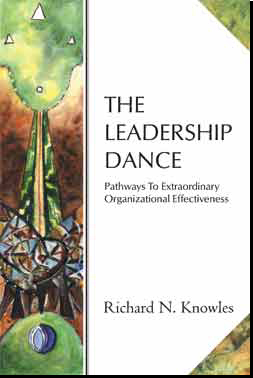
At 91, I’m overjoyed for this book development. Our new book will help you to learn more about this approach. My former book, “The Leadership Dance”, written in 2002, will also help you to understand this work. The Leadership Dance is available on Amazon.

It will be interesting to see how our book project develops as we move forward. I’m excited for this to happen! Please stay tuned. I’ll let you know when this new book is ultimately published.
Beyond Compliance: Safer Workplace Culture

Our safety industry is huge and makes a lot of good contributions across millions of businesses to help to make workplaces safer.

There is no question that thousands of safety people are trying their best for a safer workplace.

It seems to me that with all this effort we should see fewer injuries and deaths, but over the last 10 years the number of people being killed and injured has not gone down and is stuck at about 5,200 fatalities and 2,500,000 injuries year (based on BLS statistics). Everyone agrees that this is NOT okay – yet even with focused effort there has been no breakthrough. Why?

The safety industry is currently working with organizations as if they are machines with linear work processes that can be taken apart and have the parts optimized. There have been thousands of change processes trying to do this, but successes have been limited. This approach is okay for simple situations, but our challenge is with complex systems where many people and parts are interacting all the time. In this situation, trying to fix a part like safety does not work because the whole system pushes back and spoils it.

a safer workplace is important to employees

When I was a plant manager, I found that in two different plants that shifting from seeing and working with the organizations as if they were a machine to seeing and working with them as if they were a living system made a huge difference. In learning to lead this way, the entire organization changes for the better.

This approach is based on the belief that most people want to do better and that they are intelligent and can make good decisions about their work. We created the conditions where it was safe to think and talk together, share information, and encourage them to make decisions close to their work. The whole system changed for the better, not just the safety (the injury rates dropped by over 90 %).

When I moved into my 30-year career of helping organizations to improve, I have seen similar progress. Not only did the performance improve, it happened quickly.

Making the Safety Shift…

Each organization can begin to make the shift and do this. The site managers and leaders need to be on board. The safety people can be a major help in this shift since they work across the organizations having access to many people at different levels. They can tell the success stories and encourage people to begin to work together in new ways.

This begins with treating people with respect, listening to them, and learning together. The people working close to the work have a lot of valuable information to share and build upon. Managers shift their focus from trying to control the work to trying to support the shift in culture.

Right now, for example, safety people can begin to work this way by having focused conversations with the people about how to handle heat stress in their workplaces. What ideas do they have to improve their working conditions? What can they do to make things better? You can encourage and support them to do the needed work.

work together to make a safer workplace

There is Help Available for a Safer Workplace…

I have developed a way of working with the people in organizations which I call Partner-Centered Leadership. My book, “The Leadership Dance,” available from Amazon, is a place to start. I also have some YouTube videos that will help.

You may also like to read this article, Faces of EHS: Richard Knowles on Being People-Focused.

If you concur that it is NOT okay for workplaces to be killing 5,200 people every year and injuring 2,500,000 people too, and want to make sure your workplace isn’t among the statistics, please connect with me at RNKnowles@aol.com or call me at 716-622-6467. I’ll share with you how your organization can achieve business and safety excellence at the same time.

YOU are the Reason…for safety in the workplace

There’s a reason – a very good reason for practicing Safety: YOU! Your life, your eyes, your ears, your fingers, your toes, your arms, your legs, your brain.

At its core, the purpose of safety is not compliance for its own sake. Compliance is a means to an end. The ultimate goal is to protect people – YOU… employees, supervisors, contractors, vendors, visitors and the public – from injury, illness, and fatality. It is about preventing serious incidents before they occur and ensuring that everyone returns home safely at the end of the day.

When an organization embraces this purpose, compliance becomes the foundation upon which a stronger culture of care, responsibility, and operational excellence is built.

Compliance establishes the minimum acceptable standard of performance. Safety excellence is achieved when people voluntarily do what is right, even when no one is watching, because protecting one another has become part of the organization’s culture and values.

safety in the workplace is for your safety

In a previous post, I shared how the number of fatalities (people being killed at work) is around 5,200 every year in the United States. Unfortunately, that number has fluctuated very little from year to year. If we have more safety professionals, more training, more audits, more regulations, more data, and more oversight than ever before, why do workplace fatalities remain relatively constant? What is being missed?

The next frontier in safety is not doing more safety activities; it is ensuring that safety activities influence the decisions, behaviors, and conditions are focused on the real outcomes we want.

The purpose of safety is not to create more safety programs – it is to prevent harm to people. So, to make sure that we’re really doing what we should be doing in the workplace, what are we really measuring?

  • Do workers trust management?
  • Do supervisors feel pressure to prioritize production over safety?
  • Are workers comfortable to stop work, for a valid safety concern?
  • Are critical hazards understood?
  • Are we watching for warning signs of a catastrophic event being ignored?
  • Why, after all our investment and effort, do serious injuries and fatalities continue to persist? What’s the root of this?
  • If our current approach is producing the results we see today, and the results are not good enough, then how should we be thinking differently now?

How about beginning to shift our focus:

  • Instead of asking if people are following the rules—how about, “Do people really understand the hazards?”
  • Instead of asking who made the mistake—how about, “What conditions made the mistake possible?”
  • Instead of asking how many audits we completed—how about, “What are the few things most likely to kill someone, and how certain are we that they are controlled?”

people need to practice working safely

Compliance seeks certainty through rules. Safety Excellence seeks resilience in the face of uncertainty.

For years I’ve been sharing about the Partner-Centered Leadership process because it works. It keeps people safe and fosters relationships, plus a healthy culture – Yes, your organization can become world-class in safety.

The Safety Leadership Process(TM) described in Partnering for Safety and Business Excellence,” helps leaders to lead their respective organizations beyond compliance, to safety excellence, with virtually zero injuries. Huge costs are saved as the waste of human suffering, injuries, and lawsuits and bad press are avoided.

You can order a copy of “Partnering for Safety and Business Excellence” on Amazon and learn more about the five simple steps to get you there!


Safety Success in Your Workplace!

Let’s Not Keep it a Secret!

Our Industry’s Focus

As I read safety newsletters and various safety stories each day, I am struck that most people are focused on safety conferences and meetings, on developing better accident investigation procedures, and on withstanding OSHA audits.

These are important professional activities for sure, but I hardly ever see stories about successful safety work with our front-line people.

There about 5,200 people getting killed at work each year so this is not a trivial problem. We need to help more people go home to their families safely.

On LinkedIn, there are frequent arguments about the best investigation procedures or interpreting some new or old theory. For example, the “Bradley Curve,” which I was a part of creating, has received a lot of criticism and discussion with made up theory about it. That’s been useless, in my view. Apparently, the Curve has been used by different organizations in many ways. I hope they have been useful. Some of the theories discussed are way out there.

We, at the DuPont Belle, West Virginia Plant had been able to make terrific progress in talking together, listening and learning together. The Curve, now known as the Bradley Curve, was merely a simple way to illustrate what we had accomplished.

success in the workplace is built on safety

An Invitation…

I would like to publish some stories in my newsletter and website about safety successes in the workplace. Many of you know my passion for helping to make workplaces safer. I am sure that some of you also share this passion.

What successes can you share about reducing the number of injuries and incidents in your workplaces? How have you engaged the people to help them work with fewer injuries? What insights have you gained as you help to lead this work?

Sharing some success stories would be great to illustrate your work and provide ideas to others.

Many of you probably have some fine stories to share, which would help to provide ideas and guidance to others. Please send your story to me so I can put it into my newsletter and website, with attribution, of course.

individuals can thrive in the workplace with safety

Please Call Me

I would love to talk with you about your story and safety, in general, so please call me at 716-622-6467. I live in the Eastern Time Zone and calls between 10:00AM and 4:00PM are welcome.

The Safe Acts Audit…A Key to Safety in Businesses

In many of my safety blogs, I have emphasized the importance of conversations so we can all learn and grow together.

The conversations brought us all together and helped us to achieve excellent business and safety results. As we became increasingly successful in our work, we introduced a new safety audit we called The Safe Acts Audit. It is very useful and powerful; we used it extensively.

the safe acts audit - leading indicator of the safety climate

Each week, the safety team of 2-3 people would walk out into the plant among the people, looking at how they were working. We wanted to observe people doing things right.

The auditors would just walk among the people and watch. They did not stop to talk; they just cruised around the plant at random times for about an hour, 2-3 times each week. They would observe 40-60 people each time, and if (by chance) they saw anyone working unsafely,* they would deduct a point or two from the beginning Safe Acts Index number of 100%.

(*Certainly, if the observed behavior of working unsafely was blatant, the person’s supervisor was immediately notified to prevent a potential injury; however, the intent of the audit was purely to observe and record what was being done correctly. It’s a whole different type of audit when you’re looking for the good things, not the negative.)

Most of the time the Index would indicate that 95-98% of the observations were of people working safely. It gave us a very easy way to sense what was happening. We also found that it was an excellent leading indicator. The Safe Acts Audit is not to be confused with a Gemba Walk. Remember, this Safe Acts Audit was simply to observe people, and to record the number of observations of people working safely – that’s the bottom line.

After a year or so, most of us did Safe Acts Audits every time we went into the plant. These were mostly impromptu, and the official Index number was the one generated by the safety people. There is some subjectivity in doing this audit so we thought that the official number should be generated by the same people to reduce the variability of the Index.

Using the Safe Acts Index

Over time, we realized that the Safe Acts Index was a sensitive, leading indicator of the safety climate.

If the Index fell in any audit by 5-10%, there would likely be a recordable injury within the next 3 days. We had to immediately raise everyone’s awareness of the potential, and the need to work more carefully. We did this in several ways.

One way was to put a traffic stop light at the pedestrian gates; a green light indicated that we were doing okay; a yellow light indicated a drop in the Safe Acts Index; and a red light meant we had had a recordable injury somewhere on the plant. With the yellow light all of us would talk more about the safety and hold better toolbox meetings each day, simply to raise awareness.

Another way to raise awareness was to have all eight of us on the leadership team greet everyone coming into work on each shift for a day, reminding them of the need to be more aware, sharing that our Safe Act Audit numbers were indicating we need to all increase our awareness of doing our jobs safely, and that we do not want to see anyone be injured.

Another way was to publish a safety caution in the emails and newsletters we used. We also put cautions onto the login screens of their computers.

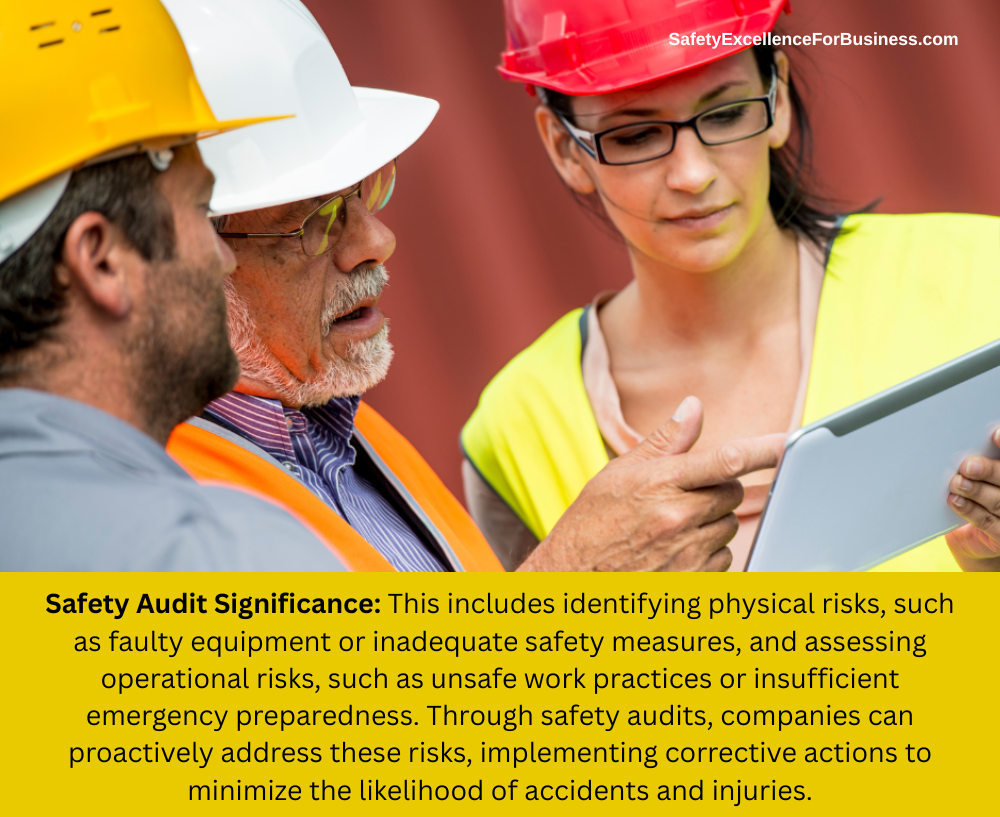
safety audit significance

Conclusion

All this communication effort was done with respect and caring. We wanted people to know that we cared and that we all had to work together so we could all go home safely to our families.

Doing the Safe Acts Audit was easy and a highly effective part of our total safety effort, contributing to helping us reduce our injury rate by about 97% in four years. It was a positive audit – seeking to raise people’s awareness to do our work safely and to watch out for each other.

There were 1,100 people working at the plant, so using our safety index as a way to look at our performance was reliable. By working together to improve our total performance, including safety, we did not suffer the problem of under reporting, but we kept a keen eye on that potential, so it did not develop.

If you’d like to know about how important this Safe Acts Audit process is or how you could adopt it for your organization, please give me a call at 716-622-6467.

Consulting or Facilitating…Which Works Best?

Do you know the difference between consulting or facilitating?

If you google consulting or facilitating, here’s what you’ll find…

  • consultant is a person who provides expert advice within a particular field, i.e., safety, quality, leadership, security, HR, etc. A facilitator, on the other hand, has a depth and breadth of expertise in process (that can be applied to most problem-solving situations). The organization has a good understanding of the subject matter, yet they need help processing the information and thinking it through to make the best decision for the organization. That’s a facilitator.

Consulting

Consultants are people who have studied a particular subject and developed a training method to sell it so they can make a living. Many people do this quite successfully. This is a pretty competitive business. Some big companies have developed out of successful consulting practices. Their goal is to apply their specific knowledge and fill the need that an organization, team or company may have.

In my experience when a safety consultant was hired to come into our plant, they were quite polished and presented their program very well. The people in my group would sit quietly listening to the offering and trying to make sense as it applied to our work. Often there would be good ideas and techniques presented. The consultants were clearly geared to fix us and make us work more safely.

But they had some big challenges. They did not know us as people, nor the real situations that we faced in our work. They did not care or have enough time to get to know anyone. They would spend a day or two and be off to their next client. Because of this their credibility was shaky. Trust levels were not very good.

As we listened to their presentations, we would begin to pick them apart in our minds. They were the experts so we could just sit back and listen (superficially). When they left, we would talk about how their ideas fit with us, or not. After a couple of days, we were doing things just as we had always done them with someone getting hurt now and then. If things did not work out, we would blame it on the consultant. It is fair, however, to note that there were often valuable nuggets of information that we gleaned and utilized.

The consultants had a very narrow focus on their particular task. They would try to get us to change the way we worked to be safer. I have found that ,over the years, trying to change and improve safety in an organization that struggles with bullies, tolerates lying and coverups, and other dysfunctional behaviors does not work. The dysfunctional behaviors crush the new ways of doing things and the new changes are not sustainable.

which is best - consulting or facilitating

Facilitating

Facilitators are people who help us to solve our own problems. They are highly trained on the safety rules and procedures, but they do not give us a lecture.

The best facilitators were people from our own organization who knew us and helped us to talk together about how to work more safely and solve our own problems. However, we hired good facilitators to join us, too. We would sit together, walk around together, talk about the work, and develop the best way to get it done effectively and safely.

They would ask us questions and help us to think things through. They knew the right questions to ask. They were not there to dictate how to do something as if we had no brains. They were there as partners in the whole effort to work more effectively. We were self-organizing and solving our own problems.

When the facilitators were with us, we began to see things differently, to think differently, help each other, listen, and learn together. We took responsibility for ourselves, each other and the work; we cared. And we learned to keep improving by using after-action reviews.

Our facilitators were available all the time in case we had some questions or needed help. The facilitators were often people in supervision who partnered with us. Sometimes a front-line person like an operator or mechanic or secretary became skilled facilitators. They were skilled because they knew the best process (or framework or model) to effectively facilitate the group and its problem/concern.

We shared information about the work, the necessary tools and procedures, the hazards, the precautions we needed to take to be both compliant with the rules and able to do the work quickly and well. We made sure that people felt mentally and physically fit to do the work. Then when the job was done, we’d talk about how it went and how we could do it better next time.

As we worked this way, all the other aspects of our work culture became more positive and supportive. When the whole organizational culture becomes more positive and supportive, everything, including safety gets better.

To really improve the organization and the safety,
we need skilled facilitators!

What do you need for your organization? Consulting or facilitating?

Note: I would be remiss if I did not share that the Process Enneagram©, which I created 25 years ago, has turned out to be an extraordinary process tool for use in effecting positive organizational change. See my book, The Leadership Dance: Pathways to Extraordinary Organizational Effectiveness, on Amazon. Call me, I’ll be happy to help you learn to use this tool.

Leading Safety in the Midst of Change is Important for Business

The amount of change and the rate of change in the middle of DOGE is huge.

Different accounts and stories about what is happening swirl around like a storm. Organizations like NIOSH and OSHA are having to make adjustments for safety. Depending on the report, the stories of partial or even total elimination abound. Those of us outside the inner circles really do not know the details of what is happening, so we can get quite worked up about it all.

Some of the work being done in NIOSH may be vital in trying to improve workplace safety, but some of it may not be very important. From the outside, it is hard to tell. Hopefully any cuts in budget will focus on the less important work. NIOSH has been around for 50 years, and I’m told they’ve done much in the research end of safety and health.

As many of you know I have been asking why our fatality and injury rates are stuck at around 5,200 and 2.400,000 cases, respectively, for about the last 10 years. I do not know how the work of NIOSH directly impacts the workplace and in what ways their work has made the most difference. Based on the number of fatalities and injuries, you can make a case that NIOSH had very little impact so budget cutting may be the correct approach.

OSHA works closer to the actual workplace, thus having a more positive impact. But, again, the fatality and injury rates are not coming down so they may need to find out why that is.

I am more concerned about any OSHA budget cuts because OSHA is already spread very thin. OSHA has been around since 1970…can anyone say that our workplaces would be as safe as they are or that people would follow the safety rules that are in place without OSHA being the enforcer?

safety and security are the goals at the end of the day

We Can Do a Lot Ourselves for Safety

Even though all the changes and cuts are happening, we can do a lot in our own workplaces at the local, company level to make a difference.

Workplace safety is a local issue, which we at the local level can impact regardless of all the other changes going on. What is the mindset we each can hold as to whether we will go home from the workplace today and every day with all our fingers, toes, legs, arms, eyes, and ears intact? What about how well we look out for our co-workers being able to also return home from work with body and mind wholeness?

We can work directly with our people to help improve the total safety performance.

We can help our organizations get a whole lot better in all aspects of our work, not just in safety. We need to help all the people in the whole workplace to work more purposefully together. We need to treat each other with respect. Listen to each other. Help each other to share information more abundantly. Listen carefully to each other so we can learn together. We need to help people find meaning in their work and have more satisfaction with themselves.

safety and security in the business still can be profitable

When we work together doing these kinds of things, the whole workplace becomes much more open and healthier.

People do not have to fear that they will get punished in some way when they speak up and make suggestions. These kinds of behaviors positively impact all we do. In an environment like this, we can all learn and grow together.

I think that the only way we can create sustainable improvements in safety is to create a climate where everything in the organization is improving. And where people work to keep each other safe.

When I was the Plant Manager at a big plant that was having terrible performance problems, we on the Leadership Team decided to become the best producer and supplier of chemicals to our customers through improving all aspects of our work.

We focused on safety. environmental performance, people development, quality, customer service, costs, and our relationship with our community. Our total culture improved dramatically over the next 4 years, our injury rate dropped by 97%, emissions dropped by 95%, productivity rose by 45%, and earnings rose by 300%.

In the Midst of Great Change, We Can Do a Lot To Get Better!

We can take charge and sail our ships successfully in this great storm!

Call me at 716-622-6467 and let’s discuss how!

Why Are People Getting Killed At Work?

Indifference… At a local event this past week, I asked a friend who is involved in safety work the question, why are people getting killed at work? He quickly came up with this answer.

A lot fewer people are being killed than it used to be before OSHA. There has been a lot of progress. We must be at about the best we can do.

Then the conversation moved off to the Olympics. He just brushed this off as no longer important.

But this is important to the approximately 5,200 families who have had someone in their family killed. This experience remains with the family forever. And this 5,200 total number is an every year statistic!

Those of you reading my newsletters know that I am constantly trying to help people reduce injuries and deaths by building Partner-Centered Leadership and sharing real case studies that have been published in Professional Safety. We can reduce the numbers of injuries and fatalities, and we shouldn’t just push this problem aside with indifference.

hard hats save workers from being killed at work

Leaders Lacking Insights About What Is Possible

At a recent graduation celebration gathering, I was talking with a family member who has a very responsible safety leadership job in a large company, about my efforts to have fewer people killed at work. We talked about Partner-Centered Leadership and having everyone involved, co-creating our shared futures and taking more responsibility for the whole business efforts, including safety.

I was asked, “How do you work this way across widely dispersed sites?” This is a challenge for sure. The way I see it, this effort has to begin with the CEO and the Leadership Team. They need to talk about Partner-Centered Leadership and walk the talk at every site visit so people can understand that they mean it. The top people need to personally engage the lower levels in learning to lead this way and insist that everyone is involved. The CEO and Leadership Team should do some of the training of the lower-level people.

If someone does not get on board, then some tough decisions need to be made. The message should be that this is the way the company is going to do business going forward. But equally important is helping everyone to see that going home to one’s family at the end of the workday with all one’s body parts intact – no injuries, no incidents, is the absolute answer to What’s in it for me?

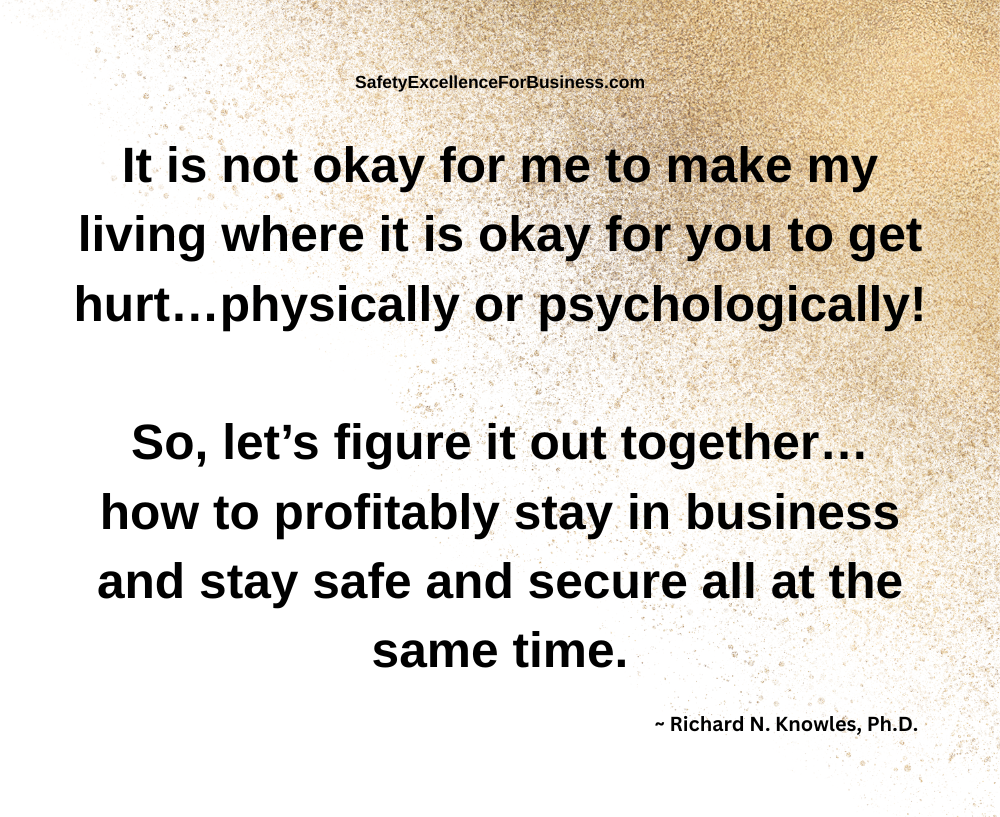
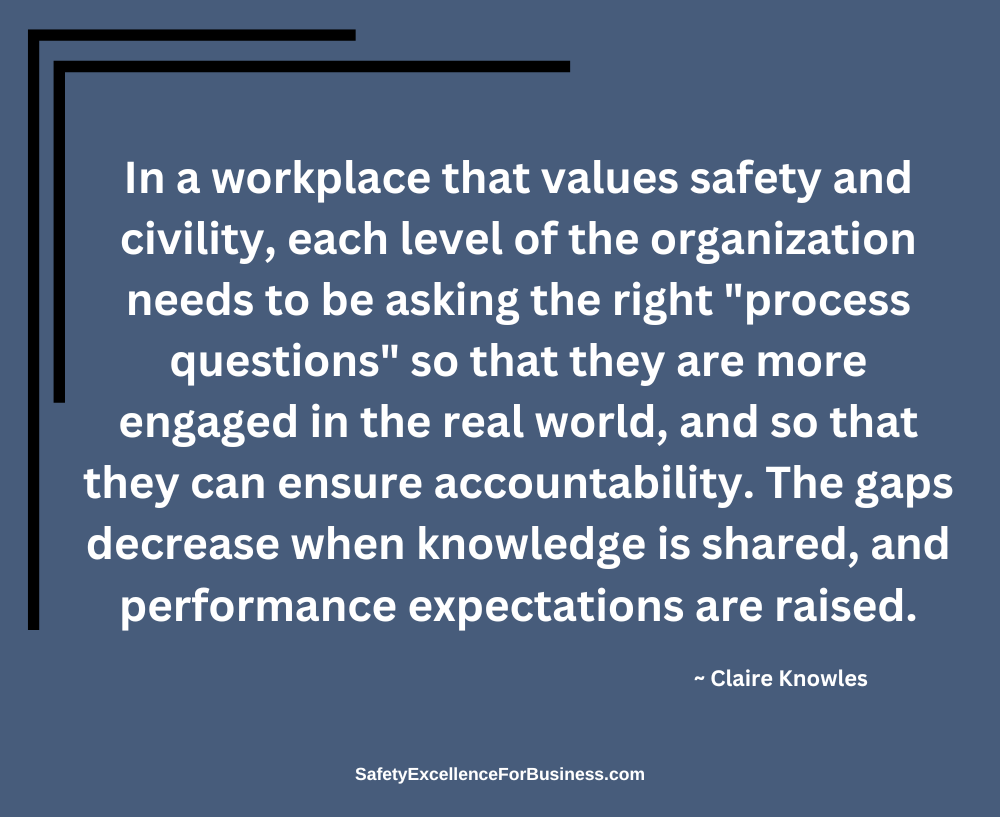
My mantra when I was a plant manager was, “I don’t have a right to make my living where it is okay for you to get hurt!” Does anyone have this right? The methodology for success is to engage people – for supervision across the board, up and down the organization to learn how to ask process questions. When it comes to safety, leaders who are in denial, or pretending one “doesn’t know” just doesn’t cut it. Asking process questions can ensure accountability.

We then talked about why there was so much resistance to these ideas. Based on some hard systems thinking, I think that the whole US safety industry with all the training, audits, fines, blame, etc. is driven by FEAR! This idea can be startling. Examining safety from a systems perspective was a different idea – particularly noting that fear was a key driver.

The problem with a culture being driven by fear is that it is very difficult to learn and do new things. Just about everyone is concentrated on covering their backside rather than talking together in an environment that is safe enough to explore new ideas together. When we work together using Partner-Centered Leadership, we can open up the vast knowledge that is lying hidden in our organizations. When we treat people with respect, listen and learn together, amazing new ideas and possibilities bubble up.

Everything changes! Productivity goes up. Earnings go up, Safety improves. The culture becomes one where almost everyone is learning, growing, taking more responsibility and producing great results. New possibilities emerge which often lead to much better earnings.

workplaces should value safety

Partner-Centered Leadership

When the CEO and the Leadership Team learn what is possible and how to work this way with authenticity and caring, this can spread throughout their organization and achieve significantly better results. It takes some effort and dedication, but there is no need for new capital investment. In a sense, Partner-Centered Leadership is free!

Contact me (716-622-6467) and let’s discuss how this can work for you and your organization.

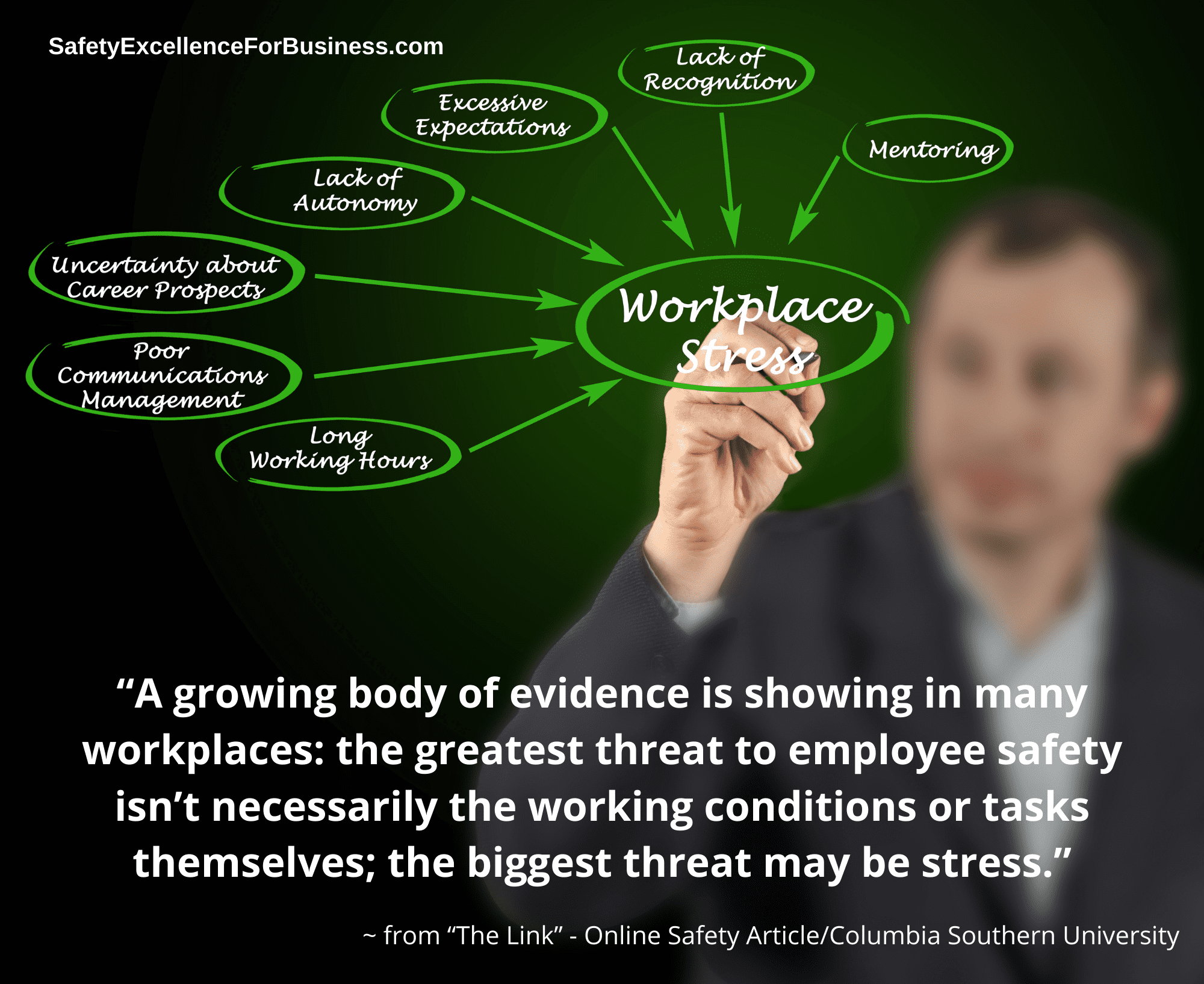
Workplace Stress

There is a lot of stress all around us – in our personal and workplace lives.

The war in the Ukraine, inflation, gas prices, groceries, apartment rents, and the mass shootings are a few examples. This stress affects us all in one way or another. It feels as if everything is under some sort of threat. Do we have to make churches, schools, grocery stores, playgrounds, offices, factories and even homes hard targets to try to protect ourselves? Stressors are many – negativity is high.

In previous posts I have talked about the need for situational awareness. This is so important for all of us. It is a first line of defense. We also need to take basic precautions around our homes being sure that we have taken reasonable precautions like having bright, outside lighting, keeping doors locked, picking up packages from our front porches, etc. When we go out to mix in big groups like bars and night clubs, or events, or any gathering, we need to ask ourselves if this is the right thing for us at that time.

stress in the workplace

When we are at work, we need to be cognizant of everyone that is feeling stress and preoccupied. Things we say or do may be taken in the wrong way. People may have short tempers. Some will be hurrying and careless. We each need to avoid contributing more stress to the situations.

All this stress and preoccupation makes us vulnerable to our own mistakes and errors. I tend to make poorer judgements when I am stressed like another driver and I did recently – we had a fender bender. Fortunately, there were no injuries other than egos being beat up. Preoccupation like this at work can lead to injuries and incidents as well. Perhaps the biggest threat we face is our own impatience and anxiousness.

For me, I need to slow down a little and ask myself what I am doing to be able to do the next task correctly. Do I need to take a deep breath to clear my mind before I do the next thing? Am I centered before starting the next conversation? Am I paying enough attention to what is going on around me so I do not cause problems and get someone hurt? Am I trying to select the correct words for the next conversation so I do not cause unnecessary troubles? Is one of my friends or coworkers feeling stress and do they need some extra kindness from me?

The number of road rage incidents is going up as well as the severity of the violence in these incidents. I need to be more aware of my own behavior. Small things I do may cause someone else to get angry. I need to keep my phone put away. I do not want to be caught up in one of these road rage incidents, so I need to be sure that my speed is appropriate, and I am not driving aggressively. I need to be sure to leave plenty of space between me and other cars and not to crowd people as I give way to my stress and start hurrying.

These are tough times for all of us. Stress levels impact all areas of our lives. We need to be kind to ourselves and others to help relieve the stresses a little.

Signs of Hope

Many of you reading my posts know how highly I value using really good processes for participation in our workplaces, sharing of information, building trust, and helping people to find meaning in their work. (Having meaning in one’s work helps to lessen work stress!) Over the last 50 years of my work in the field of Leadership, I have gradually seen progress in this participative and meaningful way of working. While there are plenty of bad examples of leadership, I am seeing improvements taking place. More people are talking about working this way. Some recent articles in Professional Safety, the journal of the American Society for Safety Professionals, have begun to talk about this. Other business journals are also talking more and more about this.

There is a growing awareness that our traditional top-down management approach is not up to the rapidly changing and more complex world. I have even seen some recent papers indicating that some of the professionals in government are more aware of the need to recognize and use ideas like Ross Ashby’s Requisite Variety, Complexity and Reflexivity so we can lead, learn, and think more clearly and effectively about how work is being done. It is heartening to me to see this participative progress!

I urge all of you to work on expanding your own leadership thinking so that you can also be more effective in your own work, and as you lead others. It has been extremely important for me in my own journey over the last few generations. I urge you (also) to learn about and practice situational awareness – for your safety and for others. If you have questions, please contact me at 716-622-6467 or send me an email.

Remember, it takes Leadership to improve Safety.
It takes being “aware” to notice what’s happening in your surroundings.
It takes de-stressing measures to bring calm to the moment.

stress in the workplace


Doing Safety Right in the Workforce!

So much of our safety efforts are aimed at trying to get the people to do safety right.

Photo Credit: OSHA.gov/Safety

There are lots of good ideas, new techniques, slogans, better equipment, PPE and so on. When I go to an American Society for Safety Professionals Conference, I am awed by the beautiful displays of new and better equipment and supplies. A lot of safety people are trying to improve safety in the workplace. It is hard work, and progress in reducing injuries and incidents is slow.

My Earlier Years

Over my 20+ years in managerial positions, working to improve the performance of organizations, I have found that the way I worked in my early years of pushing, pushing, scolding, blaming, looking for root cause, etc. was not very successful. I did not listen well and did a lot of arguing. I took an approach of trying to take things apart, thinking that if I understood the parts I could fix things. I felt that I had to know everything and fix the problems and the people. But the same problems kept popping up and no one seemed to learn or care. Trying to catch people doing something wrong, sets us up for a lot of arguments and struggles. Many organizations where I worked were not happy places. (And I learned that it didn’t have to be that way – old school management certainly had its flaws!)

Growing Up

However, when I began to realize that almost all people are smart in their own ways, things began to change. As I learned to purposefully go into the workplace, sit down with the working people, and listen to what they had to say, I found that most people are doing things quite well. They wanted to help to make things better. Most people do not want to get hurt or cause a problem. Rather than treating them as if they just did not care, I realized that they had a lot to offer and wanted to contribute. I just had to ask them, listen, and create the conditions where they could be their best. (They had so much information and innovations to offer!)

At first, I found the people frustrated and unhappy that no one had ever listened to them. When I first began to walk among them, there was a lot of fear and little trust. What was I really doing? Was I really trying to engage with them and learn? Was I just trying to find something wrong in a sneaky way? As I kept trying, kept listening and learning to talk with the people, and not at them, things began to shift. Each conversation was a little step, so I had many conversations. When I was the Plant Manager at the DuPont Belle, WV Plant, I did this for 4-5 hours a day for over 7 years. (Yes, I kept long work hours!)

In talking with the people, building trust, and helping them to see that they were an important part of our total success, our performance improved. In the first 4 years, our injury rate dropped by 97%, emissions dropped by 95%, productivity rose by 45% and earnings rose by 300%. We kept getting better. I did not do this by myself, the people, all of us together did this. I found that in all these conversations that the collective intelligence of the whole organization went up and kept going up as we all talked and learned together. We all became partners in building a successful business.

respect and honor others in the workplace

My Consulting Experiences in Safety

Over the last 28 years of consulting with organizations around the world, to help them improve their performance, I have used and taught this approach. I have developed a focused tool for our conversations that helps to make this work focusedeffective and fast. It helps the people to see what they are doing, breaks down barriers, builds trust, enables them to solve complex problems, and make decisions close to their work. In these conversations the collective intelligence of the groups always goes up. All dimensions of their performance improve, often quite quickly. They sustain this work for years by continuing these conversations among themselves. I call this tool the Cycle of Intelligence. It is simple to use, requires no new capital investment and helps the people, all of them from the top down, to sustain and improve progress in their continuous conversations.

Invitation:

If you want to learn more about the Cycle of Intelligence and how this process works, please give me a call at 716-622-6467 or contact me at richard@rnknowlesassociates.com. We can set up a Zoom call if necessary. (Yes, we do “Train the Trainer” sessions.)

Perhaps you have a story you want to share. It is so important to establish your credibility as a manager or supervisor who is committed to improving safety and to respect your people – because worker participation, involvement and enthusiasm is a treasure. Hope to hear from you!