When I came into a big chemical plant as the new Plant Manager, I found a deeply dysfunctional organization.
They were demonstrating the poorest performance in the entire company. The workplace culture and leadership were very dysfunctional.
During the first year, we had to work hard to re-establish the basic standards; things were difficult and intense. There was still a lot of bad behavior like cover-ups, lying, turf battles, and stifled flow of information. To survive, we had to turn this around.
One bright spot was that there were well-trained fire brigades on each shift. The shift supervisors were the incident commanders. They all went to fire school for a week each year and had much supplemental training and Hazmat training.
Late one morning the fire alarm went off (this is especially scary in a chemical plant). The fire brigade responded beautifully and had the fire out in about 30 minutes. Then the people came together, self-organizing around the needs to get things cleaned up, repaired and back into production. We had about a one-month inventory of finished product, so time was short. The clean-up post this fire was a huge effort.
Yet, note: During this incident and recovery, information was freely shared, so everyone knew what was going on. The various crafts like pipefitters and electricians helped each other cross craft lines as they were capable, people worked extra overtime without complaining. Those close to the work were making key decisions about what needed to be done and did it. It was an entirely different experience from what had been the norm (prior to this emergency). We were back into production in just over two weeks. We all celebrated.
Then, in no time at all, everyone went back to the former, bad behavior within the environment – it was a “negative norm.” As I watched, I was really perplexed. Why couldn’t we work like we did in the crisis all the time, helping each other, making decisions close to the work, sharing all information, working together as a team, and not covering things up and/or lying?
We Can Do It!
Once people can “see” their own behavior, experience the better way to be,
and then decide that they’d prefer to work together,
they can voluntarily rise above old toxic ways!
Caring about each other and our future together is ultimately, a good thing!
So, that became my leadership focus. After working with the people, openly sharing information, listening to each other, learning together, working together, respecting and honoring the skills and knowledge of the people, we, indeed, learned to work this way together. We built a level of trust that enabled all of us to work differently and much more effectively.
I lead this effort by walking around among the people, holding conversations of meaning, sharing, listening, offering help, accepting criticism, respecting their deep knowledge and skills. I did this for about 5 hours a day, every day, for about 8 years – providing the stimulus to keep this changed way of working alive, while providing the safe structure for it to manifest.
People learned to self-organize around their work, identify the problems and fix them. The morale and creative energy grew and grew. People felt great satisfaction in being able to deal with and solve their own problems. These were the conditions that had emerged during the fire crisis, but now we could live them all the time. These were the conditions that led to excellence in performance.
My work as manager shifted from totally focusing on things, procedures, equipment, etc., (although I did these as needed and we kept the standards high) to working to be sure that the conditions for excellence were maintained and shared among all the people. These were not focused on just one area like safety, but they applied to everything we did. Our total performance greatly improved and as we learned how to do this better and better–the improvements grew and grew.
Analysis of the Workplace Culture and Leadership
When I arrived at the Plant and during the first year, I used the traditional top-down management approach. We had to get things fixed. But then with the shift to a participative approach where we all learned and worked together as partners, everything changed for the better.
Please think about these ideas and begin to apply them where you work. Yes – your team, your group, your organization can learn to work in principle-centered and partner-centered ways as described above. Call me (716-622-6467) if you want to chat about this.
I have been working with Sebastian Wolf Siebzehnruebl to write a new book about working this way. The manuscript was submitted to the publisher so the book should be ready before too long. This too might provide supplemental information for how to achieve extraordinary results. Stay tuned.
 In this story, a wicked witch puts the princess and the whole kingdom to sleep for 100 years. They all have to wait for the arrival of the prince to kiss the princess and awaken everyone. As children, we all knew this story, but in this new book, Stephen Capizzano shifts the story to thinking about what happens in our organizations.
 When we were able to shed our old habits at our Plant in West Virginia, injury rates dropped by 97%, emissions to air, ground and water as reported to the EPA dropped 95%, productivity rose by 45% and earnings rose by 300%. As I walked the plant for 5 hours each day we were reminding ourselves to shed the old habits and create a much brighter future.
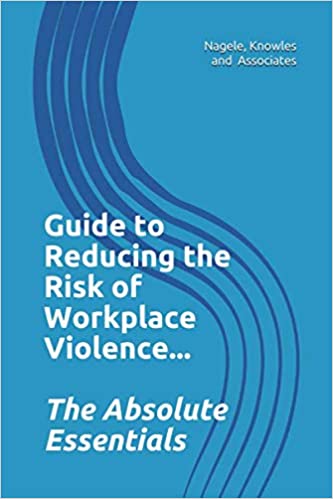
 The COVID-19 pandemic, the return to school questions, the protests and riots in so many of our cities, the bitter political campaign, the demand for using the “correct” words, are driving people crazy. The COVID-19, the questions, the anxieties and concerns, spill into our workplaces causing a lot of uncertainty and stress. We see this happening every day. Our businesses, our schools and hospitals, our governments, and not-for-profits, at all levels, are struggling. Changes and pressures are coming faster and faster.
 In thinking about your own place where you work, what do you suppose it would be like if you did some of these things? Do you think that you could begin talking with others about the COVID-19 challenges and building a more respectful environment? What do you think it would be like if you could openly talk together about the important issues like workable, social distancing and improving the safety of your job?
 When I was transferred to the DuPont Belle, West Virginia plant in 1987, the Total Recordable Injury Case Rate (TRC) was about 5.8 and emissions to air, water and ground, as reported in the EPA Toxic Release Inventory (TRI) annual report, was over 6,000,000 pounds/year. Within three years, both of these had dropped by about 95% to a TRC of about 0.3 and a TRI of about 275,000 pounds/year. Emissions to the environment is one way to measure how well the process safety is working; the better the process safety work, the lower the emissions to the environment.
 The process safety management collapsed in January of 2010 with major, accidental releases to the air and river and they had a man get killed with a phosgene release. When the US Chemical Safety Board investigated in late 2010, they reported that while the occupational safety and health performance was the best in the DuPont Company, the process safety management had fallen apart and the plant was not even using the DuPont standard procedures. This was a sad commentary about how far things had fallen.
 You can’t turn on the news or check your Internet homepage without sensing the depth of the issues that our country is experiencing. Whether it is returning to the workplace amidst COVID-19 rules, political protests, religious non-tolerance, or negative nightly news events – we’re experiencing a wide berth of dramatic events. And each of us has an opinion, a response, a way that we individually see these events and cope with this discord.
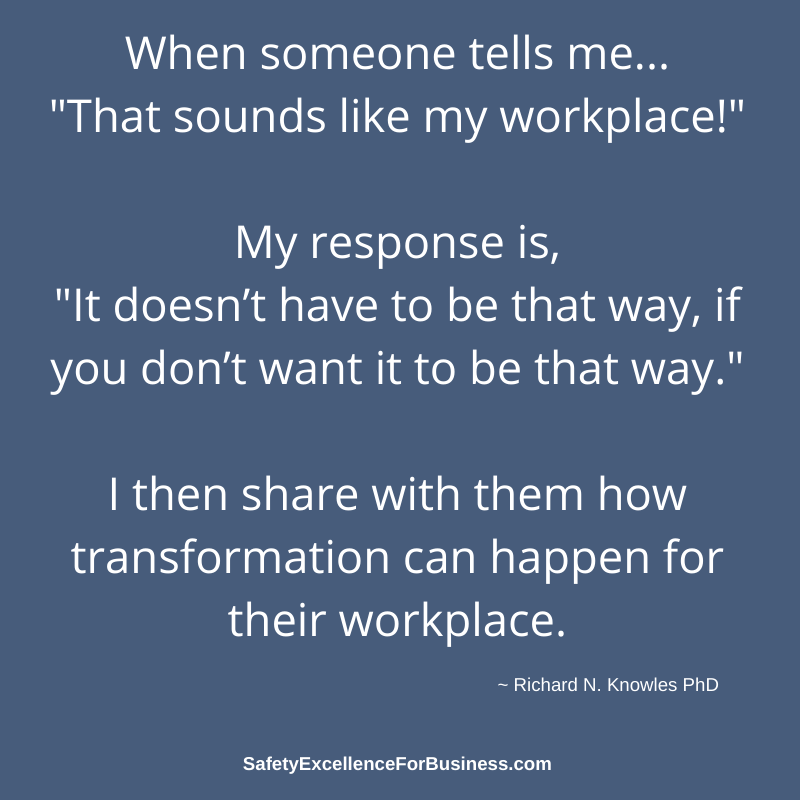
 It doesn’t have to be that way! Take a timeout!
 It will not be easy as people are returning to the workplace. Leaders and managers must get out of their offices and purposefully engage with the people. They need to talk about the COVID-19 problem, share what is happening, and talk about the problems with which they are dealing. They need to do this with openness, honesty, respect, and caring. This is not just a one-off contact; leaders and managers need to engage in these conversations every day!