Opening a Big, Often Untapped, Resource…Communication

Most organizations rely on their research people, top management, and outside experts for the information they need to run their businesses and to solve their problems.

These people do their best to contribute to helping the organization – lending their expertise. A lot of money is spent on these resources; sometimes they are quite successful and sometimes they fail badly. Communication, however, is the most important.
look for solutions in communication

As a society, we honor Ph.D.’s, experts and professors for their great learning. They often develop fine theories about problem-solving and learning. Often, we defer to them to do our thinking and to solve our problems. This is okay for tough technical problems, but we depend on them too much. Now AI has come into this dynamic.

When I was a plant manager, I asked the engineers to go into the plant and to talk directly and openly with the people who were running the production operations. Their first reaction was to resist because the engineers said that those people did not know the technology. I pushed them further, pointing out that those running the processes live with the processes and have a lot of information that the engineers did not have, and the engineers could teach them the critical technology. As they talked together a lot of new information surfaced that was very helpful.

Not only did the operators of the processes learn more about the
technical aspects of what is happening and the “why” of the processes,
but the engineers learned a lot from the operators – how they have to
troubleshoot, for example, what different temperature and flow concerns
surface and how they have to respond, what alarms/alerts are
most difficult for them to address.

A big mistake many managers make is to ignore the huge amount of information and energy that the people across their organization actually have. Top management, engineers and experts have only half the information they need to successfully solve problems.

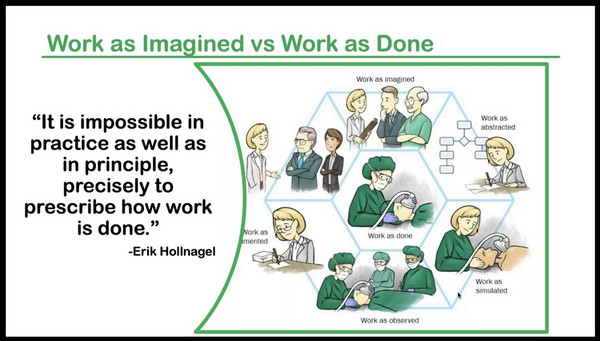
When they build trust among the people, they become willing to share what they know. As they all talk with each other, they discover that even more information emerges. The gap between work as imagined and work as done almost disappears. People open up and begin to use their discretionary energy to help to improve things. This discretionary energy is a gift the people will give in this environment.

Some Basic Keys… Relationships and Communication

Relationships are so important. We all need to be treating each other with respect, listening to each other, and learning together. Caring for and helping each other is also very important.

Being sincere with each other is also important. Telling the truth and respecting the ideas people bring up is also important. As people begin to speak up, it can feel quite risky so let’s make it safe for them.

Dedicating time each day to go into the organization, talking with the people about substantive issues, listening carefully, and helping people to solve their own problems is another important thing you can do. It is about learning how to hold “deliberate conversations of meaning – specifically looking for betterment.”
discretionary effort of the people

The Payoff

As these interactive, learning processes develop, the collective intelligence of the organization goes up, everyone gets smarter. More and more people begin to solve their own problems and find that this is quite satisfying and fun. As this spreads, the performance of the entire organization improves, problems get solved more quickly, close to the actual work and earnings improve.

Call me at 716-622-6467 and let’s discuss how focused conversations can help your organization make a huge difference too.
Artificial Intelligence and Big Data Can’t Replace the Wisdom of the Skilled People Doing the Work

I have read several recent articles about how big data and artificial intelligence (AI) can be used to help to improve safety.

The AI approach involves the collection and evaluation of huge amounts of data (big data) to learn from human behavior, looking for patterns and helping to improve safety performance. By doing this over and over, the machines can learn to keep doing better and better analyses and even begin to provide predictions about improving human performance. For example, repeated activities like lifting can be studied, problem patterns in lifting techniques be identified and improvements in the behavior or the physical arrangement of the lifting work modified.

This could provide very useful information that could reduce injuries and incidents, however, it is important to understand that people creating the algorithms are making assumptions and decisions about the way the work is done. “The devil is in the detail.” This can lead to a gap between the work-as-imagined and work-as-done. While the piles of data, the patterns they predict and the predictions they make can be useful, they can also be a problem. All this information can be quite beguiling and lead us to thinking we have all the information we need to reduce the injuries and incidents.

These studies can help to reduce injuries and incidents by providing the people some tools to see what is happening and make some adjustments in their behavior. But relying on them to do our thinking is a problem.

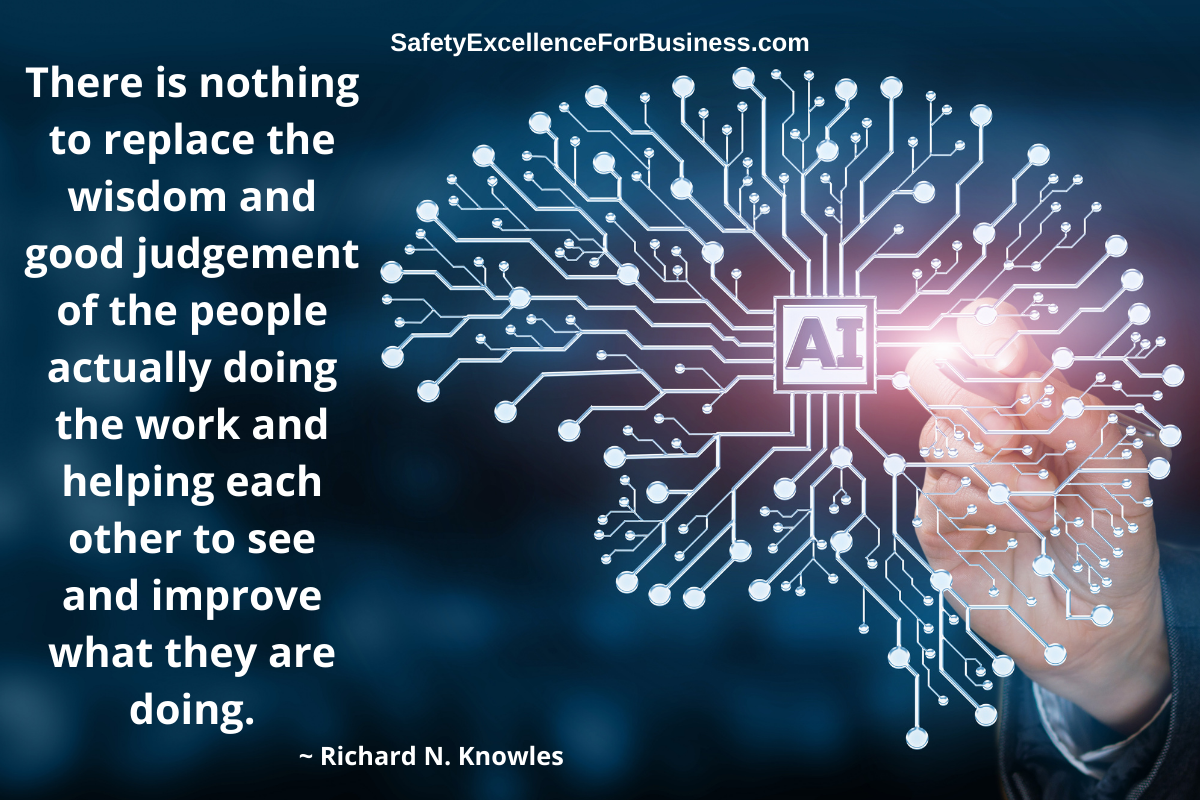
These tools need to be taken with a huge grain of salt. There is nothing to replace the wisdom and good judgement of the people actually doing the work and helping each other to see and improve what they are doing.

artificial intelligence can't replace the wisdom and good judgement of humans

These AI tools can help, but they are not the final answer. It is those close to the work who need to make the final decisions. We do not want to automate taking peoples’ brains out of the picture. These AI tools cannot see the actual situation that the person is facing as he/she does their job. Decisions often need to be made as the work unfolds to get the work done right. The gap between work-as-imagined and work-as-done needs to be closed as much as possible so the best procedures and practices can be used to do the work safely.

work as imagined

We need to help each other to rise to be the best we can be. Partnering together, helping each other, talking together about the work and the potential safety challenges are all highly effective ways to improve the total performance in sustainable ways. We should not allow the AI to push the thinking and good judgement of our highly skilled people aside. We can use AI as a supplement and to provide clues about improving the work. But pretending that AI can do our thinking for us is myth.

Everyone sharing information about your particular situations, treating each other with respect, telling the truth, making sure that the standards of performance and expectations are clear, helping everyone to see the importance of their work for the success of the whole business are foundational. Treating the people as intelligent, highly skilled and thoughtful will bring out the best in them.

AI can help, but it is not a replacement for the collective intelligence of the people who are dedicated to excellence.

I would be remiss if I did not insert (here), that the process for actually achieving this highly effective communication among and with people is Partner-Centered Leadership. Please call me (716-622-6467) and I’ll show you how easily this framework can be applied to your every-day communications and Leadership.

The Internet of Things (IoT): Another Caution

There are more and more electronic tools becoming available to help us with all sorts of tasks. We see ads for building electronic homes, installing fine security systems and even monitoring the sleeping babies. There are dozens of Apps for our cell phones so we can keep track of things.

Monitoring tools are also becoming available to monitor people as they do their work. It is a good idea to monitor someone who is working alone at a remote location or working alone at night doing security in a big warehouse. Sensors installed across wide locations enable rapid response in the event of an accident or emergency.

Like AI, these can be quite helpful, providing we don’t become too dependent on them. As these tools are developed and deployed, remember that they are put together by people who are making assumptions about their particular use.

Some of this monitoring can be used – drawing from the old time and motion studies from the days of Frederick Taylor in his 1911 book, “Principles of Scientific Management“. There is high value in learning from the past. There is high value in integrating new technologies. Yet striking that right balance is key – and always, always, with the genuine involvement and input of the people who are actually doing the work.

Summary

AI and IoT can be quite useful, but they need to be taken with caution and not allowed to replace the good thinking, planning and actions of our highly skilled, intelligent people. The comments in this newsletter are not luddite, but rather a caution about not throwing away the thinking, creativity and resourcefulness of the people with whom we work. Let’s help people become their best and rise to the top.