Our safety progress here in the USA, in having fewer people getting hurt and killed at work, is way too slow.
 A review of the Bureau of Labor Statics summary of fatal occupational injuries for 2011-2017 shows a 1% drop in fatalities from 2016 to 2017 to a total of 5,147 people having lost their lives at work. This is about 9% higher than the 4,693 people killed in 2011. The top three 2017 fatalities categories are roadway accidents totaling 1,299 (up 15% since 2011); slips, trips and falls totaling 887 (up 23% since 2011); and murders and suicides totaling 733 (up by only 2% since 2011).
Huge efforts by OSHA, The OSHA Voluntary Protection Program, ASSP, the Campbell Institute, the National Safety Council, NFPA, all their safety professionals and others seem to be stuck. A lot of significant effort like the ISO 45001 work is taking place. Big conferences are being held to share information, new ideas and all sorts of PPE, and other safety equipment. The ASSP conducts many safety professional certification programs in addition to all the various training programs and workshops. There is a lot of good information on the Internet to help as well. There is a lot going on! The amount of knowledge and expertise on safety is huge.
Why?
But why aren’t the improvements showing up in fewer people getting killed? Safety is about everyone going home to their families and loved ones healthy and injury-free.
I have a hunch!
Having worked as both a plant manager of big chemical plants for 13 years and consulting around the world for 23 years in all sorts of organizations, I have realized that so much of what we do in safety is managing the systems and processes and trying to keep things stable, focusing on reliability, predictability, stability, and control. This is good for the step-by-step, linear processes like running payroll, a production line, conducting a basic safety training session, or caring for the equipment and facilities and doing excellent PSM. Most supervisors and managers get promoted because they are doing a good management job. Every supervisory and management position has elements of managership that are very important and must be well done. But when we drive this sort of thinking relentlessly onto the people treating them like machines, things do not go well. This is where we are stuck in our safety work!
We need courageous leaders!
 We need courageous leaders who focus on the people, change and the future. Leaders value sharing information, building trust and interdependence, and helping people to see how their job is important for the success of the whole venture.
Leaders see their organizations as if they are living systems; people are living systems so let’s treat them that way! Leaders go into their organizations on a daily basis modeling respect and openness, listening to and talking with the people about safety, the business and other important subjects. Leaders take a stand and ask the people to help them live up to it.
My safety stand was, “I do not have a right to make my living at a place where it is okay for you to get hurt. We also have to make profits so let’s get going and do both.” My stand on disrespect, harassment and bullying was that this was totally out of place. We need to treat each other with respect. I asked the all the people to hold me accountable to live up to these stands and they did.
When talking with the people, ask questions like these about their job:
- How is your job going?
- Do you know a better way to do it?
- What are your two biggest safety hazards today and how are you going to manage these? (Employees need autonomy to be able to think things through!)
- Do you have all the information you need?
- Do you have the right tools and PPE for this work?
- How can I help you?
In leading this way, I used tools for complex adaptive systems to help me develop clarity and co-create, with the people, the principles and standards of behavior like be respectful, listen, help each other, ask for help if needed, look after each other, apologize for mistakes, and tell the truth. We held ourselves and each other accountable to live up to these principles and standards.
Leading this way will help to shift us from Eric Hollnagel’s vision of Safety I to Safety II. In managing, we get stuck in Safety I and in leading, we break out and achieve Safety II.
Every supervisory and managerial position has a leadership component in their work. Supervisors have a larger managership component and higher level managers have a large leadership component. However, everyone with responsibility for people needs to balance and use both sets of skills.
When I was the Plant Manager of the DuPont Belle, WV plant, I led this way and the results the people achieved were amazing. Injury rates dropped by 98%, we went 16.5 million exposure hours between lost workday cases (8 ½ years), emissions dropped by 88%, productivity rose by 45%, and earnings rose by 300%.
Leaders take a stand! Put your Stake in the Ground!
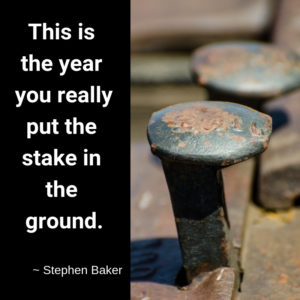 Go into your organizations listening to and talking with the people. Share your vision. Build trust and interdependence. Create safe spaces for people to talk with each other, to share and create the future. Everything will change. That is what I experienced at the Belle Plant.
Safety happens when people take the responsibility to take all they know into themselves and do it! In leading this way energy and creativity are released, resistance to change almost disappears, and everyone can become the best they can be. A lot fewer people will get injured and killed and the business will make a lot more money. This is what is at stake…a Stake that requires Leadership.
All it takes is the courage and WILL to lead.
Richard N. Knowles and Associates are happy to talk with you about this so please give us a call at 7167-622-6467.
 It is a problem across society in general and a big safety and HR problem in our organizations. In 2017, it is estimated that there were about 72,000 overdoses across the country. About 70% of businesses report that they have been impacted by this terrible problem. The National Safety Council reports that there are problems with poor prescription drug use, higher absenteeism, injuries, and accidents resulting from overdoses.
 Next, you need to reach out to the people with respect and offer to help them. Many people with drug problems believe no one cares, so reaching out to help would be a step forward.
 The patterns at work are also changing as the business activities and demands are changing. There are not enough good, trained people to fill all the openings so the pressure on everyone is going up. Everything at work happens through people so it is critical that we keep everyone engaged in helping to achieve our successes. We need to open up the trust and build interdependence among everyone to keep the information flowing freely. It is clear how important genuine engagement is within our workplaces.
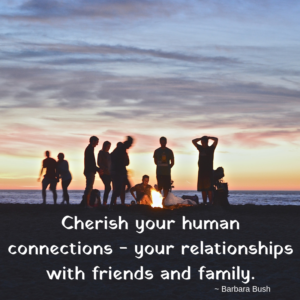 They are totally unconscious that they are an important part of networks at work and at home. Many are the bread winners and if they get hurt or killed, they will cause their loved ones terrible hurt and trouble. The indifference of so many people in supervisory or management positions to this sort of behavior is terrible.
 The rapid growth of active shooter incidents was one of the main areas of concern. The FBI and other experts gave talks about this, with their main focus on the active shooter incident itself. Most active shooter situations are conducted by men. Most of these occur in places of business. There is no typical profile for these people who come from all walks of life.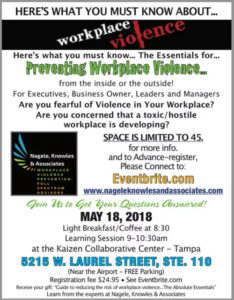
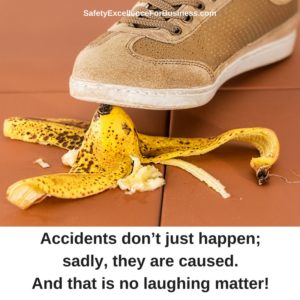
 Almost every day I see people post on LinkedIn, engaging in awful safety practices. Some are so ridiculous that they could be funny – except that people are getting hurt. Some workers seem quite content to endanger their lives and co-workers seem to be so unaware of the risks around them – that it is unbelievable!
 A recent Gallup study conducted over several years, covering about 150 countries, revealed that only about 15% of the people were actively involved in their work and that another 15% were actively opposing their managers and supervisors. The other 70% must be just doing as little as possible and not helping or looking out for each other. We are better in the USA, but not by much.
 Recognize Einstein’s Words of Wisdom: “Insanity is doing the same thing over and over again, but expecting different results.“
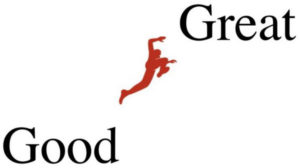 In 2001, Jim C. Collins wrote the best-selling management book, Good to Great: Why Some Companies Make the Leap…and Others Don’t. It described how companies transition from being good companies to great companies and how most companies fail to make that transition. The author found that focused leadership, clear expectations and alignment, and staying true to their field of major competence was key. There were other factors about greatness that showed up too – like Leaders being humble, and high employee engagement – employees being in tune with the company’s purpose, mission, endeavors, goals – not just the business side of things, but on the people side of the enterprise. Line organizations integrated information; people were involved, included and respected – because getting the right people in the right places was deemed as essential too. Entire organizations were communicating, collaborative, and cooperating.
 Changes in our workplaces keep coming fast and furiously. A recent report released by Price-Waterhouse-Coopers indicates that by 2030 the pressure on workers to perform will be huge. Organizations will be using all sorts of ways to track performance…even putting chips under their workers skin to look at location, performance, health and wellness! They may be tracking safety performance as well. Managers will need to be having “mature conversations” with the people about all this change and the feeling of threat this creates for their people and their jobs. The pressure to keep improving skills and performance continues to increase.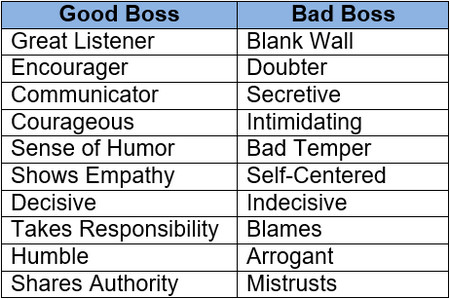
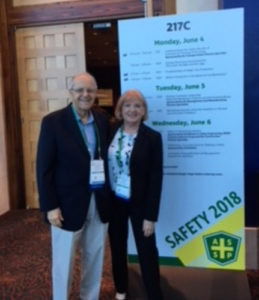
 The American Society for Safety Engineers (soon to be The American Society for Safety Professionals) in Denver, Colorado, on June 19-22, 2017, was attended by about 5,000 people. This was a record for attendance. There were lots of papers and a huge trade show exhibit. I never saw so much safety equipment and other offerings.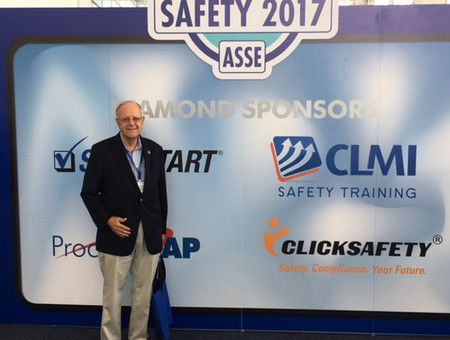
 As the snow begins to melt and the spring winds arrive, it is time for cleaning up the place. Mud season is upon us as the snow melts. All sorts of curious things emerge from the melting piles of snow; stuff that was covered up and lost. (Just imagine: Years ago the settlers kept their animals sheltered next to their houses or barns attached to their houses so that they could care for them when the winter cold set in. They really had to do the spring-cleaning!)