This blog-post is NOT about Safety, but rather it is about the larger arena of Leadership. For those that know me, Leadership and Complexity are important to what I teach, what I apply in my Workshops, and what I often write about. The focus today is on the growing interest that is developing around the Leadership of Complex Systems…and The Process Enneagram©, which is a tool of complexity. Please read on….to learn about how this increasing interest is showing up!
There is a growing awareness of the science of complexity and how to apply the insights gained from this work in organizations. This is showing up in various places like the Linkedin Group discussion boards. There is also a growing awareness of the Process Enneagram© and its usefulness in helping people to solve complex problems, build the social connections they need to get the work done and create the emotional energy and commitment to do the work quickly and well.
The Journal “Emergence: Complexity and Organization” asked me to Edit a Special Issue of their Journal devoted to the Process Enneagram. This Special Issue was published in March, 2013. (Emergence: Complexity and Organization, Vol. 15 #1, 2013).
In the call for papers for this Special Issue a total of nine papers were submitted. This was too much for the Special Issue so all nine papers were recently published in a book. The Special Issue and the book, “The Process Enneagram©, Essays on Theory and Practice” are both available at Emergent Publications.
Beverly G. McCarter and Brian E. White in “Leadership in Chaordic Organizations”, (2013, ISBN 978-1-4200-7417-8) write a large section on the Process Enneagram and say that it seems to be the missing link between complexity theory and practical application.
International Top 100 Magazine just listed my biography in their “Who’s Who in Consulting” in their August 2013 Issue.
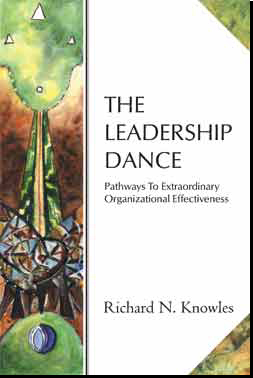
There is a growing interest in my book, “The Leadership Dance, Pathways to Extraordinary Organizational Effectiveness”. Even though it is 11 years old and has sold about 1,500 copies, Claire, my wife and partner, was able to do a book launch on my 78th birthday on August 8th and it became a #1 Amazon Best Seller and remains a Best Seller 15 days later as this is being written. This book is now considered by many people as a classic in organizational transformation.
The Process Enneagram is being used by many people around the world, especially in New Zealand and Australia where I have done a lot of work over the last 15 years. It is also being used by Datuk Mary Yap Kain Ching in Malaysia to study the leadership of head teachers in their most successful schools. Ms. Ching was recently elected to Parliament in Malaysia and is now the Deputy Director of the Ministry of Education in her Country.
A series of videos is being prepared for The Center for Self-Organizing Leadership website to introduce more people to this way of leading and to determine interest levels for developing a webinar on the Process Enneagram and its use.
Interest in Accreditation is developing in New Zealand, Australia and the US so I am now working with a number of people who are interested in becoming Accredited in the use of the Process Enneagram©. (If anyone reading this Blog is interested in becoming Accredited, please contact me.)
The Center for Self-Organizing Leadership website is being up-graded and many articles that I’ve written will be available and new products are being created.
My work in the application of complexity theory and The Process Enneagram to helping organizations achieve excellence in their safety performance progresses. My understanding of these tools and their application continue to develop. A description of my new Complex Systems Leadership Process© can be found in my previous blog.
This Process has three simple rules:
- Share all information.
- Build trust and interdependence.
- Help people to see how they fit into the organization and the importance of their work to the success of the whole.
There is also a simple 4-step process for the people to use together to achieve and sustain excellence in their safety performance.
Having pursued this vision of the Process Enneagram and its value and importance, it looks as if things are beginning to come together. I thank all of you reading this for your help in this long journey.
Richard N Knowles, Ph.D.
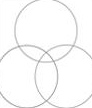 Overlap: All three of these areas of safety are often lumped together as SHE, EHS or HSE. When we lump these all together we can miss things so I think it is useful to see these three overlapping, interacting areas of our safety and health work. There is some overlap between Occupational Safety and Occupational Health like the proper selection and use of respirators. There is some area of overlap between Occupational Health and Process Safety like preventing chronic exposures to toxic chemicals. There is some overlap between Process Safety and Occupational Safety like locating trailers and offices away from operating areas using large quantities of flammable and explosive materials.