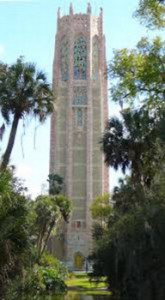
 At one of the highest geographical points in Florida, at Lake Wales, is a large, 205-ft high, carillon tower. It is beautiful, as are the gardens surrounding this tower structure, made of glistening coquina stone. The tower and gardens were a gift from benefactor Edward W. Bok, who cared deeply about nature, beauty and sanctuary spaces. Millions of visitors have traversed this place of solace since it opened in 1929. Edward Bok was all about CARING for future generations – to be able to enjoy peace and beauty. His tribute signature is this:
“Make you the world a bit better or more beautiful because you have lived in it.”
~ Edward W. Bok (1929)
Our safety work (at R.N. Knowles & Associates) has taken us to many places over the last few months. We’re reminded, as we’ve interacted with many people, and visited many workplaces, that Safety is about caring deeply. Likened to Edward Bok’s inspiration about caring about the world of beauty and leaving his legacy, let’s substitute the word safety for beauty, and leave our positive safety legacy for our respective workplaces. What if everyone in our workplaces chose to care deeply about safety?
What if this statement became your chosen signature phrase?
“Make your work-world a bit better and more safe because you have lived in it.” (2016)
We all make choices – every day – as we live and work in our workplaces. We do “Safety” because we care deeply – stemming from a core concern for others.
 For our workplaces, this is about the way we think about safety, the way we engage around safety, and the way we bring a third unifying force to the whole culture of safety.It’s the missing link in our respective workplaces. Without it, we tend to stay engulfed in a culture of compliance, yet despite trying and trying, we never reach excellence. Without it, we keep repeating the same mistakes – round and round we go.
 I spoke about Partner-Centered Safety™ and the importance of this as the quickest way to achieve sustainable safety excellence. As many of you know, I have written and spoken about this many times over the last several years. The information and data I share clearly shows that this approach to leading safety is very powerful, producing improved results quite quickly. Many of you have seen the terrific results the people at the DuPont, Belle Plant achieved. This approach has a very strong scientific basis in complex adaptive systems theory.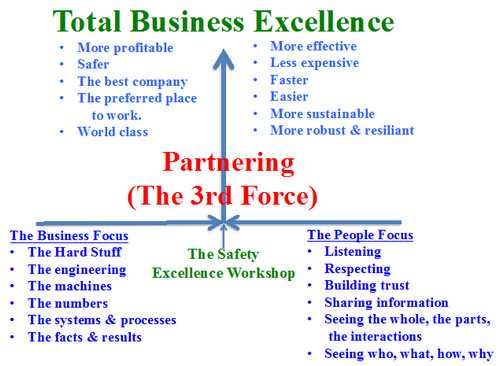
 “
“ At a recent safety conference I learned about a way to quickly assess whether a manufacturing site was cutting corners and trying to get by on less than the best. The person speaking, Ewan Alexander of BHP Billiton, said that he looked for improvised tools being used.
  Safety excellence is achieved and sustained one day at a time, day after day.
 There is no doubt that work in the oil and gas industry is tough and dangerous, but that is no excuse for disregarding the health and safety of the workers. Almost all the deaths occurred when safety procedures were not followed. There is plenty of safety information available relating to tank cleaning. Have we not learned the lessons of improper confined space/vessel entry?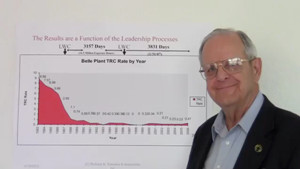
 When I began to learn about chaos and complexity science, I saw that this was the way to handle the high level of change. As we shared more and more information, helped people to really understand the nature of the business and their important roles in its success, and as we built more trust and interdependence, people began to step forward to help us take on all the changes that poured into our organization. I did not have to do everything myself, which was a great relief.
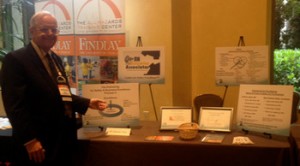 It was fascinating to see the contrast between the usual, linear, mechanical approach to safety and The Complexity Leadership Process (CLP) that I discussed at my display table. A large number of people talked with me at my display table about The Complexity Leadership Process which was new to all of them. Many could not believe how quickly and dramatically the safety performance improved using the CLP. At one level the CLP looks like a simple employee involvement program, yet it is much more and also different at a deeper level than the usual employee involvement processes. One fellow, who recently wrote a book about changing the safety culture to excellence just brushed the CLP aside as something he’d already seen. The approach to safety excellence he’s written about involves 43 linear steps that take 3-5 times as long as the CLP and require a very high level of persistence and determination over many years.
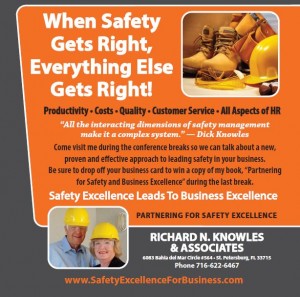 I’ll be participating as a sponsor for the Conference Program Brochure. I’ll have an ad in the Brochure as well as a display table. My tag line is “When safety gets right, everything else gets right”. Since I am not an official speaker, I am going to use my display table as an opportunity to talk with people about the