Compliance with OSHA Standards is Important

As I study the safety publications like Professional Safety and EHS Today, there is a lot of effort in discussing new ways to achieve better safety performance, develop better ways to do hazards investigations, evaluate accidents, and being in compliance with OSHA standards.

When I have attended American Society for Safety Professionals and American Institute of Chemical Engineers meetings and conferences, there are lots of papers focused on improving various aspects of safety for the people at work and being in compliance with OSHA standards. There are thousands of really good safety professionals doing this work.

There is also a lot of effort in developing a better understanding of OSHA Standards and rules. There is good advice on how to work effectively with OSHA. None of us want to get OSHA citations after an audit.

I remember how nervous I was when we had our occasional OSHA audits. Most of the time we had successful audits (we had complied with the Standards), but now and then we’d get a citation which then brought down a lot of criticism from upper management. Being in compliance is really important from a career and publicity perspective, so we worked really hard to meet the OSHA Standards.

Surviving an OSHA investigation without any citations is one measure of success for safety professionals. I know that it takes a lot of work to have a successful audit.
keep employees safe

Moving Beyond Compliance is Important

Another way to see how well we are doing is to look at the people getting injured or killed at work. This is not a numbers game; we are working with real people.

This is important to our companies since these tragedies can cost a lot of money for health care or have to deal with lawsuits. It can also cause bad publicity, prompt an OSHA investigation, and suffer fines, and destroy families.

Fortunately, most of the millions of businesses in the USA don’t have these problems, which gives them a feeling of success. They are in compliance. This can lull them into thinking they are doing a great safety job; then something happens and everything hits the fan.

Unfortunately, a lot of businesses do have fatalities (5,200 a year) and injuries (about 2,500,000 a year). We can’t predict which businesses will have a tragedy so many may think that it will not happen to us, and feel compliance is good enough. But compliance is not good enough, in my view. A death or serious injury are devastating to those involved and the families and loved ones never got over the loss, EVER!
work together to stay in compliance with osha and keep everyone safe

A Path Forward

When I was managing operations where we could have a fatality or serious injury, I found that partnering with the people was extremely important.

We created an environment where we could all talk together about work, share our ideas and insights freely, and learn together – all of us at all levels, contributed and shared our knowledge. contributed and learned. The collective knowledge of our organization grew and strengthened as we co-created our future. We treated each other with respect and care, maintained high standards, and addressed problems together.

As we learned together, more and more people began to contribute. We did not just work on safety – we worked on all aspects of our work.

I spent about half of my time walking among the people in the plant, getting to know the people, and building our relationships and trust. I modeled how we needed to work together so people could see that I was genuinely interested and committed to improving all we did.

I had a safety mantra:

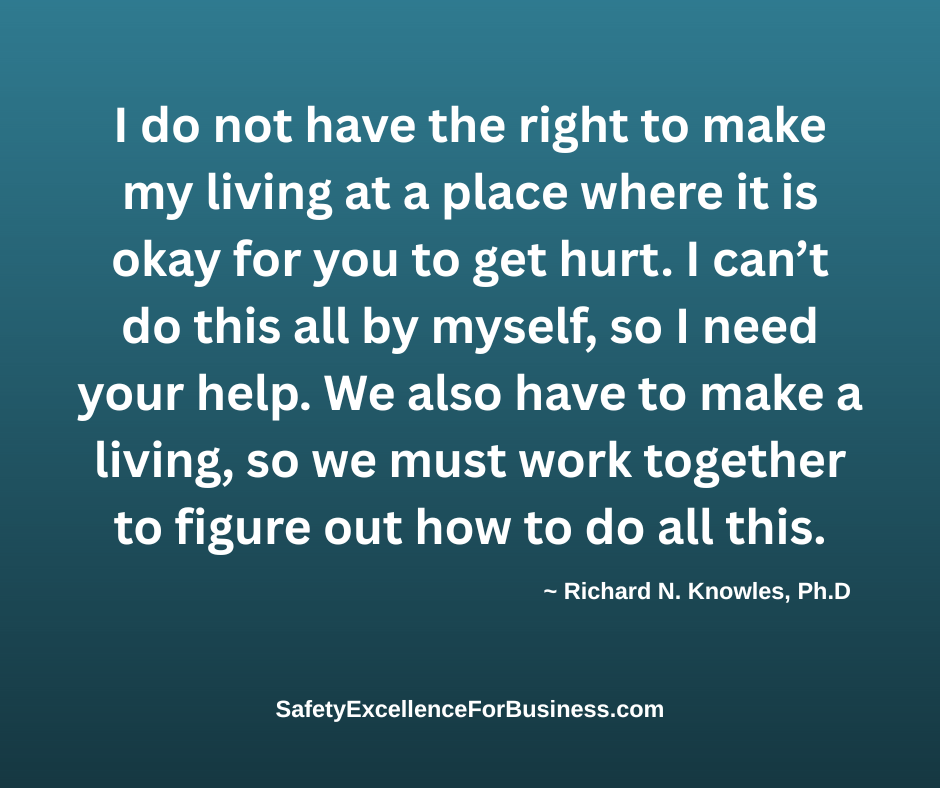
I do not have the right to make my living at a place where it is okay for you to get hurt.
I can’t do this all by myself, so I need your help.
We also have to make a living, so we must work together to figure out how to do all this.

Our total performance made significant progress, people were more satisfied, we had more fun, and my job got a lot easier as we focused on our growing successes.

I would be pleased to talk with you if you would like to do this. We could do this with a Zoom or phone call. Call me (716-622-6467) to set up a meeting.
Ours is not to wonder why? Ours is to do or die!

It has been over 50 years since President Richard Nixon signed into law the Occupational Safety and Health (OSH) Act.

safety is important in organizationsWe are all familiar with OSHA as both a regulator for Safety Standards and Compliance in the workplace and as an Educator (offering Information and Training across-the-board on the OSH standards). Indeed, if you’ve not looked lately, go to OSHA.gov and scroll through the various topics available for your learning.
Have you ever wondered what our workplaces might be like if OSHA had not been enacted? Would employers, on their own, protect the health and safety of their employees? If there was no law that employers “must” have PPE, or Lock & Tag, or Vessel Entry, or Machine Guards, or Eye Wash stations…would they? If there was no expectation of you, would you be your brother’s/sister’s keeper in the workplace?

You may make sport of these questions because, obviously, times have changed.

There is so much more awareness to safety, to life and limb, than in 1970 when OSHA came into fruition. And sometimes, the regulations seem like they go overboard in detail. Still, what we know deeply is that every one of the regulations was written in blood – meaning someone was killed or severely injured – and that prompted the writing of the regulation to avoid additional victims falling prey to similar work circumstances.

The standards underscore the safe way of doing things, to reduce the hazards and reduce the opportunities for being hurt, maimed, or killed. The OSHA mandated rules and procedures have had a big, positive impact in improving workplace safety. But these only get compliance in most organizations.

Today, even with the OSHA laws in place, about 5,300+ workers become victims of job-related fatalities every year. Why is that?  Even with increasing numbers of Safety Professionals working within almost every facility, why is it that we keep killing so many people? Even with the oodles of hours of safety and health training that is conducted, why do these violations and tragedies continue?

We believe that a lot of the safety-related problems are systems problems. These are deeper than the things we can see on the surface like a specific incident or injury.

We need to dig in more deeply to find the things that are driving the surface problems. What is happening in the whole system and why? When we do this work, together, we can find things to fix that make a big, positive difference.

For example, we know that critical factors are the open flow of information for everyone, treating each other with respect and dignity and helping people to see how their work is important for the success of the whole organization. These ideas rarely show up in an incident report, yet from a systems point of view, these are huge.

We need commitments from across the organization
for improved safety.
It is all about everyone going home in one piece!

When we take a systems approach, we all get involved. The people and the company, together, working for improved safety results. Individual safety attitudes, fatigue, complacency, lack of taking responsibility, taking shortcuts and carelessness are addressed in the systems approach, and lead to fewer risks and serious injuries, even deaths.

Training must be meaningfully connected to the real work. Keeping track of injuries and incidents is also essential – why? These lagging indicators are one way to tell us if we are on the right track. But we do not use these to try to manage safety; we use leading indicators like the amount of time we spend in the field with the people, sharing information, listening, learning, solving problems and fixing them at an early stage; this is a powerful leading indicator.

We don’t want to return to the era where peoples lives or limbs accounted for little. Rather, that OSHA’s stated purpose for every company is fulfilled: “Each employer shall furnish a place of employment which is free/protected from recognized hazards that are causing or are likely to cause death or serious physical harm to their employees.”

I repeat my mantra:

It is not okay for me to work and make my living
where it is okay for you to get hurt – physically or psychologically.
So, let’s figure it out together…how to profitably stay in business
and stay safe and secure all at the same time.

What differentiates a good safety culture? Internalized, focused communications…up and down. It is the energetic daily conversations that are crucial for having a safe workplace and safe attitudes.

Because, through conversation you engage employees to think for themselves, in turn, focus (less auto-pilot) and ultimately, to develop a discipline where the employee thinks things through (daily), has the autonomy (choice) in addressing the perceived greatest risks, and overall, the daily conversation becomes the “muscle” – to active caring – building relationships. (And no one gets hurt!)

Plus, the more awareness of our surroundings we develop the better off we are from being surprised by workplace hazards, or from bullying emerging, or from being surprised by a perpetrator entering our workplace to do harm. Awareness matters in both the safety of doing our tasks and in the security of surveying our environment. Call me to learn more about the processes we use to heighten safety, security, effectiveness, performance. Culture matters.

With the Occupational Safety and Health Act of 1970, Congress created the Occupational Safety and Health Administration (OSHA) to ensure safe and healthful working conditions for workers by setting and enforcing standards and by providing training, outreach, education and assistance. Note: OSHA has now weighed in on Workplace Violence as any act or threat of physical violence, harassment, intimidation, or other threatening disruptive psychological behavior that occurs at the work site. It ranges from threats and verbal abuse to physical assaults and even homicide.

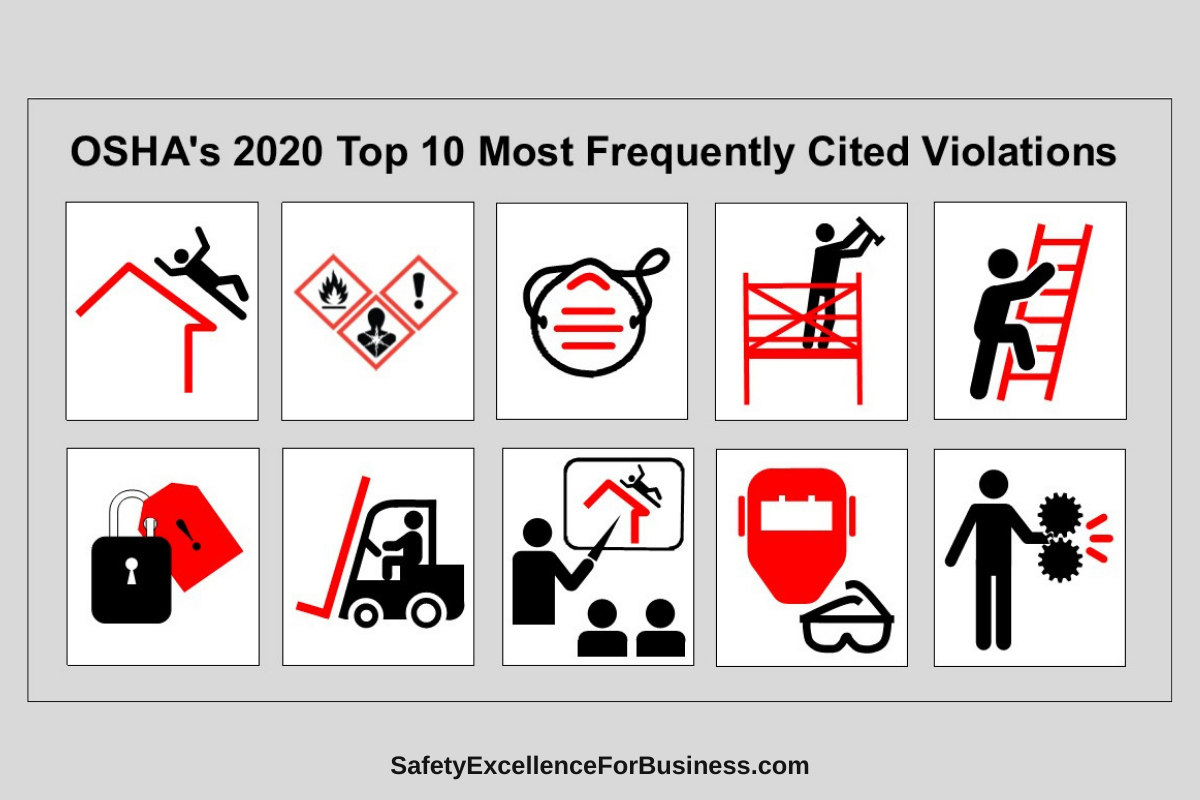
OSHA'S 2020 Top 10 Most Frequently Cited Violations

Top 10

  1. Fall Protection, construction
  2. Hazard Communication Standard, general industry
  3. Respiratory Protection, general industry
  4. Scaffolding, general requirements, construction
  5. Ladders, construction
  6. Control of Hazardous Energy (lockout/tagout), general industry
  7. Powered Industrial Trucks, general industry
  8. Fall Protection – Training Requirements
  9. Eye and Face Protection
  10. Machinery and Machine Guarding, general requirements

What we know is that companies must have a company culture that embodies both a systems perspective and a strong safety focus. How does your company stack up? We wrote the book on improving safety culture – give me a call if you need a re-set – 716-622-6467.

Moving to a Safety Culture of Excellence

Most organizations seem to be comfortable with being at the level of safety compliance. This is a start, but is not good enough over the longer run. We have to meet the OSHA guidelines and train the people in how to work safely and use equipment properly. There are lots of people doing the safety training and the American Society for Safety Engineers (ASSE) has many, many resources for the safety professional. Most of the people in most organizations have some knowledge about how to do the work safely, know how to use the PPE and have some knowledge of the safety rules.

Reaching high levels of safety performance when working in organizations like these is very hard. Sustaining these levels of performance is even harder. Once the people have been trained, proven that they know and understand what they have learned and then actually doing the work as they have been trained often falls short. For a variety of reasons people don’t follow through; people take short-cuts, forget, are pre-occupied, feel pushed, don’t believe that management really cares, there are not enough people to do all the work, management does not listen, they hear the words about working safety but their supervisor ignores the words.

There is a powerful need for our organizations to shift to safety cultures of excellence. Way too many people are being killed (~4,600 in 2011). Most of these accidents are preventable. Our existing cultures need to shift from top-down driven processes to ones that are more self-organizing and sustainable. Yet many people resist change.

Being fearful of changing job assignments, bargaining unit challenges, abuse of the rules, not knowing what is going to happen to them and their jobs is one major reason for resistance to change. Another fear of change comes from the uncertainty of who the new people will be that they’ll need to work with if they are reorganized; they have a set of relationships in their current job and any change will upset these. Another fear of change can relate to their status as relationships and structure change. Another reason to fear change relates to the level of control that a person currently has in their job over their work and uncertainty about how that will change. Almost all of these fears come about because change is imposed with little input from the people who will experience the change.

However, change is with us all the time. It is not some unusual incident which is being shoved at us.

If the processes of Self-Organizing Leadership are used most people will not resist change. With Self-Organizing Leadership the people are co-creating the changes that need to be made. People do not resist changes that they create, but rather they push these changes. Most imposed change efforts fail; most co-created change efforts succeed.

The four-step, Safety Leadership Process we use enables the people in the organization to co-create their safety culture and transform it to one of excellence where injury and incident rates drop almost to zero. In this process the first step is to use the Process Enneagram© to work with a cross-section of the organization to co-create their Safety Strategic Plan. In using the Process Enneagram an important, compelling question is developed; one that the group feels is really important and one they want to resolve. Then the facilitator begins to move the group through the sequence of conversation relating to each point helping them to develop clarity and coherence relating to what they want to accomplish and how they will do it. Everyone makes inputs which are written down onto the Process Enneagram Map.

The space is created so that the environment is safe and open for honest conversation.

This part of the Safety Leadership Process usually requires about a day so that the issues, assumptions, Principles and Standards, and goals are understood and the energy required to accomplish their transformation is released.

In the next part of the Safety Leadership Process, the Process Enneagram Map they have created is taken out to those who were not involved to share the thinking and to seek improvements. In these conversations, trust and interdependence are built as people see what management wants to accomplish and are walking the talk.

The next part of the process is to talk with people about what they are doing, listen to them, discover ways to improve the work and help the people to make the needed changes. As we do this, people become more comfortable in talking together and opening up.

Another part of the Safety Leadership Process involves actually looking at what people are doing.

Systems problems show up as we make our observations. We often see very high levels of unsafe behaviors that are the result of people trying to work within the work environment and making mistakes. This is not an employee discipline process, but rather a process of discovery and learning. As the organization continues to make observations enough data is collected that the observations can become a predictor of a potential injury. Then we show the leaders how to react and avoid the injury.