In my previous Blog I talked about the America’s Safest Companies Conference in Atlanta, GA. There were about 400 people in attendance for the fine papers, displays and the awards to the 10 Safest Companies of 2013.
 It was fascinating to see the contrast between the usual, linear, mechanical approach to safety and The Complexity Leadership Process (CLP) that I discussed at my display table. A large number of people talked with me at my display table about The Complexity Leadership Process which was new to all of them. Many could not believe how quickly and dramatically the safety performance improved using the CLP. At one level the CLP looks like a simple employee involvement program, yet it is much more and also different at a deeper level than the usual employee involvement processes. One fellow, who recently wrote a book about changing the safety culture to excellence just brushed the CLP aside as something he’d already seen. The approach to safety excellence he’s written about involves 43 linear steps that take 3-5 times as long as the CLP and require a very high level of persistence and determination over many years.
In an example of a long, slow, linear process was in a presentation by one of the Award–Winning companies about their journey to safety excellence. The presenter showed a chart showing their progress from a Total Recordable Injury Rate (TRIR) of about 8 to about 0.5 over 12 years, one little step at a time. It is great that fewer people are being injured, but it took way too long, and too many people were hurt along the way. When I count the number of injuries they suffered over this 12-year period, they had about 36 more recordable injuries per 100 employees than we experience at my Belle, WV Plant when we went from a TRIR of about 6 to 0.3 in just 3 ½ years. If the average cost of an OSHA Recordable Injury is about $50,000, then the Belle Plant with 36 fewer injuries and the suffering, saved about $1,800,000 for every 100 people. At Belle, we had about 1,000 people so we saved closer to $19,000,000.
It is interesting to watch people try to reframe a new idea into their old paradigm. The evidence of the improvements doesn’t seem to have an impact.
I think that if people believe something, they will see it, but if they don’t believe it they won’t see it, and not the other way around.
The evidence of many fewer injuries and the large savings that this generates, while proven in real cases, don’t seem to have much impact.
So for you who are reading this Blog, here is my question for you:
How do we get people to see, to understand and to try this new CLP approach when it is proven to be so effective?
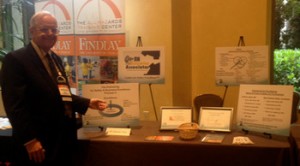
The photo above is a picture of Dick at his Display table at the America’s Safest Companies Conference, where he had the opportunity to speak with lots of managers about eliminating workplace injuries.
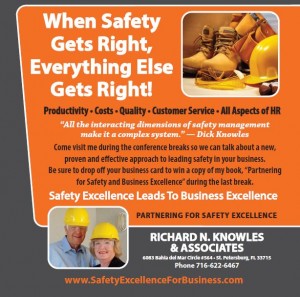 I’ll be participating as a sponsor for the Conference Program Brochure. I’ll have an ad in the Brochure as well as a display table. My tag line is “When safety gets right, everything else gets right”. Since I am not an official speaker, I am going to use my display table as an opportunity to talk with people about the
 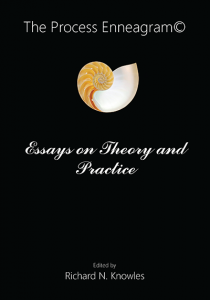 This Blog is focused on my new book, The Process Enneagram©: Essays on Theory and Practice. I am the editor for this book that was just published by Emergent Publications. It can be purchased directly from their
 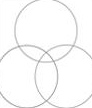 Overlap: All three of these areas of safety are often lumped together as SHE, EHS or HSE. When we lump these all together we can miss things so I think it is useful to see these three overlapping, interacting areas of our safety and health work. There is some overlap between Occupational Safety and Occupational Health like the proper selection and use of respirators. There is some area of overlap between Occupational Health and Process Safety like preventing chronic exposures to toxic chemicals. There is some overlap between Process Safety and Occupational Safety like locating trailers and offices away from operating areas using large quantities of flammable and explosive materials.