Compliance with OSHA Standards is Important

As I study the safety publications like Professional Safety and EHS Today, there is a lot of effort in discussing new ways to achieve better safety performance, develop better ways to do hazards investigations, evaluate accidents, and being in compliance with OSHA standards.

When I have attended American Society for Safety Professionals and American Institute of Chemical Engineers meetings and conferences, there are lots of papers focused on improving various aspects of safety for the people at work and being in compliance with OSHA standards. There are thousands of really good safety professionals doing this work.

There is also a lot of effort in developing a better understanding of OSHA Standards and rules. There is good advice on how to work effectively with OSHA. None of us want to get OSHA citations after an audit.

I remember how nervous I was when we had our occasional OSHA audits. Most of the time we had successful audits (we had complied with the Standards), but now and then we’d get a citation which then brought down a lot of criticism from upper management. Being in compliance is really important from a career and publicity perspective, so we worked really hard to meet the OSHA Standards.

Surviving an OSHA investigation without any citations is one measure of success for safety professionals. I know that it takes a lot of work to have a successful audit.

keep employees safe

Moving Beyond Compliance is Important

Another way to see how well we are doing is to look at the people getting injured or killed at work. This is not a numbers game; we are working with real people.

This is important to our companies since these tragedies can cost a lot of money for health care or have to deal with lawsuits. It can also cause bad publicity, prompt an OSHA investigation, and suffer fines, and destroy families.

Fortunately, most of the millions of businesses in the USA don’t have these problems, which gives them a feeling of success. They are in compliance. This can lull them into thinking they are doing a great safety job; then something happens and everything hits the fan.

Unfortunately, a lot of businesses do have fatalities (5,200 a year) and injuries (about 2,500,000 a year). We can’t predict which businesses will have a tragedy so many may think that it will not happen to us, and feel compliance is good enough. But compliance is not good enough, in my view. A death or serious injury are devastating to those involved and the families and loved ones never got over the loss, EVER!

work together to stay in compliance with osha and keep everyone safe

A Path Forward

When I was managing operations where we could have a fatality or serious injury, I found that partnering with the people was extremely important.

We created an environment where we could all talk together about work, share our ideas and insights freely, and learn together – all of us at all levels, contributed and shared our knowledge. contributed and learned. The collective knowledge of our organization grew and strengthened as we co-created our future. We treated each other with respect and care, maintained high standards, and addressed problems together.

As we learned together, more and more people began to contribute. We did not just work on safety – we worked on all aspects of our work.

I spent about half of my time walking among the people in the plant, getting to know the people, and building our relationships and trust. I modeled how we needed to work together so people could see that I was genuinely interested and committed to improving all we did.

I had a safety mantra:

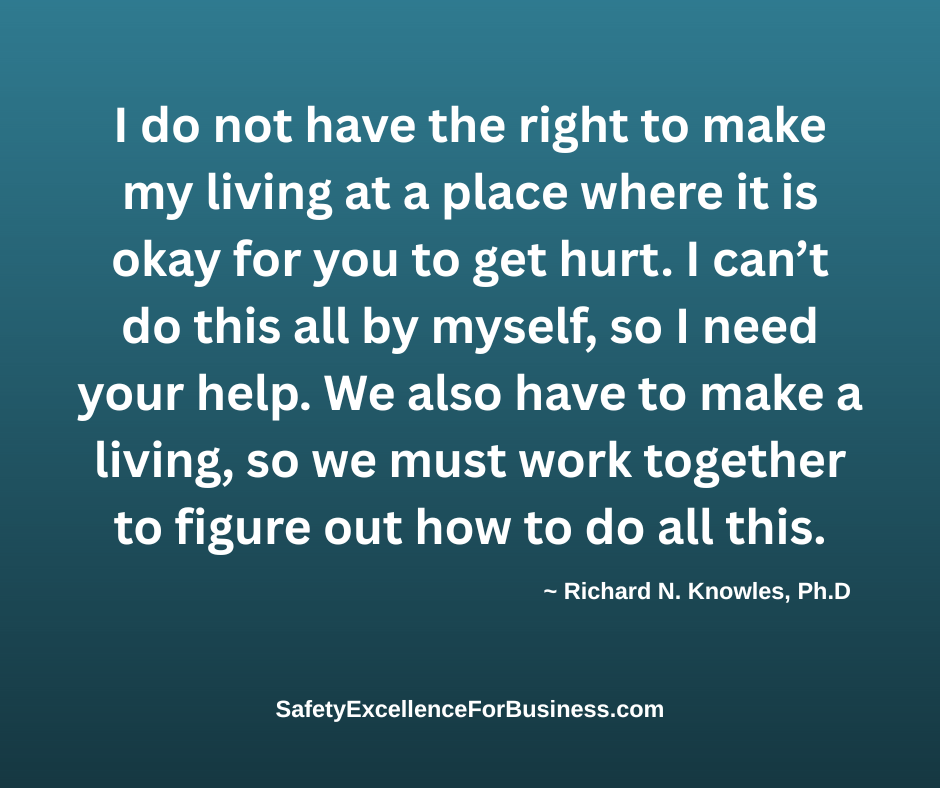
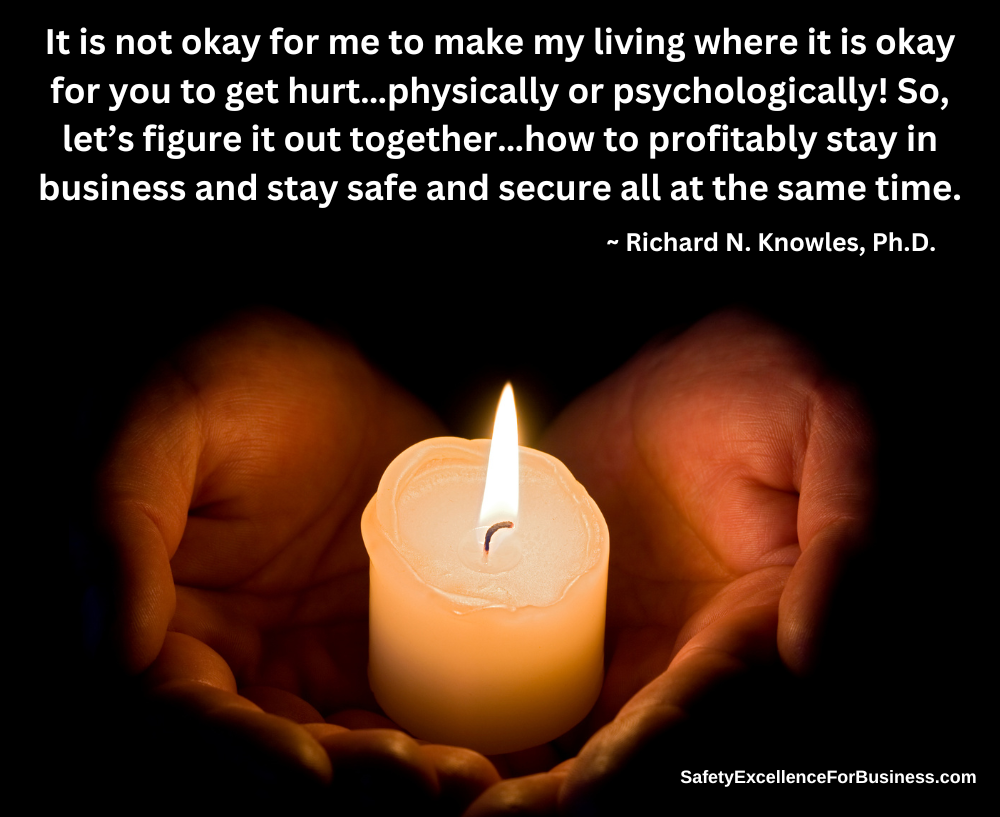
I do not have the right to make my living at a place where it is okay for you to get hurt.
I can’t do this all by myself, so I need your help.
We also have to make a living, so we must work together to figure out how to do all this.

Our total performance made significant progress, people were more satisfied, we had more fun, and my job got a lot easier as we focused on our growing successes.

I would be pleased to talk with you if you would like to do this. We could do this with a Zoom or phone call. Call me (716-622-6467) to set up a meeting.

Cold times are here… Watch Out for Black Ice

The strong, fall winds are blowing hard. The temperatures are dropping.

With roads and driveways wet, and cold winds blowing, the risk of black ice becomes real. So it is timely to raise our awareness to this lurking risk.

expect the unexpected with black ice

When I was in college – about this time of year – one morning I set out on my bicycle to class. (Yes, bicycle!). Things went fine until I hit a patch of black ice, WOW! What a crash. Books and papers everywhere and me laying flat on my back wondering what hit me. Fortunately, I was not hurt.

Another time I was walking to work and we had a light dusting of snow. It was quite pretty with everything having a slight snow cover. As I was walking, I stepped onto a small patch of snow on the sidewalk. Under it was a sheet of black ice. I crashed so hard and fast that I was really shocked and had a good bump on my head. Fortunately, nothing came of the bump, but falls like this can be serious, even fatal.

I spun a car around early one morning as I drove onto a bridge. Fortunately, no other cars were there as it was very early morning, so nothing serious happened. I was lucky.

watch out for black ice

In all these stories, I was lucky that things were not more serious. In each of these, the black ice was a complete surprise. I was not expecting it at all. That is the way black ice is. It is almost invisible and very slippery, especially when covered in a dusting of snow. (I should have been more attentive to the potential risk of black ice.)

Please keep an eye out for yourselves as you get going in the morning, so you do not get into a black ice adventure.

I’m reminded how experiencing the surprise of black ice fits perfectly in the seasonal safety slogan of Expect the Unexpected.

Partnering Workplace Safety and Artificial Intelligence

The Artificial Intelligence (AI) Offering

There are great hopes that Artificial Intelligence (AI) will make workplace safety easier and better.

I think that this can be a trap – potentially inhibiting us from actually reducing the number of people being killed and injured at work each year (~5,200 fatalities and ~2,400,000 serious injuries a year for the last 10 years; Bureau of Labor Statistics). Please understand: It is prudent to have some wariness so that we remain focused on what it will take to make sure our people go home at the end of their shift in the same way they arrived, with their arms, legs, eyes, ears, all intact.

There are thousands of good safety people working to improve things in real-time and Artificial Intelligence (AI) is the next great hope for improvement in broader know-how: computer generations, algorithms, which may be very important – depending on how we apply the new “learning”. AI is indeed one of the technology megatrends that are shaping the future of work. That includes the future of workplace safety. The area of ergonomics, computer-interactive safety training, and predictabilities come to mind, as prime for AI applicability – indeed, they are already in place.

But make no mistake: There’s a balancing dance to do…of AI innovation and the human aspect of our workplace. Although AI offers powerful tools and notable progress, it is necessary not to lose sight of the human element in day-to-day workplace safety. AI should complement and enhance human capabilities.

As you know AI scans a huge amount of information and will feedback interesting summaries. All we have to do is to frame a question and ask AI to give us an answer. It is really fast and often the answer is plausible. There are a lot of AI models already functioning, so you need to choose the correct one to answer your question.

Just about everything on the internet is scanned, which is really impressive. This information can be quite useful, provided you really think about it and see how it connects with your experience and knowledge. Does it make sense? Is it really answering your question? How does it fit your situation?

artificial intelligence and workplace safety

Workplace Safety

Every workplace is unique. Real workplace safety is a local experience. The safety approach we need is highly specific to each and every workplace. Each person working there needs to think about their situation, look at it and talk about it with their co-workers to figure out the best and safest way to do the job. None of this specific workplace’s situation and information is on the internet so an AI search cannot really apply to their specific situation. The people doing the work need to take the responsibility together to use their specific resources (other people, PPE, develop a better procedure, etc.).

Expecting AI to tell you what to do is like having the plant manager or CEO who is sitting in her/his office and thinking that they really know your job and then giving you specific instructions on how to do the work.

Artificial Intelligence is a faster version of the “work-as-imagined and work-as-done” situation, which a lot has been written and covered in thousands of workshops and lectures. We close the AI/ real workplace gap in the same way as we have learned to close it in other situations.

artificial intelligence and workplace safety

AI Use

AI is a powerful, challenging tool that must be used wisely and its output used cautiously. Dr. Michael Lissack has written about using AI in his new book, Augmented Science, which is available from Amazon. He thoroughly investigates a number of aspects of AI and has many questions and insights to consider.

AI is not something to just jump into without some serious training:

  • What is your organization’s policy about how to use it?
  • Are people trained to navigate the AI programs?
  • If someone blindly follows an AI recommendation and it does not work, who is responsible?
  • What are the biases in the AI program which can impact its output?

Your organization needs to do some deep thinking about how to build the proper relationship with AI so that it can be used to help us work better. But remember: AI does not have your specific situation in the database so it cannot give you answers to your specific needs. For more information, the May 2024 issue of Safety+Health magazine provides a valuable overview for all safety people and supervisors.

Everything works through people. Treat each other with respect, listen and learn together and use AI wisely and carefully. Call me, 716-622-6467, and let’s chat!

This Month’s Kaleidoscope of Safety Thoughts

The Eclipse… On April 8th, we are going to have a total eclipse of the sun.

The path will cross right over our area. Excitement is quite high as many scientists and tourists are expected to be here. Hotel rooms are renting for astronomical amounts of money. It will be quite a big party, full of excitement. Totality lasts for about 3 1/2 minutes so it will be like night right in the middle of the afternoon.

kaleidoscope of safety

The safety challenges will be significant. Special glasses are needed to look directly at the sun, so I hope people will have and use them. Crowds on Center Street in Lewiston, New York, will be thick, so I hope no one gets run over. I have heard that some people can get disoriented during the totality. The birds get quite disturbed and make a lot of noise. At Fort Niagara in Youngstown, New York, will have all sorts of historical activities to help celebrate. They will fire some cannons and have special drills. People will be all over the place.

This will be quite something!

Big Crowds-Big Hazards

Big crowds attract all sorts of people. Most will be just great and have lots of fun. However, we need our situational awareness hats on as well. There will be lots of excitement and some accidents; hopefully none will be too serious. There may be some people who get sucked into a fight and then look out. There may be some who get quite drunk in their celebrating and that can be a problem. Hopefully any raucousness will be little. But we have to be on alert and have good situational awareness because there may be someone who wants to really hurt people.

Every community has a few people who are having trouble and are quite dangerous, so this problem is not out of the question. We will all need to be looking out for each other. Situational Awareness means keeping alert to your surroundings all the time.

Shifting into Springtime or Fall

The Eclipse isn’t the only thing going on. All of you are moving into Spring if you are in the Northern Hemisphere or into Fall if you are in the Southern Hemisphere. Either way, you are facing changes of season and the adjustments you’ll need to make. Try not to hurry so you do not miss the special, good aspects of the changing seasons.

When it comes to your work, what new demands do you face? Cleaning up from the winter or preparing for it takes some thought and making sure the equipment you need is ready. For example, are the special demands of heat stress being considered and is the training and equipment ready? For those of you down-under, are you ready for the cold? I was a manager in one plant where we were surprised each winter by pipes freezing. People kept putting off the inspection and repairs of pipe insulation, so the first freeze hit pretty hard with lots of frozen lines. This happened every winter. You would think we would have learned.

Election Season Here in the USA

The level of polarization and anger is huge. It is hard to have civil conversations about the various issues. The court battles are hard to follow. The media do not tell the truth. Justice is unevenly applied. It goes on and on.

This stuff should be kept out of the workplace, if possible. You do not want these distractions since they will lead to unsafe conditions, injuries, and incidents. We have enough to worry about without the politics spilling into the work.

I am an advocate of sharing information, but there are times when we must use caution. We need to share information about the work, the competition, safety, etc., but the political stuff is just trouble. You must keep it out and not contaminate your culture.

I hope you’ll share these safety-related thoughts with your team. Safety Vigilance is what we all need. Give me a call 716-622-7753 to talk more about this kaleidoscope of safety pieces!

We Remember Them… Workers’ Memorial Day

We honor their memory by doing SAFETY better and differently!

April 28th was Workers’ Memorial Day. This was a time to reflect on all those who have lost their lives or were seriously injured at work. This was a time to honor their memories and the suffering of their families.

The Bureau of Labor Statistics reports about 5,200 deaths and 2,300,000 serious injuries in each of the last 6-7 years. The AFL-CIO’s 2023 “Death on the Job” report estimates that occupational diseases kill 120,000 people each year. Not only is this bad for the people and their families, it is also bad for the businesses. These injuries cost businesses far more than the work that can be done to prevent most of them.

It seems that for many companies, the dash for profits is their primary goal, and it must be achieved regardless of the adverse impact on the workers. I don’t know why the financial losses seem to be ignored by the businesses.

OSHA is taking a stronger stance and is increasing the fines and penalties for violations. The EPA is also more involved through their initiative titled Reducing Risks of Accidental Releases at Industrial Facilities.

The EPA participated in a recent court decision against the DuPont LaPorte, TX Plant where four people were killed on November 15, 2014. The decision resulted in:

  • $12,000,000 penalty,
  • $4,000,000 Community Service payment to the National Fish and Wildlife foundation to help to restore the western shore of Galveston Bay, and
  • One-year probation for the Unit Operations Manager.

workers memorial day

There is a far simpler, easier, and less expensive way to quickly reduce the number of deaths, injuries, illnesses, and uncontrolled releases.

No one can claim that they do not know how to vastly reduce incidents, injuries, fatalities, and wastes to the environment. Over the last 35 years, I have helped a number of organizations cut these rates by over 90% quickly. When I was the Plant Manager at the big DuPont Chemical Plant in Belle, WV, in the early 1990’s, we cut injury rates by about 97%, wastes dropped by 95%, and earnings went up about 300% in just 4 years. I have also published several articles in the ASSP journal, Professional Safety, which prove we can do a lot better in reducing the number of deaths, injuries, and illnesses at work.

I don’t work on reducing the safety and environmental releases numbers, they are just an outcome that is useful in seeing if the work is accomplishing its goal of having everyone go home healthy and injury free, and we are not hurting the environment.

Building the Capacity of the People

The focus of my work is building the capacity of the people to:

  • be together
  • think together
  • listen and learn together
  • solve problems together
  • make decisions about their work and act together, and finally
  • reflect on what they are learning, make improvements and co-create their future together

The managers and safety leaders can make this happen by doing just three things, every day:

  1. Go into your workplace, be among the people, sit with them and talk with them about things like:
    • the safety problems they are running into
    • what is holding them back
    • what are the challenges they face every day
    • how you can help them to solve their problems
    • how the business is doing
    • what the competition is doing
    • how their family is doing
    • what activities are their kids are involved in like baseball
    • etc.
  2. Help to build trust by talking respectfully with the people in their workplaces, listening and learning about their challenges and contributions.
  3. Give them credit for their good work and help them see how their work helps the business and builds the long run sustainability.

I walked among the people every day for 5 hours a day (the plant was quite large) for almost 8 years. I did not make decisions there; I listened, watched, and learned how to help the people to build capacity and achieve excellence. I stayed in integrity with them – creating meaning, behaving with honesty and reliability, and caring for ourselves and others. We built a culture of trust where we could all learn and grow. Some managers have told me that this was a waste of time, and they have other, more important work to do. Really? I have not talked with any manager who got the improved safety, environmental, productivity and earnings improvements we achieved at the Belle Plant.

Workers' Memorial Day

This is simple work which requires the will and courage to be in the process and do it. By helping each other, we can all do this important work!

Call me with your questions (716-622-6467). I’ll be pleased to help you in your Safety Excellence endeavors.

Employee Engagement and Respect Equals Safety

Safety gets better when there’s Engagement and Respect happening!

The Occupational Health & Safety Survey

The State of Employee Safety in 2023 survey was published by Alert Media in Occupational Health and Safety.1 They surveyed 2000 full-time workers in the USA.

About 80% of the employees felt their safety was more important than productivity and job satisfaction. They all felt that their employers did not have as a high a value for any of these things. This was also true for mental health issues. Almost half of the employees are concerned about public health emergencies, workplace violence and technology failures.

About a third want better communications, more information about injuries and incidents as well as better safety training.

Reflections on the Feedback

In reflecting on the survey, the employees were fairly positive. It seems as though the people really want to be more a part of what is going on. While most of them care about their own safety, they feel that their managers do not care so much. They also feal that they are being left out of things. They want to know more about what is going on, not only about the things happening in their on workplace, but also about things going on outside of work that can impact them.

engagement and respect equals more safety

They want to know what the managers are thinking about. The employees also have ideas that they would like to share. They want better communications, as well as safety training. These are all good. But there is a sense that their managers do not have the same level of concern for their safety and health.

There was not much about what the employees could do to improve things. It is not just the managers who can make a positive difference, everyone can do that. This survey opens the door for good conversations about how things can get better.

Going Forward

In my experience, most people want to be treated with respect, be heard and have their ideas given consideration. As the managers and employees talk together, a lot of learning will take place. People will become more engaged and contribute more towards the organization’s success.

Sometimes managers hesitate to be more open and share for fear that they will loose control of things. As a manager for many years, I found that when I had my thinking and messages clear, I could talk openly with the people. We could set the standards and formulate the direction we needed to go. Then as we talked together, the people began to come together working towards really improving things, so I actually had better control in helping the organization to achieve success. Safety improved, productivity improved, and earnings improved.

employee engagement means more safety

While this sounds fairly simple, I have found that many managers try to avoid talking with the people. Managers are supposed to know what is going on and be able to answer questions so when they are asked a question they can’t answer, they feel as if they have failed. I struggled with this in my early, manager days until I accepted the fact that I did not know all the answers, and that was okay. No one knows everything, we all know that so let’s accept this and learn together. When I made this shift in my thinking, things got a lot better and much easier. I did not have to pretend that I knew everything, and fear that someone would embarrass me. When someone asked a question I couldn’t answer, I told them I did not know the answer, and then got back to them promptly when I did get the answer.

The more we interacted, talking and learning together, everything improved, and my job got a lot easier. I spent a lot more time being a cheer leader which was fun.

Everywhere I have worked, I found that treating people with respect, listening to their ideas, talking together, getting clear on the standards of performance, co-creating our goals and praising them for their successes was the formula for our successes. A lot fewer people got injured and the company made a lot more money.

This is a WIN/WIN for us all.

Safety Isn’t Just Safety Anymore…

What every Manager needs to know that OSHA and ISO already do!

It started out in 1970 with OSHA’s regulations to enhance Safety in the Workplace – the first leg of the Safety Stool, a.k.a. as Occupational Safety, exampled by preventing slips, trips and falls, requiring hearing protection, hand and foot protection, and eye-ware.

Then came the second leg of the Safety Stool, Occupational Health, exampled by preventing environmental/respiratory and ergonomic hazards. Then came Process Safety Management (PSM), exampled by what it takes to keep hazardous substances in the pipes, and which became an essential part of workplace safety with the comprehensive issuance of OSHA 1910 – the third leg.

All three legs are important and are critical for Safety professionals, HR professionals, Managers and Supervisors to embrace and for people to understand. Indeed, OSHA requires this attention to keep our people safe (life and limb) within the workplace.

safety in the workplace

Now, with this new decade of Workplace Violence rearing its ugly head, we know that we must add a fourth leg to the Safety Stool. Because attention to this 4th prong needs diligent awareness, it is now becoming paramount that every manager and supervisor be schooled in Situational Awareness:

  • What is happening around you?
  • What is happening between and among people in the workplace?
  • Where are your vulnerabilities?
  • Are you noticing the cultural dysfunction happening in your workplace?
  • Are you able to engage appropriately to find out what’s happening?
  • How do you address these dysfunctions?

The fourth leg of this stool is what is called Psychological or Social Safety. Another way to describe it is the psychological harm that comes with repeated bullying, harassment, incivilities, and dysfunctional behaviors, that leave workers dreading to go to work, or that increase the risk of home-growing an active threat/shooter, or having a suicide or murder in your workplace, let alone the bad press that comes with a highly publicized incident.

If no one steps in to stop bad behaviors when they are happening, they continue and escalate over time. Not paying attention to social risk manifests into psychological harm as the continuum of bad behaviors escalate in the workplace – and ultimately can impact people in harmful ways. Yes, OSHA is keen on this 4th leg of the safety stool, too, and wants to know what your business, company, organization, or team is doing about it. Prevention of Workplace Violence is the operative word.

What is Workplace Violence?

OSHA explains that workplace violence is violence or the threat of violence against workers. It can occur at or outside the workplace and can range from threats and verbal abuse to physical assaults and homicide, one of the leading causes of job-related deaths. However it manifests itself, workplace violence is a growing concern for employers and employees nationwide.

OSHA makes it very clear. Employers are responsible for ensuring that the workplace does NOT become a hostile workplace. (Bullying, harassment, and incivilities contribute to hostile environments). OSHA requires employers to provide a safe workplace for their employees…both physically safe and psychologically safe. This is covered by the General Duty Clause Section 5(a)(1).

Enter the new ISO Standard: ISO 45003 IS THE NEW INTERNATIONAL STANDARD (2021-06) – Occupational Health and Safety Management – Psychological health and safety at work – Guidelines for managing psychosocial risks. This new standard states that Management must be prepared to deal with violence that involves a person (employee, visitor, vendor), etc., losing control, without a weapon. This normally means dealing with psychological safety factors.

It is difficult to predict violent acts, so the Standard expects managers and associates to be vigilant. Report any concerns of erratic behaviors to supervision and HR as soon as possible.

Examples of violent behavior include but are not limited to:

  • Intimidating or bullying others
  • Abusive language
  • Physical assault
  • Threatening behavior
  • Sexual or racial harassment
  • Concealing or using a weapon
  • Anger
  • Tantrums

You get the picture. None of these types of behaviors belong in a workplace, thus the underscoring of new Respectful Workplace policies.

employees need to become stakeholders in their safety

At Nagele, Knowles and Associates, we understand the construct of workplace violence and how to identify it. It starts with knowing your inside culture (culture assessment) to understand where bullying and dysfunctional behavior is happening and how to stop it in its tracks. What is your workplace doing to ensure a Respectful Workplace? It equally starts with a physical security vulnerability assessment to understand where you, your site, your people are most vulnerable to a perpetrator entering your workplace to do harm, and how to deter that from happening.

The 4th leg requires Situational Awareness – that is the tip of the spear when it comes to the prevention of workplace violence…from the inside or from the outside! This holds true in the workplace, and in living our daily lives. Wake up! Be Alert! Observing, expecting, embracing, and requiring a Respectful Workplace is powerful for reducing those harmful dysfunctional behaviors.

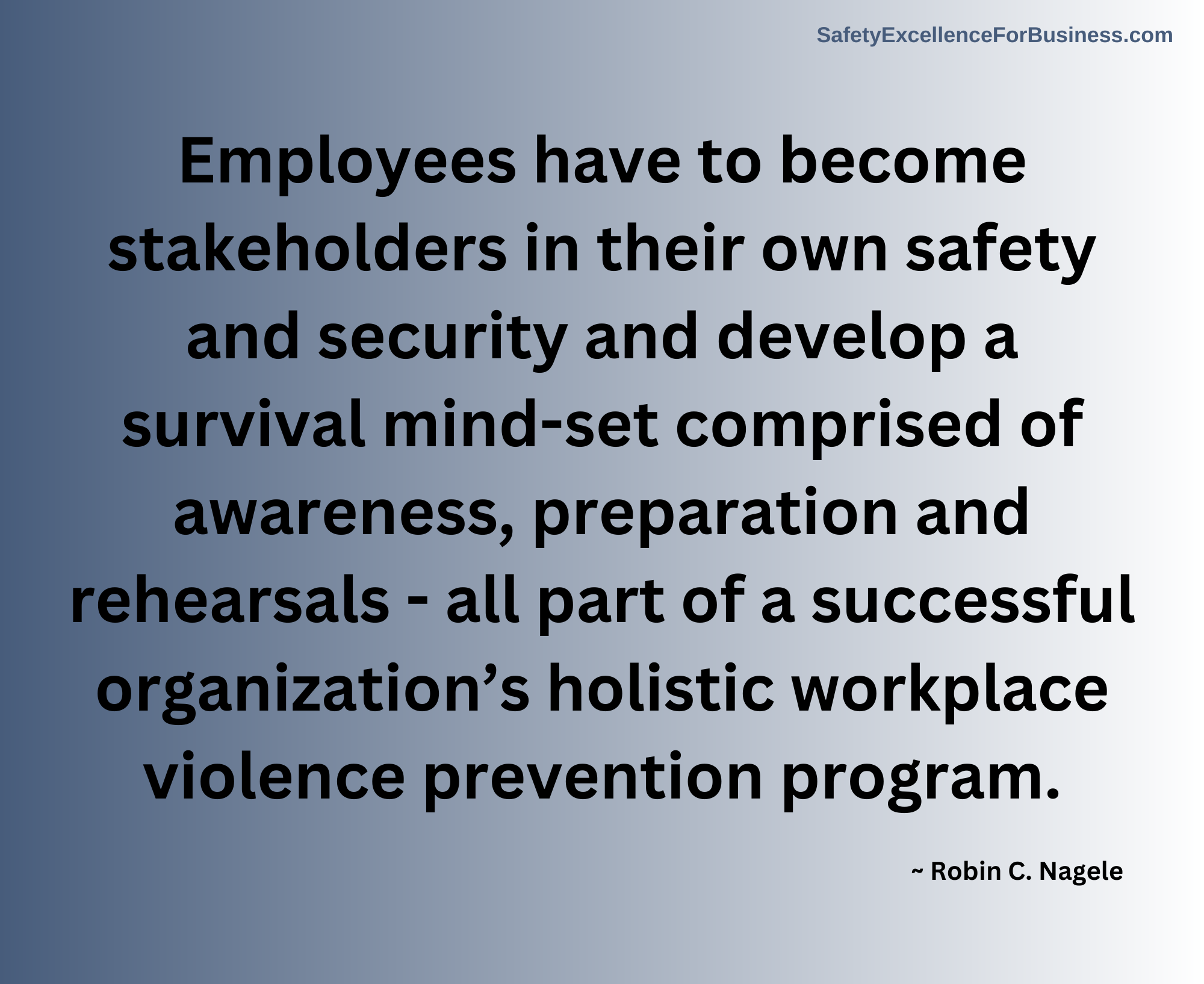
Employees must become stakeholders in their own safety and security and develop a survival mindset as well. Vigorous prevention programs, timely interventions, and appropriate responses by organizations and their employees will contribute significantly to a safe, secure, and respectful environment. That’s what we teach; that’s what we do.

Want to know more? Check out our book “Guide to Reducing the Risk of Workplace Violence…the Absolute Essentials” available on Amazon. It has been labeled the “gold standard” – a comprehensive guide to reducing your risk of workplace violence happening in your workplace…from the inside or the outside or give us a call at 716-622-6467.

Trust is so Important for Improved Safety Performance

I have been trying to understand why the number of people getting hurt and killed at work is not getting better.

According to the Bureau of Labor Statistics, since 2017 the number of people being killed at work is averaging about 5,130 a year, with no sign of improvement and the injury frequency rate is stuck at about 2.7 for that period.

There is a lot of effort being put into trying to improve safety with the global effort totaling about $20,000,000,000 being spent for services, regulation, equipment, trade associations, etc. This is a huge industry; I call it “Big Safety.” Why isn’t Big Safety making more progress in reducing the number of people getting hurt and killed? These are real people and their families that are suffering so much.

I have been getting some help from Kerry Turner and Marc Pierson in looking at the safety work from a systems perspective. The safety system is huge with many factors at play. The systems approach is helpful in being able to see the whole system, the various components, how they interact, find key points where changes can be made.

trust your team for safety performance

One thing that I have seen is that injuries and incidents are local events, and it is hard for Big Safety to know what really happened in detail. What it offers often does not fit quite right and comes across to the people as “the Flavor of the Month.” The people doing the work have little confidence in what the offerings provide so they often do not stick very well.

Another thing that I have noticed is that the consultants coming out of Big Safety often are seen as “experts” and come into the organization to fix the people rather than teaching the people how to solve their own problems. This weakens the people and tends to disempower them. This is a lot like Big Government coming into a local community to fix a problem when they do not know the people or much about the real nature of the problem they are coming in to fix.

In studying the Safety System, it becomes obvious that trust is a central feature that is often missing when Big Safety comes into the organization. There has been a lot written about the importance of trust, and in using a systems approach, trust really emerges as the central feature that needs to be in place before much progress in improving safety performance can take place. Real progress requires the energy, creativity and commitment of the people doing the work. This is a gift that people will give if they have trust in the other people and feel safe in opening up to meet the safety challenges.

safety of the people is important in safety performance

A Suggested Approach to Building Trust

Perhaps when a consultant comes into an organization to work on a safety issue, they come into the organization 2-3 days before their planned work begins and walk into the facility among the people to get acquainted with them. Talk with the people, listen to their concerns, and discover what the real problems are that are causing the need for improved performance. Talk about their work with them and find out what they need so they can work more safely and effectively.

Open yourself up to their questions and concerns about you. Creating a safe space where they can talk with you is an important step in building trust with the people. Then the consultant needs to reflect on all that was learned and see how their knowledge and skills can be used to help the people to solve their problems. Don’t try to solve their problems for them or fix them. Rather teach them how to solve their own problems.

I have found that this approach works very well in helping to get to know the people, the issues, and to begin to build trust.

Doing Safety Right in the Workforce!

So much of our safety efforts are aimed at trying to get the people to do safety right.

Photo Credit: OSHA.gov/Safety

There are lots of good ideas, new techniques, slogans, better equipment, PPE and so on. When I go to an American Society for Safety Professionals Conference, I am awed by the beautiful displays of new and better equipment and supplies. A lot of safety people are trying to improve safety in the workplace. It is hard work, and progress in reducing injuries and incidents is slow.

My Earlier Years

Over my 20+ years in managerial positions, working to improve the performance of organizations, I have found that the way I worked in my early years of pushing, pushing, scolding, blaming, looking for root cause, etc. was not very successful. I did not listen well and did a lot of arguing. I took an approach of trying to take things apart, thinking that if I understood the parts I could fix things. I felt that I had to know everything and fix the problems and the people. But the same problems kept popping up and no one seemed to learn or care. Trying to catch people doing something wrong, sets us up for a lot of arguments and struggles. Many organizations where I worked were not happy places. (And I learned that it didn’t have to be that way – old school management certainly had its flaws!)

Growing Up

However, when I began to realize that almost all people are smart in their own ways, things began to change. As I learned to purposefully go into the workplace, sit down with the working people, and listen to what they had to say, I found that most people are doing things quite well. They wanted to help to make things better. Most people do not want to get hurt or cause a problem. Rather than treating them as if they just did not care, I realized that they had a lot to offer and wanted to contribute. I just had to ask them, listen, and create the conditions where they could be their best. (They had so much information and innovations to offer!)

At first, I found the people frustrated and unhappy that no one had ever listened to them. When I first began to walk among them, there was a lot of fear and little trust. What was I really doing? Was I really trying to engage with them and learn? Was I just trying to find something wrong in a sneaky way? As I kept trying, kept listening and learning to talk with the people, and not at them, things began to shift. Each conversation was a little step, so I had many conversations. When I was the Plant Manager at the DuPont Belle, WV Plant, I did this for 4-5 hours a day for over 7 years. (Yes, I kept long work hours!)

In talking with the people, building trust, and helping them to see that they were an important part of our total success, our performance improved. In the first 4 years, our injury rate dropped by 97%, emissions dropped by 95%, productivity rose by 45% and earnings rose by 300%. We kept getting better. I did not do this by myself, the people, all of us together did this. I found that in all these conversations that the collective intelligence of the whole organization went up and kept going up as we all talked and learned together. We all became partners in building a successful business.

respect and honor others in the workplace

My Consulting Experiences in Safety

Over the last 28 years of consulting with organizations around the world, to help them improve their performance, I have used and taught this approach. I have developed a focused tool for our conversations that helps to make this work focusedeffective and fast. It helps the people to see what they are doing, breaks down barriers, builds trust, enables them to solve complex problems, and make decisions close to their work. In these conversations the collective intelligence of the groups always goes up. All dimensions of their performance improve, often quite quickly. They sustain this work for years by continuing these conversations among themselves. I call this tool the Cycle of Intelligence. It is simple to use, requires no new capital investment and helps the people, all of them from the top down, to sustain and improve progress in their continuous conversations.

Invitation:

If you want to learn more about the Cycle of Intelligence and how this process works, please give me a call at 716-622-6467 or contact me at richard@rnknowlesassociates.com. We can set up a Zoom call if necessary. (Yes, we do “Train the Trainer” sessions.)

Perhaps you have a story you want to share. It is so important to establish your credibility as a manager or supervisor who is committed to improving safety and to respect your people – because worker participation, involvement and enthusiasm is a treasure. Hope to hear from you!

Peeling the Onion: Exposing the Various Layers of Safety in the Workforce

Let’s peel back the onion on some recently published Safety Stats.

The number of people killed at work dropped in 2020 – Good News!

The Year 2021 was full of changes and challenges. Much of the news was pretty negative. But, one piece of good news was that the US Bureau of Labor Statistics reported that the number of fatal occupational injuries in 2020 dropped from 5,333 in 2019 to 4,764 in 2020. This is the first drop in fatalities since 2014. This is good, but no one knows why this happened. There are many possible things that could have had an impact. We must peel back the onion and look deeper.

exposing the layers of safety stats

Here are some stats:

  • Did the COVID epidemic have an influence? Probably.
  • Were there fewer businesses operating? Yes.
  • Were fewer people actually at work? Yes.
  • The pressures of excessive overtime were up as businesses began to expand again but could not get enough people to fill all the positions. Did this have an impact? Maybe.
  • Were the numbers unclear because there were more part-time workers? Probably.
  • Was management actually doing a better job in the safety arena? I hope so!
  • Even though there was a lot more stress among the people with all the COVID worries, the number of murders dropped by 14.5%. Women made up 16.3% of workplace homicides. Maybe people were handling the stress better than usual. I hope so!
  • Exposure to harmful substances went up, including overdose of drugs. Was this from increased workplace pressures. Maybe.
  • Fatal injuries among law enforcement people went up 18.6% to 115 people. Thank you for your courage!

This is a complex problem with which all of us in safety are working to improve. The number of fatal injuries in 2020 was lower than it has been (and that is a good thing!), but the reasons are multifaceted. Please keep up the safety work you are doing and we’ll see if the 2021 numbers improve again.

What Do Workers Want?

American workers want better stability, safety, and leadership.

Randstad, USA, a large professional and commercial staffing organization, recently conducted a survey of their clients, finding that the COVID situation had an enormous impact in raising the workers’ concerns for safety. Workers want their leaders to clearly take the lead, making and acting on decisions to improve their safety and the stability of the workplace environment. Workers want clear standards on vaccinations and working conditions like spacing and overtime considerations. This is a big challenge since guidance from the Government, OSHA, the CDC and the courts is in such flux, and the shortage of skilled workers complicates this even further. This is a huge source of stress on everyone. It is critical that there is open, honest conversations among all the people so the best, most logical decisions can be made. This is really the work of leaders and the people want them to step up and lead.

Getting back to the onion metaphor…the Leader needs to be rooted (strength of conviction, knowledgeable) and have a strong inner core…yet be flexible, able to listen, communicate and most importantly, to be able to step up and lead.

Call to Action: As you peel back the onion around the safety performance of your workplace during this past year, what will you find? Contact me (716-622-6467) and I’ll share with you the “Layers of Safety” I use when speaking to Leaders on becoming the most effective they can be in leading Safety in the Workplace.

removing layers of safety stats