 As this year comes to an end, we will be looking at our overall performance to see how we did and to plan for 2017. We will usually look at our injury statistics like the total recordable injury rate and try to determine how we performed. Often quite independently, others will look at other performance indicators to see how they came out. We act as if these are independent of each other, but in our organizations everything is connected so all aspects of performance influence each other. Everything happens through the people. All the parts are interconnected. Excellence in safety performance is strongly related to our total performance because it all works through the will of the people.
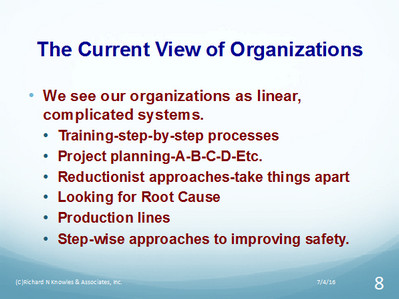
We traditionally try to apply safety and other metrics to our organizations in a machine-like fashion. We see that something needs to improve so we push harder as if we are pushing a wagon up hill. Too many regulators and managers sit in their offices trying to imagine what needs to be done and write a new procedure or rule so that things will be better. Then they issue edicts pushing everyone harder. However, the work as imagined is never the same as the work as done. Why do managers think that sitting, bound to their office chairs, that they know everything? How can they? Then at the end of 2017 we will do this all over again trying to understand why things did not get better. Around and around we go!
We break this vicious cycle by opening up ourselves to a different way of thinking, seeing and being.
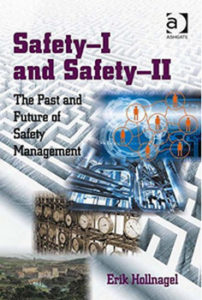 Work-as-imagined and work-as-done are ideas developed by Erik Hollnagel in his book, Safety-I and Safety-II (2014. Ashgate Publishing Ltd., UK). Safety I is our traditional top-down management approach to safety management where rules and procedures are issued by those far from the actual work. This is like the approach discussed in the proceeding paragraph. I think that a lot of people are trying to do good safety work from the Safety I perspective, but the results are not improving fast enough.
For example, the Bureau of Labor Statistics (BLS) recently reported that the rate for nonfatal injuries and illnesses per 100 people dropped to 3.0 in 2015 from 3.2 in 2014 and 3.3 in 2013. That is a 10% drop over three years. That is way too slow! In 2015 2,900,000 injuries were reported. That is WAY TOO MANY people getting hurt. In an earlier paper the BLS reported that the number of fatalities has hovered around 4,700 people a year for the last 5 years. This is WAY TOO MANY!
This is not just a US problem. For example, Worksafe, New Zealand recently reported that the health and safety laws have had little effect on reducing fatalities further.
While driving safety from the top has had benefits historically, the effort is having less and less impact. But when we change our approach to working with the people to co-create our future, things change for the better quite quickly. This is true! It’s proven!
In the work of Richard N. Knowles and Associates, we approach the organization as if it is a living organism. Time after time coming out of our Safety Excellence Workshops, the performance improves quickly. When we engage with the people this way and help them to co-create their safety future, building on the positive strengths of the people, safety and all other aspects of their work get better quickly. For example, when I was the Plant Manager at the DuPont Belle Plant in West Virginia we worked this way, and our injury rates dropped by over 95% and earnings rose 300% in just three years. This is similar to Hollnagel’s Safety II approach.
Whenever we, at Richard N. Knowles Associates, work in organizations the safety and total performance improves quickly. Everything happens through the force of the will of the people. We release this force helping the people to co-create their shared future. Then we show them how to sustain their work for the years ahead. All dimensions of the business improve; costs are lower, productivity is higher, morale is better and far more people are working safely.
Call us at 716-622-6467 so you can release the positive, creative forces in your organizations quickly!
 A recent article in the October 13, 2016
 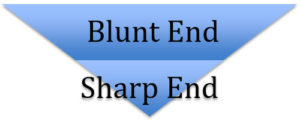 This story illustrates so many of the changing conditions and people involved in our work places. Most of our companies do a good job in risk assessments and developing safe working procedures. However, this planning often takes place away from the actual location where the work will be done. This is sometimes called the “blunt end” of the safety process where the people doing the planning do not understand what happens in the work at “sharp-end” where conditions and demands may be quite different, and where most of the injuries happen.
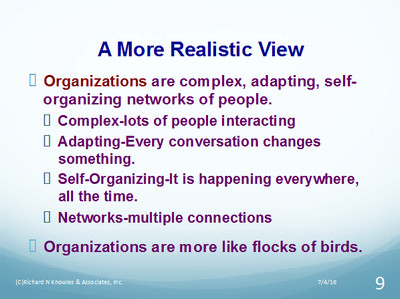
 For our workplaces, this is about the way we think about safety, the way we engage around safety, and the way we bring a third unifying force to the whole culture of safety.It’s the missing link in our respective workplaces. Without it, we tend to stay engulfed in a culture of compliance, yet despite trying and trying, we never reach excellence. Without it, we keep repeating the same mistakes – round and round we go.
 I spoke about Partner-Centered Safety™ and the importance of this as the quickest way to achieve sustainable safety excellence. As many of you know, I have written and spoken about this many times over the last several years. The information and data I share clearly shows that this approach to leading safety is very powerful, producing improved results quite quickly. Many of you have seen the terrific results the people at the DuPont, Belle Plant achieved. This approach has a very strong scientific basis in complex adaptive systems theory.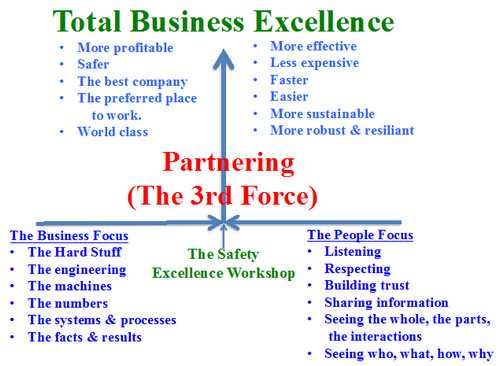
 When the Safety Culture is right…what do you see? What does Excellence look like?
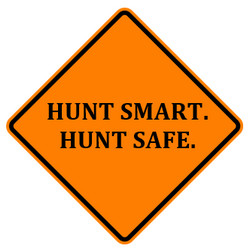 In many places, the hunting season is underway or just beginning. This is always a time of change and hazard. Some years when I was a plant manager, we would have one or two serious hunting-related, off-job injuries – like falling from a tree stand or tripping over something and breaking a leg. There is a lot of change as people go into the woods and fields looking for game. Many have not done this for a while. Others may not be fully prepared for a sharp change in the weather where a heavy rain could come in or the temperatures drop below freezing and hypothermia becomes a worry. It is often dark and visibility is poor. I have read of hunters getting killed with their own weapon when they have tripped and accidentally shot themselves. Don’t load your gun until you are ready to use it.
 I have been talking about checklists in my previous newsletters and they can be useful as people go out hunting.
 I recently read of a fatal accident where a man was killed while working on a lathe. It was properly shielded and okay for the normal conditions, but the unexpected happened. The part he was working on exploded apart under the high rotating speed when he engaged the cutter. The parts from the exploding piece went right through the shield and gave him terrible, fatal wounds.
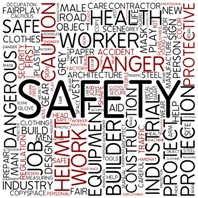 Another thing that can happen around hunting season and the holidays is the need to hire temporary people to backfill for those who are out. These people need extra care and attention, but things are often so busy that it is hard to give it to them. These people just don’t know the hazards.
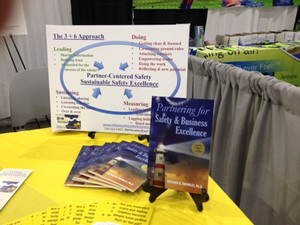 At our exhibit booth, Claire and I shared our Partner-Centered Leadership approach. We handed out brochures and other literature that can help organization’s achieve safety excellence and move towards their OSHA Star designation. We were there to share important information, including the need to be able to lift up and address one’s safety elephants that are preventing organizations from being the best they can be.
 The keys for addressing both of these concerns in building sustainability into their programs and in achieving the OSHA Star status is for the people at all levels and parts of the organization to talk together to get clear and aligned on just what they really want to do. How sincere and authentic is the desire to have safety excellence for the long-term? (This means Communication with a Capital C—requiring Co-creation, Clarity and Coherence.) In addition, together they must take the time to co-create a set of ground rules about how they agree to work together in order to achieve their safety goals and then hold each other accountable to live up to them. (That’s Partnership and Commitment!) The process to achieve this is available to you and your organizations now.
 This is all about having everyone go home in one piece and having a profitable business. Excellence in both the safety performance and business results are attainable.
 “
“ Talking together is one of the most important things we can do to help to improve the safety in our workplaces. Letting people know that you care about them and respect them. But too many times I have seen supervisors and managers talking down to their employees ordering them to do this or that.
 At a recent safety conference I learned about a way to quickly assess whether a manufacturing site was cutting corners and trying to get by on less than the best. The person speaking, Ewan Alexander of BHP Billiton, said that he looked for improvised tools being used.