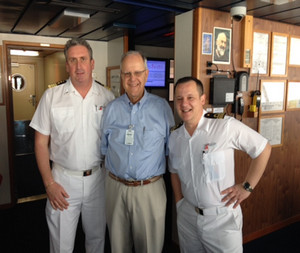
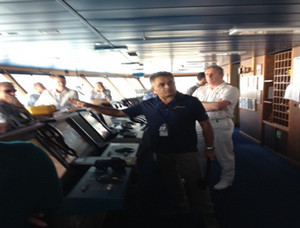
 On December 16-18, 2015, I was able to attend the Cruise Line International Association Safety Conference in Miami. The focus was on improving the safety culture and Bridge Resource Management. This is a very interesting business for me to learn about. I was there to give some perspective from the chemical industry.
This cruise line industry is doing a lot to keep improving their safety performance. Their safety challenges range from slips, trips and falls all the way to navigation, building effective teams on the bridge and crew communications challenges. Ken Koves from the Institute of Nuclear Power Operations spoke about safety culture from their perspective. The level of regulation in that industry is quite impressive. There is just no question about doing things safely, yet they still have their challenges.
I spoke about moving towards a stronger safety culture by sharing more information, building trust and helping people to see the importance of their work to the success of the whole effort. I showed the 35 attendees a slide about the layers of the safety process effort, which they found quite interesting. I also gave them some cards with tips that the officers at different levels could use to help them when they go out to talk with their people. These were seen as quite helpful as well.
The second day focused on training, bridge resource management and simulation so that the captains and their bridge officers could develop stronger skills relating to navigation, ship piloting and management skills.
There is some very sophisticated work being done with large simulators being used by several companies. There are also several institutes providing skills, refresher training and qualification for the officers. Their training loads are very heavy.
Two test pilots from Boeing spoke about their training and the use of simulators. Their simulators are so advanced that, after a month of simulator training, a person could fly an airplane even though they never had seen it before. The basic ideas about the way simulators help them are quite alike even though the differences between a single seat jet fighter and a cruise ship are huge.
Part 2 – Integrating this Learning into all Safety Leadership
 There is a big need to be sure the managers of chemical plants are qualified so that their employees and neighboring communities do not suffer the consequences of chemical releases and spills. Many manufacturing businesses that do hazardous work, aside from chemical manufacturing, should heed this thinking too.
As I was listening to these talks, I got to thinking about my chemical industry experiences. When I was a DuPont Plant Manager 20 years ago, we were very strong in operating discipline and safety. Managers were carefully selected and a lot of attention was paid to doing safety and everything else right. Training and integrating safety into every task, every day, was paramount.
Over the years, since I retired in 1996, a lot has changed, with the terrific pressure on cost control and efficiency. The safety standards fell terribly and accidents occurred like the four LaPorte, Texas deaths that DuPont had in October, 2014. In reading the reports of that accident it was sad to see that standards had slipped so far that even their company fire truck broke down on the way to respond to the incident.
This isn’t just a DuPont problem. Many companies are being broken up and purchased by finance and fund managers who know nothing about manufacturing and the high standards that need to be met. Just look at the First Chemical Company spill in West Virginia, when their poorly maintained storage tanks failed, spilling chemicals into the Elk River near Charleston shutting down the city water system for weeks. The people who owned this facility had no idea about their safety responsibilities. Their tanks were leaking for some time, yet the owners ignored them; the size of the leaks increased over a considerable period of time, then the dikes finally failed.
I am beginning to think that the people who manage facilities using highly hazardous materials, like those on the TSCA list, should have some sort of licensing requirements to certify that they are qualified and that their companies know how to fulfill their safety responsibilities. Ship Masters have licenses and certifications. Nuclear plant people are certified. My barber has to have a license. Professional Engineers must be licensed.
While this may sound like just more red tape, I think it is time to open the conversation about this. Plants that handle chemicals like chlorine are hard to run, can fall into a backwater and not receive the attention and support they need – yet a big chlorine spill would be a disaster.
There are lots of questions related to getting this going, but we, as a society, need to address it. What are your thoughts? What areas in your specific business, (chemical or not), are such that being certain that your managers and owners know what they’re doing and have the required knowledge and demonstrated operating discipline, are paramount? Where do you need to put some marked attention in 2016?
 I’m reminded about the organization that thought their safety performance was always good, because they were primarily an office environment. They scoffed over how bad could a paper cut be? Or, what’s the worst that could happen if someone fell off their chair? Little did they expect that one of their office workers, when on a healthy outdoor walk during her scheduled break time, tripped over some roped off tape that had been blown by the wind. She actually walked into it – not paying attention to her surroundings – got caught up in it as it wrapped about her feet. She fell, twisted her knee, required surgical repair, etc., etc. Try to explain that office worker lost-time injury! (The good: healthy walk; The bad: not paying attention; The ugly: lost time injury).
 We see organizations as complex adapting networks of people who are the vital keys to its success. When the people in the various parts of the network are sharing information and helping each other, all aspects of EHS Performance rapidly improves, resistance to change disappears and the energy bubbles up spilling over into all other parts of the work lifting the organization to new, higher levels of performance.
 In many places, the hunting season is underway or just beginning. This is always a time of change and hazard. Some years when I was a plant manager, we would have one or two serious hunting-related, off-job injuries – like falling from a tree stand or tripping over something and breaking a leg. There is a lot of change as people go into the woods and fields looking for game. Many have not done this for a while. Others may not be fully prepared for a sharp change in the weather where a heavy rain could come in or the temperatures drop below freezing and hypothermia becomes a worry. It is often dark and visibility is poor. I have read of hunters getting killed with their own weapon when they have tripped and accidentally shot themselves. Don’t load your gun until you are ready to use it.
 I have been talking about checklists in my previous newsletters and they can be useful as people go out hunting.
 I recently read of a fatal accident where a man was killed while working on a lathe. It was properly shielded and okay for the normal conditions, but the unexpected happened. The part he was working on exploded apart under the high rotating speed when he engaged the cutter. The parts from the exploding piece went right through the shield and gave him terrible, fatal wounds.
 Another thing that can happen around hunting season and the holidays is the need to hire temporary people to backfill for those who are out. These people need extra care and attention, but things are often so busy that it is hard to give it to them. These people just don’t know the hazards.
 In many of my newsletters, I have talked about the importance of sharing information abundantly, building relationships of trust and interdependence, and helping people to see the importance of their own work in building the success of the whole organization.
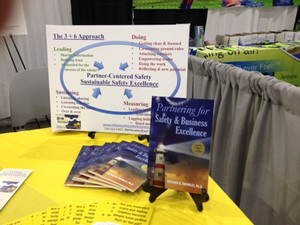 At our exhibit booth, Claire and I shared our Partner-Centered Leadership approach. We handed out brochures and other literature that can help organization’s achieve safety excellence and move towards their OSHA Star designation. We were there to share important information, including the need to be able to lift up and address one’s safety elephants that are preventing organizations from being the best they can be.
 The keys for addressing both of these concerns in building sustainability into their programs and in achieving the OSHA Star status is for the people at all levels and parts of the organization to talk together to get clear and aligned on just what they really want to do. How sincere and authentic is the desire to have safety excellence for the long-term? (This means Communication with a Capital C—requiring Co-creation, Clarity and Coherence.) In addition, together they must take the time to co-create a set of ground rules about how they agree to work together in order to achieve their safety goals and then hold each other accountable to live up to them. (That’s Partnership and Commitment!) The process to achieve this is available to you and your organizations now.
 This is all about having everyone go home in one piece and having a profitable business. Excellence in both the safety performance and business results are attainable.
 Talking together is one of the most important things we can do to help to improve the safety in our workplaces. Letting people know that you care about them and respect them. But too many times I have seen supervisors and managers talking down to their employees ordering them to do this or that.
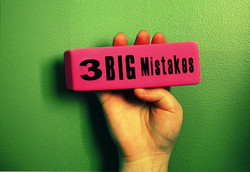 In reading the various, publicly-available reports, it looks as if all three of these big mistakes were probably made. The push for production was dominant, piping changes had been made without documentation, the safety procedures were modified or ignored, operating problems were not properly addressed and tolerated, previous practices allowed the draining of small quantities of material right into the room, and the communications were such that people probably could not or would not tell their management, who probably were not listening anyway, all the problems.
 At a recent safety conference I learned about a way to quickly assess whether a manufacturing site was cutting corners and trying to get by on less than the best. The person speaking, Ewan Alexander of BHP Billiton, said that he looked for improvised tools being used.
  How important it is to stay on top of global strategic trends and innovations while aligning our efforts with business strategy.
  Each of us, as we travel to and from our work spaces want to be “safe and sound”—we want to return at the end of the day or at the end of our work-shift to our loved ones—safe and sound.