Leading Safety Through Partnership and Respect

The Alcoa Transformation: A Lesson in Leadership

In October 1988, Paul O’Neill became Chairman of Alcoa, a global aluminum producer facing challenges in safety, quality, and profitability.

O’Neill recognized that true, sustainable improvement required a cultural shift – one built on open communication, respect, and recognition. He championed what I call Partner Centered Leadership, where every voice matters and information flows freely.

To enable this change, O’Neill asked all managers and supervisors to regularly ask their teams three simple questions:

  • Does everyone have all the information and resources needed to do their best?
  • Does everyone treat you with respect and consideration, every day, at every level
  • Does everyone receive recognition and honor for their contribution?

He also invited employees from all levels to contact him directly with suggestions for improvement. The results were remarkable: within a few years, Alcoa’s earnings increased fivefold, and both safety and market evaluation improved dramatically.
partnering for safety and business excellence

My Experience: Partner Centered Leadership in Action

When I served as Plant Manager at DuPont’s Belle, West Virginia facility, I independently adopted a similar approach. By engaging with employees daily – walking the plant, asking questions, and listening – I witnessed dramatic improvements:

Our injury rates dropped by about 97%,
emissions to the air, water and land dropped by 95%,
productivity rose by 40%, and
earnings went up 300% in just four years.

These results were not achieved by imposing top-down directives, but by building trust, sharing information, and working together. Over time, our culture shifted organically – people contributed more, leadership became easier, and our values for safety, quality, and respect became the foundation of our success.

Building a Positive Workplace This Holiday Season

As we enter the Christmas holiday season, let’s bring cheer and positivity into our workplaces. Treat each other with kindness and consideration, keep divisive politics out of the workplace, and focus on building a supportive environment. Remember, even in diverse settings like the International Space Station, shared values and mutual respect enable people to thrive together. We can do the same.
approach the new year for safety and partnership

Key Takeaways on Safety and Partnership

  • Open communication, respect, and recognition are the foundation of a strong safety culture.
  • Simple, consistent questions can drive meaningful change.
  • Sustainable improvement comes from partnership, not top-down mandates.
  • A positive workplace is built by everyone, every day.

Reflection on Safety

What’s one thing you can do this week to foster a safer, more respectful workplace? You don’t have to wait until the new year – you can start right now! Call me to learn more. Ask me questions!
Being in the System and Partner-Centered Leadership

When I was assigned as the Plant Manager of this large (1,300 people) chemical plant, I had a formidable challenge, which is why I developed Partner-Centered Leadership approach.

This was about the poorest performing of DuPont’s 150 plants world-wide.

Note: “In the system” means to be wholly integrated with, rather than apart from.

I had been Plant Manager of the DuPont Plant in Niagara Falls, NY, so this change was a challenge for me and for the Belle Plant people. I did not know the people or the culture of West Virginia and I was told by my VP to improve all aspects of the plant’s performance or face a potential shutdown with the loss of 1,300 jobs.

I was an outsider – no one trusted me, and they were strongly opposed to change. It was ugly at first, with several death threats and other stuff.

being in the system and wholly integrated with the system

I knew that the traditional top-down management approach would not work; it had failed with others for years. I knew that I had to personally engage with all the people, build trust, and share with them why we had to change in a way where the people would want to listen. I had to change from my top-down approach and have the courage to go into the plant every day and personally talk with everyone – sharing information, cheerleading, learning about them, their work, their lives, and instilling a caring about our collective future.

I heard a lot of anger, gripes and frustration so I had to listen and learn.

I walked the plant every day for about 5 hours a day. Gradually, the tensions began to go down. Many of the conversations I had were simple one-on-one interactions. I also held two business meetings each week in different shops, control rooms, and offices; the minutes of these were published within 30 hours so that communications increased.

I found that most of the people were quite intelligent, knew their work, and were frustrated by the top-down management they had experienced – where they were treated as if they did not have a brain and had to be told what to do. They had been treated condescendingly. I treated them not as employees but as “people”, which made a huge shift – genuine people – all on the same team.

After about a year, things were beginning to change. Our mission was to be the best we could be in safety performance, environmental performance, quality, costs, customer service, and interactions with our neighboring community. We were treating each other with respect, listening to each other, asking questions, learning and solving problems faster than we ever imagined.

After four years, the changes were quite significant. Our injury rate had dropped by 97%, emissions to the environment (as reported to the EPA) were down 95%, productivity was up 45%, and earnings were up 300%. I talked with the people about all these things, but they came up with making the needed improvements.

It was wonderful to see people grow, learn, solve problems, and make a big difference. My job was to set the conditions so that they could thrive. We continued to improve all during my 8 years of being with the people and in the system.

My leadership process was sharing information abundantly, treating people with respect, listening and learning, and helping people see the importance of their contributions to the success of the whole plant. They sustained their 0.3 total injury rate performance for 15 years after I had left the plant.

Partner-Centered Leadership – The Process

It was in these intense experiences at the Belle Plant that I developed the Partner-Centered Leadership approach, as well as the Process Enneagram tool that was so effective in helping us to lead well.

Partner-Centered Leadership is a dynamical way to lead organizations. It is built on the fact that there is deep knowledge among the people, which is a huge resource to the organization, and most people want to contribute. Using the Partner-Centered Leadership approach, this resource can be opened up – providing new ideas, better ways of working, new business possibilities, personal growth of individuals, high morale, and the business getting much stronger.

For this to be successful, managers and supervisors must have the courage to lead by example, be more open, creating, leading and sustaining a culture of openness, honesty and truly caring about each other. Leaders need to understand that strong, purposeful relationships among the people must be cultivated and nurtured. They must treat each other with respect, listen, talk together and continuously learn.

Everyone needs to be open to feedback and improvement. Everyone could talk with anyone. Leaders co-create, with the people, a shared mission, develop their agreed upon standards of behavior which apply to everyone, and share information abundantly about all aspects of the business and how we are all doing as they work together. As the leaders lead by example, there will be more and more people joining in to help. Success is contagious.

The leaders need to help everyone see the system in which they are working so they are able to see the parts, the interaction of the parts, and how they can work most effectively together. Just focusing on one problem after another is like playing “Whack-A-More” and the problems never go away. When we can see the system, talk about it together, discover key interactions, we are much more likely to solve the underlying problems and achieve real improvement. As we all learn together, more and more people self-organize around, form ad hoc teams and solve problems themselves.

Partner-Centered Leadership – the Process Enneagram Tool

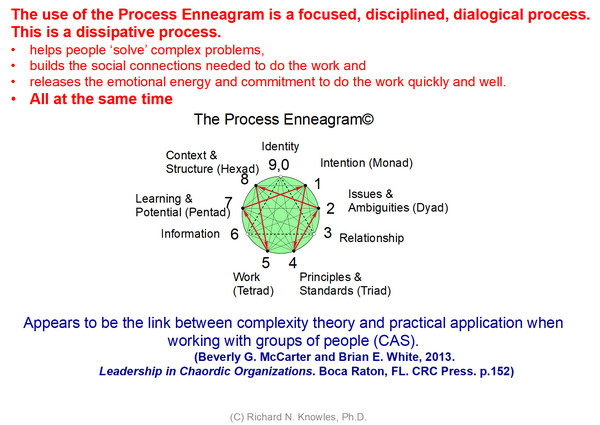
The Process Enneagram is a highly effective tool the leader can use with everyone to help to see the system and develop better ways of working together. In using it ,we can see our problems from 9 simple perspectives: see the parts, the whole and the interaction of the parts, and how they interact.

Here is a picture of the Process Enneagram tool. I have made the theory and use of the Process Enneagram open source on my YouTube site.

Partner-Centered Leadership - the Process Enneagram Tool

Give me a call at 716-622-6467 and let’s chat about how you can learn and apply this process in your work.