The Injuries Go On and On and On…New Ways to Help

Each day as I read the safety reports, serious and fatal injuries keep showing up.

These are happening across the spectrum of industries and businesses. Hardly a day goes by without a serious report. There is much pain. Families are suffering the loss of loved ones. Injuries cost businesses in lost time, replacement workers, training, Workers Compensation, etc. It’s not only the human cost and family loss, but the cost of injuries continue to go on and on and on.

There are thousands of safety people working to reduce these sorts of losses, and a huge amount of money is being spent, yet improvements in reducing these incidents are almost zero. Most people see organizations as if they are machines with relatively simple cause-effect relationships where we tend to blame the person who was hurt and look for root-causes. There is another way of seeing them which gives a different picture.
workplace injuries happen but we need to be safer

A New Way of Seeing and Thinking

Over my 40+ years of working to help organizations suffer fewer injuries and incidents, I have shifted my total approach from seeing organizations as if they are machines to seeing organizations as if they are living systems where the relationships are complex, dynamical and full of feedback.

People doing the actual work are intelligent and want to do things well. People want to be treated with respect, to talk about their work, to share ideas and concerns, to make decisions about their work and to solve their problems themselves. They want to know what is going on in their organization. This should not a big surprise to anyone, since this is the way in which I want to be treated, and I expect you do too.

As I engage with people this way, having purposeful conversations every day, the progress we make together is quite astonishing. I have had several workshops where the people and their work situation changed for the better in just one day. They need supportive managers to sustain this, but it is exciting to see how things change. Everything ties back to authentic employee engagement.
companies need to build trust with their empoyees

I have been working with Sebastian Wolf Siebzehnruebl in Berlin to write a new book about working this way. The book is named Navigating Complexity; From Control to Flow Using the Process Enneagram. It will be available from Routledge Publishers in January of 2027.

The Process Enneagram is a tool for having meaningful conversations with people about what is happening. It enables them to see their system in a new way, providing new insights into what is happening and how they are working. It works in any organization from coal mines to sugar mills, to homes for teenagers and even to symphony orchestras. One conversational tool that works everywhere is a big help.

Sebastian analyzed about 100 years of OD literature finding that the Process Enneagram is the bridge between most of these theories and practical application in the workplace. It can be used with plain English so technical jargon is left out. I have used it successfully in workshops with people at all educational levels; no one has ever walked out on me because it makes sense and is easily grasped.

In the workshops as the people tell me about their organization, I write their inputs onto a Process Enneagram map which is posted so all can see it as it develops. In the days and weeks after the workshops it is posted and used as a guide going forward. This enables the people to continuously build on this work and keep improving, together.

In working together this way, the improvements they make are very good – bettering things as they move forward. The Process Enneagram Map is their living strategic plan. As things get done, they are crossed off. As new things arise, they are placed onto the Map. When the Map gets full, a new one is made which includes all the open items. This is their living strategic plan as they move forward—together—engaged, making things better, because they want to.

Since this is a picture of how people decide to work together, it applies to virtually all organizations. The patterns and processes used across organizations are remarkably consistent, and how well these are used makes all the difference in an organization’s success.

Navigating Complexity, From Control to Flow will be an excellent guide as you do this important work.

Meanwhile, please give me a call at 716-622-6467. I will gladly share with you different ways you can get started on an authentic betterment journey for your organization.
Fix the Process, Not the Operator: Improve Workplace Safety

The Traditional Focus on the Parts – The way we see things has a big impact on how we try to figure out what is happening.

Let’s consider the job of a chemical operator. The first line supervisor, the superintendent, the accounting clerk, the mechanics, the truck drivers, the safety supervisor, the environmental engineer, the process engineer, the plant manager all see the chemical operator’s job differently. Yet they are not sitting in the operator’s chair. In the event of an incident, all these perspectives come together as separate parts, each with a different emphasis and all with an opinion, perhaps valid, perhaps not.

fix the process for safety

When the chemical operator is doing the job, he or she must integrate many knowledge pieces, skills, nuances, variables into a single whole. All the parts have to be done carefully and correctly. The chemical operator has to pull these all together in the right order and sequence. The chemical operator experiences the job as a single whole. The experience of running a complicated chemical process emerges as the work unfolds. When the operator leaves at the end of the shift, his “job” has included having dealt with a huge array of knowledge-based problem solving and safety awareness.

Another challenge is the specific job context is always different from one day to the next. Maybe it is raining, or windy, or bitter cold, or the equipment is stuck and hard to maneuver, or the job is blocked by mis-stored equipment. Maybe the pipes are frozen, or a valve is stuck, or a control room indicator is not reading correctly. The chemical operator needs to figure all this out in order to do the job safely and in a timely way.

In the event of an incident or some screwup, all the people doing the required incident investigation are sitting in their safe place, looking at their particular part and deciding if the job was done correctly. We try to take the job apart and find where the mistake was made. The tendency is to blame the chemical operator and decide to do more training…again and again.

Let’s Turn This Around

The chemical operators doing the work are intelligent and trying to do their jobs as well as they can. The chemical operator is the person that most wants to NOT have an incident occur. All the people related to the job are intelligent as well. There is a lot of knowledge scattered among the people which is not usually shared. In sharing, the collective intelligence of the whole group goes up.

What would it look like if each of the people who are involved got together on critical jobs (this may be too much for every job) and had a focused conversation about the job with the chemical operator where the work will actually take place? People get out of their offices, put on their PPE and share their insights and learn together.

They would look at the job as a whole task and experience. This becomes a really good learning experience for everyone, and they discover that they really know a lot together. The various holders of pieces of information can each inform the other pieces, and in turn, the whole.

(This idea is not far-fetched; that is, in every newly built process, about to come online, yet never operated until go-time, this process of people having come together to determine what the best expectations for safe start-up and process control are, is absolutely necessary.)

As they talk together, new ideas will likely emerge about how to do the job better, more safely and effectively. When they are looking at the whole job, the interactions among the different parts become visible. The complexity of the whole becomes visible; people can see opportunities for improvement and make the needed changes on the job right then.

More and more of the people will learn how to do this and make appropriate changes. Doing this work with the chemical operator is far more effective than doing it to the chemical operator. This idea was first expressed by Mary Parker Follett in 1918, yet 120 years later, we are still learning.

If you’ve ever worked within a team of chemical operators, those sharing the same shift, sometimes over a number of years, their camaraderie is evident, and their shared knowledge – what they’ve learned together – is worn as a valued badge of honor.

You can do purposeful conversations like this and make big improvements.

I have found that most people want to be involved and make a positive difference. Suppose you gathered a small group around a particular job and have a conversation like this. Pay attention to what you see happening. Listen carefully for new insights. Support the people and encourage them as they explore the job this way and watch the collective intelligence go up. Start slowly and build safer, more effective processes together, while improving the knowledge potency of people and the effectiveness of human dynamics.

(At one of the chemical plants I managed, we needed to do Process Hazards Analyses on various chemical processes. These are not easy to accomplish, yet we found that people without direct knowledge of the process were as valuable to the review as those who were, because they brought a new sense of curiosity, asking questions which needed to be asked, because sometimes we’re too close to the work that we miss the forest for the trees. We gathered the Review Team with representation from each part of the business, including administrative, operators, mechanics, service people, and technical people. The results were thorough, and the collective knowledge gained was insightful.)

safety improvements are an unending journey

Navigating Complexity; From Control to Flow Using the Process Enneagram

This is the title of the new book that Sebastian Wolf Siebzehnruebl and I have written. Routledge will publish the book in early January 2027. It will give you many insights about working the way I have described earlier in this newsletter.

Please give me a call if you would like to talk about this work. Call 716-622-6467 between 10:00 am and 4:00 pm Eastern Time.

Bringing Safety People Together…It’s all in the Venn!

I want to share some experiences I’ve learned about the importance of sharing information and building trust – especially as it applies to the various safety aspects of our workplaces.

We surely had our hands full in 2020 with all the COVID-19 issues. While the new vaccines will help, change will always be with us. Each of you can make a positive difference for the people in your organizations by sharing information about what is going on, building respect and trust and listening carefully, so you really understand the issues and concerns.

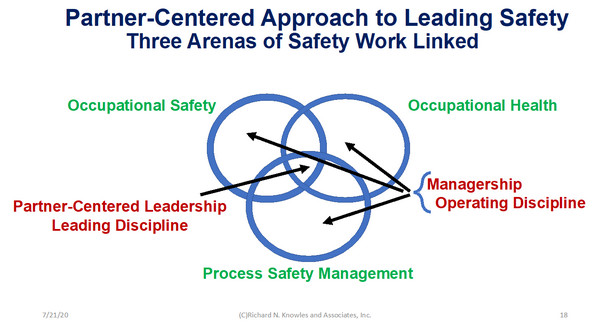
I have noticed that those working on occupational safety and occupational health do not interact much with the people working on process safety management (PSM), and vice-versa. For example, at the ASSP meetings, I rarely hear any one talking about PSM and at the AIChE Process Safety meetings, I don’t hear much about occupational safety and/or occupational health. It is as if these are different stove pipes. But each of these are areas where people are deeply involved in the total safety performance of the organization. I have found that when everyone is talking together about the total safety, synergy emerges and all areas benefit.

When I was the Plant Manager of a big chemical plant, the people working in these three areas were engaged in conversations and contributed to improvements across the board. This Venn Diagram illustrates how we brought them together while maintaining their unique contributions.

the importance of sharing information and building trust

Each safety area was managed separately, using their own operating discipline. Where the three areas came together, we talked about what was happening and looked for input from each other. This significantly raised the total safety and environmental performance of the site. PSM also has a big impact on the environmental performance when spills, accidental chronic emissions, release incidents, improved yields and fires and explosions are eliminated; and a lot less is emitted to the environment.

The area of overlap of the three safety disciplines (at the center of the Venn diagram) is where we engaged in Partner-Centered Leadership:

  • Sharing all information
  • Building trust.
  • Listening to each other’s problems and opportunities.
  • Learning and finding better ways to do the work together.

For example, we talked about the three disciplines in our site Central Safety Meetings, keeping careful track of our safety workorder backlogs, meeting our safety equipment inspection schedules and talking about incidents and injuries that had happened, and what we could all learn from them. The engineers went into the various production areas and sat with the operators to learn what the operators were experiencing as they ran the processes, and the engineers taught the operators the engineering technology supporting their work, helping them to understand what was happening in the manufacturing operations. The supervisors, engineers, operators and maintenance people talked together as safety and work procedures were developed. The gap between work-as imagined and work-as-done virtually disappeared. As trust and the open dialogue improved, our safety and environmental performance really improved.

In just three years, the Total Recordable Injury Rate dropped by about 97% to a rate of about 0.3, and the people sustained this for 17 years. PSM improved with much lower levels of releases and upsets. The emissions to the environment (accidental and permitted) went down about 95% in four years. When the PSM was run as a separate stove pipe from the occupational safety and occupational health stove pipes, the Plant’s performance did not come anywhere close to these low levels. This is significant!

The improvements we made in how we worked together in safety spread into all the other parts of our work in running the big (1,300 people) chemical plant. The more we shared information, treated each other with respect and listened to each other, the more the total performance improved. For example, productivity rose by about 45% and earnings rose about 300%.

Learning to work more effectively, through our safety work, spread to the whole organization. Each of you reading this newsletter can make a big difference as you engage with the people in your organizations, sharing information, building respect and trust. The impact of your work will spread.

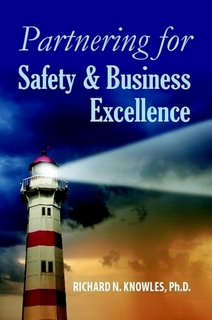
Want to know more? Contact me at 716-622-6467. Or, Order my book, “Partnering for Safety and Business Excellence” on Amazon.


Note: Venn is a diagram that shows all possible logical relations between a finite collection of different sets. Take a look at what sits right in the middle!