Organizations are complex evolving systems. Just about all the things going on in organizations are complex interactions of people, changing technology and the changing environment. Change is happening all the time.
This idea is in sharp contrast to our more mechanistic thinking that is common in many organizations where change is seen as a nuisance and people just wish management would make it stop. When I was the Plant Manager people pushed me constantly to slow all the changes down and prioritize the things we needed to do. Yet changes were coming fast and furious. At one point I asked them how do I prioritize an avalanche? I could work on the stuff for today, but tomorrow brought a new set of changes and all the priorities would change.
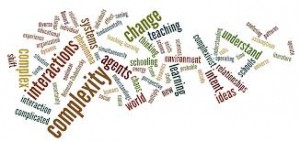 When I began to learn about chaos and complexity science, I saw that this was the way to handle the high level of change. As we shared more and more information, helped people to really understand the nature of the business and their important roles in its success, and as we built more trust and interdependence, people began to step forward to help us take on all the changes that poured into our organization. I did not have to do everything myself, which was a great relief.
One of the key ideas was the creation of the BOWL. Control of the organization shifted from edicts and directions just coming from me to building the BOWL which was our co-created mission, vision, standards, principles, and expectations. When people had internalized these ideas, they could operate with a lot of freedom as long as they stayed within the BOWL which they always did. We talked a lot about this and just about everyone had a good understanding of it and their responsibility related to it. With the BOWL we could have order and freedom simultaneously without the organization falling apart.
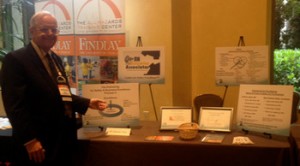 It was fascinating to see the contrast between the usual, linear, mechanical approach to safety and The Complexity Leadership Process (CLP) that I discussed at my display table. A large number of people talked with me at my display table about The Complexity Leadership Process which was new to all of them. Many could not believe how quickly and dramatically the safety performance improved using the CLP. At one level the CLP looks like a simple employee involvement program, yet it is much more and also different at a deeper level than the usual employee involvement processes. One fellow, who recently wrote a book about changing the safety culture to excellence just brushed the CLP aside as something he’d already seen. The approach to safety excellence he’s written about involves 43 linear steps that take 3-5 times as long as the CLP and require a very high level of persistence and determination over many years.
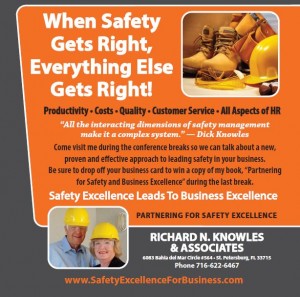 I’ll be participating as a sponsor for the Conference Program Brochure. I’ll have an ad in the Brochure as well as a display table. My tag line is “When safety gets right, everything else gets right”. Since I am not an official speaker, I am going to use my display table as an opportunity to talk with people about the
 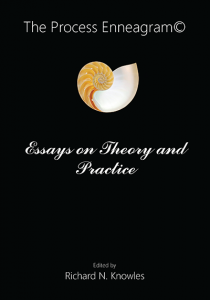 This Blog is focused on my new book, The Process Enneagram©: Essays on Theory and Practice. I am the editor for this book that was just published by Emergent Publications. It can be purchased directly from their
 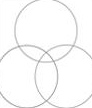 Overlap: All three of these areas of safety are often lumped together as SHE, EHS or HSE. When we lump these all together we can miss things so I think it is useful to see these three overlapping, interacting areas of our safety and health work. There is some overlap between Occupational Safety and Occupational Health like the proper selection and use of respirators. There is some area of overlap between Occupational Health and Process Safety like preventing chronic exposures to toxic chemicals. There is some overlap between Process Safety and Occupational Safety like locating trailers and offices away from operating areas using large quantities of flammable and explosive materials.