(These qualities must be missing if Safety Bloopers keep happening…and if people actually find them amusing—yet don’t heed the learning that they offer!)
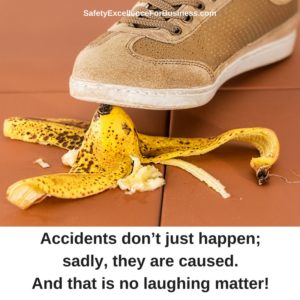
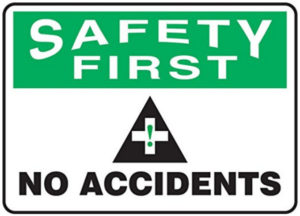 Almost every day I see people post on LinkedIn, engaging in awful safety practices. Some are so ridiculous that they could be funny – except that people are getting hurt. Some workers seem quite content to endanger their lives and co-workers seem to be so unaware of the risks around them – that it is unbelievable!
The remainder of this newsletter addresses the so-called safety bloopers, by asking ourselves…what is going on? And most importantly, what is the lesson in this for me? For my team?
Here’s to a blooper-less workplace where everyone goes home whole at the end of their work-shift, because we care and respect each other – looking out for each other!
More on Safety Bloopers…
In one, some guys were riding on the back of a fork truck to try to provide better balance and the truck still goes out of control; they were lucky to not get hurt. In another, a woman was walking along, reading her cell phone, and trips over the open cover of a sidewalk basement stairway and falls into an open stairway. Another was a guy who was standing on the top of a 12-foot step ladder, changing a light bulb and falls onto the floor. His two co-workers just stood there looking at him as he lay there immobile. Another was a guy pushing his heavily loaded lift cart off a step, and was thrown over the toppling cart is it flips. In another, a guy was working from the top of a 25-foot ladder that was balanced in the raise scoop of a big front-end loader. It goes on and on.
What is going on here? Is management so indifferent that they just tell people to get the job done any way they can? Are people so stupid that they do what they are told even when the hazards are so blatant? Who cares? What do you think?
The safety people I meet at various companies and conferences all seem to care. Managers and supervisors I talk with seem to care. I know Claire and I care, passionately. I do not understand what is going on. In 2016, there were 5,190 people in the USA who were accidently killed at work, so this is a serious problem. Are some of the stupid things I see on LinkedIn contributing to these numbers? I hope not! I hope our business owners and line organizations know better!
 A recent Gallup study conducted over several years, covering about 150 countries, revealed that only about 15% of the people were actively involved in their work and that another 15% were actively opposing their managers and supervisors. The other 70% must be just doing as little as possible and not helping or looking out for each other. We are better in the USA, but not by much.
There are lots of people writing about how to improve safety. There are lots of people working with organizations as consultants and advisors, but there are not enough to watch every single person or be at every worksite. We all have to depend on those around us to help. They see things we don’t see. They notice things that can hurt us that we have missed. They can tell us to slow down and think things through.
What will it take for all of us to be working together with respect and caring? These simple things can make a very big, positive difference. We can show our co-workers that we care and want them to go home safely to their families each day. Each of us can take the initiative to reach out to help.
What will it take for managers, supervisors and all the workers to care enough to save someone from a serious injury or fatality?
Do you care?
 One of the most effective things that I did in stressful and changing times like these was to follow these three rules:
 There are three important things that everyone needs to do to help to keep the safety performance and productivity high:
 In your tool box meetings or shift start meetings, consider expanding your thinking to imagine how someone could get killed in work planned for the day. This is beyond what most groups do, but is an excellent way to prevent an unlikely tragedy. Talk together about how a fatality could happen. Even the most unlikely scenario will happen one day. Talk about what is in place that will prevent the fatality if the event should happen. Then ask yourselves if these preventative measures are good enough to really protect you. If not, then consider what you need to do so that you will be protected from being killed if the unlikely event should happen.
 A wicked question is one where it is so complex that there is no final answer. We work to the best solution we can, which works for some period of time, then we have to revisit it again as conditions change. (The wicked question keeps repeating, sometimes reminding us of a bad penny – that keeps showing up at inopportune times!)
 We need to approach this from the whole systems perspective since everything is connected to everything else. Experience shows that if we try to just fix one part of the system or another, we will wind up making other parts worse.
 Recognize Einstein’s Words of Wisdom: “Insanity is doing the same thing over and over again, but expecting different results.“
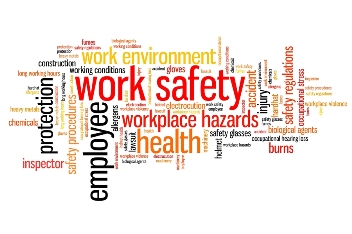 OSHA recently reported that there were about 5,190 workplace fatalities in 2017. This is almost a 7% increase over 2016. I expect that this partly reflects the higher levels of business activity and more people who are working. Still, every single number reflects a personal tragedy – the death of a worker.
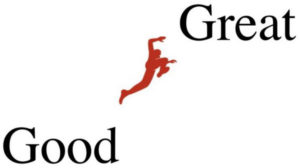 In 2001, Jim C. Collins wrote the best-selling management book, Good to Great: Why Some Companies Make the Leap…and Others Don’t. It described how companies transition from being good companies to great companies and how most companies fail to make that transition. The author found that focused leadership, clear expectations and alignment, and staying true to their field of major competence was key. There were other factors about greatness that showed up too – like Leaders being humble, and high employee engagement – employees being in tune with the company’s purpose, mission, endeavors, goals – not just the business side of things, but on the people side of the enterprise. Line organizations integrated information; people were involved, included and respected – because getting the right people in the right places was deemed as essential too. Entire organizations were communicating, collaborative, and cooperating.
 Violence at work is a growing problem. Shootings are becoming one of the leading causes of workplace deaths. Many organizations are having the local law enforcement people come in and do active shooter programs. This is a start. Preventing workplace violence has several aspects and becoming aware of how vulnerable your workplace may be, requires a physical-safety and psychological-safety assessment. These problems just don’t happen overnight in most cases. When someone is struggling with a serious problem at home or at work and have to just keep it to themselves, they get more and more lonely and resentful. If they are subjected to bullying and harassment things get bad, quickly. Stuff can build up to a tragedy. (How well do your supervisors know their people?)
 As I travel around and watch things happening, I see so many people in a big hurry. We are coming to the end of the good weather so people are hurrying to get outside jobs finished up. Roofers are really busy and not taking the time to properly use and secure their fall protection. I read of a recent 29-story fall in New York City when a guy on a big construction site fell through an unsecured hole in the floor.
 A good, proven approach is to have brief start up meetings to review the hazards of the day’s work, making sure we have the right PPE and other equipment in place and used, asking each other about what might go wrong and working to avoid this. We need to look over the schedules and be sure we have the equipment we need and the right people for the work.