The safest organizations are the ones that behave as if they are Living Systems.
 Most of us working in safety have been brought up to see organizations as if they are machine-like. This thinking goes all the way back to Descartes (1596-1650) and Newton (1642-1727). We use reductionist approaches to try to understand them. We seek cause/effect relationships. We use linear processes for training and the like, prescribing answers and doing things TO the people. We work on this part or that part trying to fix the whole thing.
It is a bit like a doctor who works on the stomach while another doctor works on the heart as if they are not connected in some way to the whole body, and have an impact on each other.
In this reductionist arena, we put a lot of effort and time into trying to reduce injury and illness rates to levels of excellence (<0.5) and sustain these levels. This is very hard, difficult and expensive.
Yet, over the last 50 or so years, scientists have been able (by using high-speed computers) to see the world and its patterns in wonderful new ways. We can see the whole of the organization – the connections of the various parts and the non-linear ways that they interact. We discover feedback loops and self-organization.
We are able to see the whole organization as if it is a living system.
All the people are vital parts to the success of the whole. We are able to share information freely, to learn together. Trust and interdependence build and the future can be co-created.
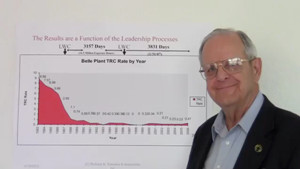
This is not just airy-fairy stuff! When I have used this approach to working with organizations to improve their safety and business performance, extraordinary results are achieved.
This is Operation Transformation for you and your organization, for Leaders and your people.
You each can begin to take steps in this direction by going into your organization, listening and talking with the people.
 The first part of this work is sharing all information and talking together about it. Another part is building trust and interdependence with the people as we openly discuss what is happening, what we are doing and why. The third part of this work is helping people to see the big picture and how important their part is to the success of the whole business.
 Lots of critical knowledge, experience and skills will be lost. Younger people, who have grown up in an electronic world of texting and games, will replace these people. Many are out of shape and bordering on being over weight; some are developing diabetes. This will pose significant challenges to employers and the need to work safely and well.
 Most of the safety people I’ve come to know approach organizations as if they are mechanical things to manipulate. Organizations are structured in functions. Knowledge is structured in pieces. People are narrowly skilled. Motivation is based on external factors. Information is shared on a need to know basis. Change is a troubling problem. People work in prescribed roles seeing only their part of the work. If change is needed people are moved around like chairs. Training is provided in abundance. Safety programs are set up as step-by-step processes where things are arranged in a prescribed sequence.
 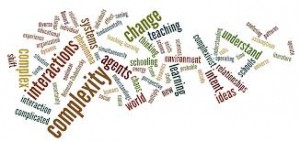 When I began to learn about chaos and complexity science, I saw that this was the way to handle the high level of change. As we shared more and more information, helped people to really understand the nature of the business and their important roles in its success, and as we built more trust and interdependence, people began to step forward to help us take on all the changes that poured into our organization. I did not have to do everything myself, which was a great relief.
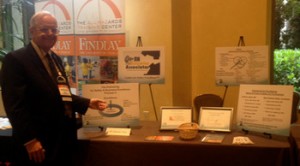 It was fascinating to see the contrast between the usual, linear, mechanical approach to safety and The Complexity Leadership Process (CLP) that I discussed at my display table. A large number of people talked with me at my display table about The Complexity Leadership Process which was new to all of them. Many could not believe how quickly and dramatically the safety performance improved using the CLP. At one level the CLP looks like a simple employee involvement program, yet it is much more and also different at a deeper level than the usual employee involvement processes. One fellow, who recently wrote a book about changing the safety culture to excellence just brushed the CLP aside as something he’d already seen. The approach to safety excellence he’s written about involves 43 linear steps that take 3-5 times as long as the CLP and require a very high level of persistence and determination over many years.
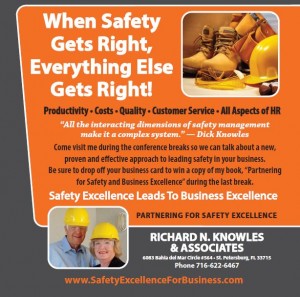 I’ll be participating as a sponsor for the Conference Program Brochure. I’ll have an ad in the Brochure as well as a display table. My tag line is “When safety gets right, everything else gets right”. Since I am not an official speaker, I am going to use my display table as an opportunity to talk with people about the
  This Blog is focused on my new book, The Process Enneagram©: Essays on Theory and Practice. I am the editor for this book that was just published by Emergent Publications. It can be purchased directly from their