In order to build a culture of safety excellence, information needs to be widely shared in a way that it is credible, clear and understood. Talking together is so important.
Treating people with respect, showing them that we care about them and their safety, listening to them as they share their hopes, concerns and ideas, is vital to building a culture of safety excellence.
 As managers go into their workplaces, walking around watching, listening and sharing with true authenticity and interest, trust and interdependence build. People learn to open up, to share, to point out possible areas for improvement, and to realize that they are a critical part of the whole safety effort. A huge, positive shift in the safety culture occurs. The people close to the actual, physical work are often in the best position to see potential hazards that are not visible to the managers. The managers often need to push to meet production schedules so it is easy for them to miss these potential hazards. Therefore, having the active help of those closest to the work is an important piece of the total safety effort. This is one way we avoid disasters like the Deepwater Horizon explosion and fire.
Yet, many managers find that talking like this with the people in the organization is difficult. In the early days of my career, I also was reluctant to go into the workplace and talk with the people. This is a participative process and sometimes you can get tripped up. I found that I needed to get very clear about the safety messages and their importance so that I was able to be coherent and credible as I engaged with every one. Once I had the ideas about safety clear and cogent, I could easily talk with people. I learned that I did not have to have the answers to every question that was asked. When I didn’t know the answer, I’d say I did not know and would get back to them as quickly as I could. This actually made the encounters more effective since the people could see that I was listening and learning as well. People want to get to know their managers and see that they are truly interested in them and their safety.
So, I strongly suggest that the managers get clear and coherent on their safety messages, get out of their offices and into their workplaces, talking together, listening and learning so problems can be avoided and potential improvements identified. Then get going with the people to solve the problems and make the improvements. This takes time and effort, but over the long run, time is saved and leading gets easier as we avoid the dreadful mistakes and injuries.
This way of communicating with the people is highly effective and a key part of The Complexity Leadership Process. While much of my focus is related to workplace safety, this Complexity Leadership Process can apply to all aspects of organizational life since organizations are complex evolving systems.
Safety is very complex with all the interactions of people, technology and varying conditions; this tool enables the people to have the necessary conversations for them to come together in partnership and achieve excellence.
 Things do not have to be this way! Most of the people know that this is counter-productive but that is the way it is. However, when we engage the people from across the organization in the Complexity Leadership Process, guiding them in a purposeful conversation of discovery that changes everything, they find it does not have to be that way!
 Most of us working in safety have been brought up to see organizations as if they are machine-like. This thinking goes all the way back to Descartes (1596-1650) and Newton (1642-1727). We use reductionist approaches to try to understand them. We seek cause/effect relationships. We use linear processes for training and the like, prescribing answers and doing things TO the people. We work on this part or that part trying to fix the whole thing.
 The first part of this work is sharing all information and talking together about it. Another part is building trust and interdependence with the people as we openly discuss what is happening, what we are doing and why. The third part of this work is helping people to see the big picture and how important their part is to the success of the whole business.
 Lots of critical knowledge, experience and skills will be lost. Younger people, who have grown up in an electronic world of texting and games, will replace these people. Many are out of shape and bordering on being over weight; some are developing diabetes. This will pose significant challenges to employers and the need to work safely and well.
 Most of the safety people I’ve come to know approach organizations as if they are mechanical things to manipulate. Organizations are structured in functions. Knowledge is structured in pieces. People are narrowly skilled. Motivation is based on external factors. Information is shared on a need to know basis. Change is a troubling problem. People work in prescribed roles seeing only their part of the work. If change is needed people are moved around like chairs. Training is provided in abundance. Safety programs are set up as step-by-step processes where things are arranged in a prescribed sequence.
 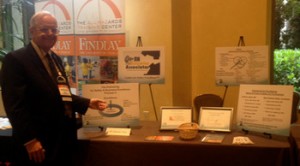 It was fascinating to see the contrast between the usual, linear, mechanical approach to safety and The Complexity Leadership Process (CLP) that I discussed at my display table. A large number of people talked with me at my display table about The Complexity Leadership Process which was new to all of them. Many could not believe how quickly and dramatically the safety performance improved using the CLP. At one level the CLP looks like a simple employee involvement program, yet it is much more and also different at a deeper level than the usual employee involvement processes. One fellow, who recently wrote a book about changing the safety culture to excellence just brushed the CLP aside as something he’d already seen. The approach to safety excellence he’s written about involves 43 linear steps that take 3-5 times as long as the CLP and require a very high level of persistence and determination over many years.
 I’ll be participating as a sponsor for the Conference Program Brochure. I’ll have an ad in the Brochure as well as a display table. My tag line is “When safety gets right, everything else gets right”. Since I am not an official speaker, I am going to use my display table as an opportunity to talk with people about the