I want to share some experiences I’ve learned about the importance of sharing information and building trust – especially as it applies to the various safety aspects of our workplaces.
We surely had our hands full in 2020 with all the COVID-19 issues. While the new vaccines will help, change will always be with us. Each of you can make a positive difference for the people in your organizations by sharing information about what is going on, building respect and trust and listening carefully, so you really understand the issues and concerns.
I have noticed that those working on occupational safety and occupational health do not interact much with the people working on process safety management (PSM), and vice-versa. For example, at the ASSP meetings, I rarely hear any one talking about PSM and at the AIChE Process Safety meetings, I don’t hear much about occupational safety and/or occupational health. It is as if these are different stove pipes. But each of these are areas where people are deeply involved in the total safety performance of the organization. I have found that when everyone is talking together about the total safety, synergy emerges and all areas benefit.
When I was the Plant Manager of a big chemical plant, the people working in these three areas were engaged in conversations and contributed to improvements across the board. This Venn Diagram illustrates how we brought them together while maintaining their unique contributions.
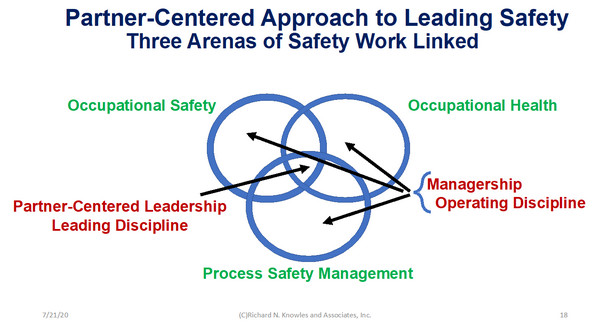
Each safety area was managed separately, using their own operating discipline. Where the three areas came together, we talked about what was happening and looked for input from each other. This significantly raised the total safety and environmental performance of the site. PSM also has a big impact on the environmental performance when spills, accidental chronic emissions, release incidents, improved yields and fires and explosions are eliminated; and a lot less is emitted to the environment.
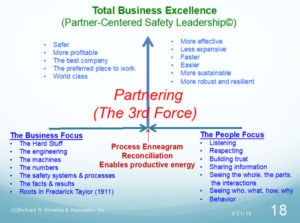
The area of overlap of the three safety disciplines (at the center of the Venn diagram) is where we engaged in Partner-Centered Leadership:
- Sharing all information
- Building trust.
- Listening to each other’s problems and opportunities.
- Learning and finding better ways to do the work together.
For example, we talked about the three disciplines in our site Central Safety Meetings, keeping careful track of our safety workorder backlogs, meeting our safety equipment inspection schedules and talking about incidents and injuries that had happened, and what we could all learn from them. The engineers went into the various production areas and sat with the operators to learn what the operators were experiencing as they ran the processes, and the engineers taught the operators the engineering technology supporting their work, helping them to understand what was happening in the manufacturing operations. The supervisors, engineers, operators and maintenance people talked together as safety and work procedures were developed. The gap between work-as imagined and work-as-done virtually disappeared. As trust and the open dialogue improved, our safety and environmental performance really improved.
In just three years, the Total Recordable Injury Rate dropped by about 97% to a rate of about 0.3, and the people sustained this for 17 years. PSM improved with much lower levels of releases and upsets. The emissions to the environment (accidental and permitted) went down about 95% in four years. When the PSM was run as a separate stove pipe from the occupational safety and occupational health stove pipes, the Plant’s performance did not come anywhere close to these low levels. This is significant!
The improvements we made in how we worked together in safety spread into all the other parts of our work in running the big (1,300 people) chemical plant. The more we shared information, treated each other with respect and listened to each other, the more the total performance improved. For example, productivity rose by about 45% and earnings rose about 300%.
 Learning to work more effectively, through our safety work, spread to the whole organization. Each of you reading this newsletter can make a big difference as you engage with the people in your organizations, sharing information, building respect and trust. The impact of your work will spread.
Want to know more? Contact me at 716-622-6467. Or, Order my book, “Partnering for Safety and Business Excellence” on Amazon.
Note: Venn is a diagram that shows all possible logical relations between a finite collection of different sets. Take a look at what sits right in the middle!
 In this story, a wicked witch puts the princess and the whole kingdom to sleep for 100 years. They all have to wait for the arrival of the prince to kiss the princess and awaken everyone. As children, we all knew this story, but in this new book, Stephen Capizzano shifts the story to thinking about what happens in our organizations.
 When we were able to shed our old habits at our Plant in West Virginia, injury rates dropped by 97%, emissions to air, ground and water as reported to the EPA dropped 95%, productivity rose by 45% and earnings rose by 300%. As I walked the plant for 5 hours each day we were reminding ourselves to shed the old habits and create a much brighter future.
 Artificial intelligence and robots, block chains and bitcoins, the opioid epidemic, political strife, and workplace violence, international worries and potential conflicts are some of the challenges facing all of us. There is a critical need for people, in all walks of life, to come together to openly and honestly talk about our challenges, share our thinking and learn together. We do not have to be blindly swept along. We can make decisions and do the things that we need to do to help to make the world a better place.
 When I talk about safety. my thinking goes well beyond the traditional safety numbers, training and procedures. It includes ideas about respect and how everyone has agreed to work together. It includes ideas about personal responsibility, integrity and dedication to helping everyone improve. It includes openness, honesty and sharing information abundantly. It includes ideas about the deeper, often hidden patterns of behavior which have a profound impact on the work environment and drive much of the behavior. It includes the fact that the managers and leaders have the largest impact on their organization’s performance. It includes the understanding that managers focus on reliability, stability, predictability and control as they try to maintain the status quo and that leaders focus on the people, change and the future sharing information abundantly, treating people with respect and helping people find meaning in their work. Both good leaders and managers are needed.
 This begins with the leaders deciding to create a culture where it is okay and encouraged that people genuinely talk together, listen, help each other, look out for each other and learn together. This is a culture that helps people to be the best they can be and for the organization to get a lot more profitable. It all begins with all of us treating each other with respect.
 This is the sort of culture that Eric Hollnagel is talking about in his Safety II work, which is intended to move the organization beyond the traditional top-down safety management. (I’ve written about Safety II in previous articles – it is all good!)
 In our November Safety Newsletter, I wrote about Partner-Centered Leadership. This is the most effective way to improve safety performance. This way of leading also results in improvements in most other aspects of the business as trust and interdependence are built and the environment is safe for the open flow of information. A key aspect of this is working with the people.