I have read several recent articles about how big data and artificial intelligence (AI) can be used to help to improve safety.
The AI approach involves the collection and evaluation of huge amounts of data (big data) to learn from human behavior, looking for patterns and helping to improve safety performance. By doing this over and over, the machines can learn to keep doing better and better analyses and even begin to provide predictions about improving human performance. For example, repeated activities like lifting can be studied, problem patterns in lifting techniques be identified and improvements in the behavior or the physical arrangement of the lifting work modified.
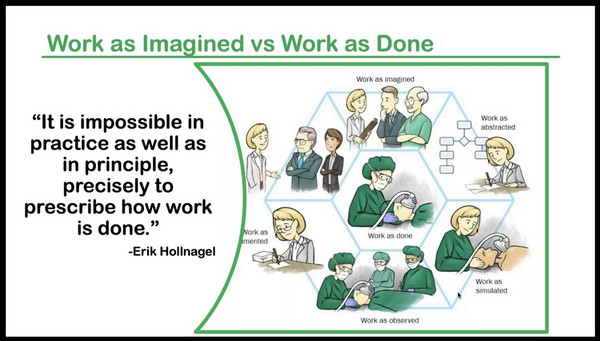
This could provide very useful information that could reduce injuries and incidents, however, it is important to understand that people creating the algorithms are making assumptions and decisions about the way the work is done. “The devil is in the detail.” This can lead to a gap between the work-as-imagined and work-as-done. While the piles of data, the patterns they predict and the predictions they make can be useful, they can also be a problem. All this information can be quite beguiling and lead us to thinking we have all the information we need to reduce the injuries and incidents.
These studies can help to reduce injuries and incidents by providing the people some tools to see what is happening and make some adjustments in their behavior. But relying on them to do our thinking is a problem.
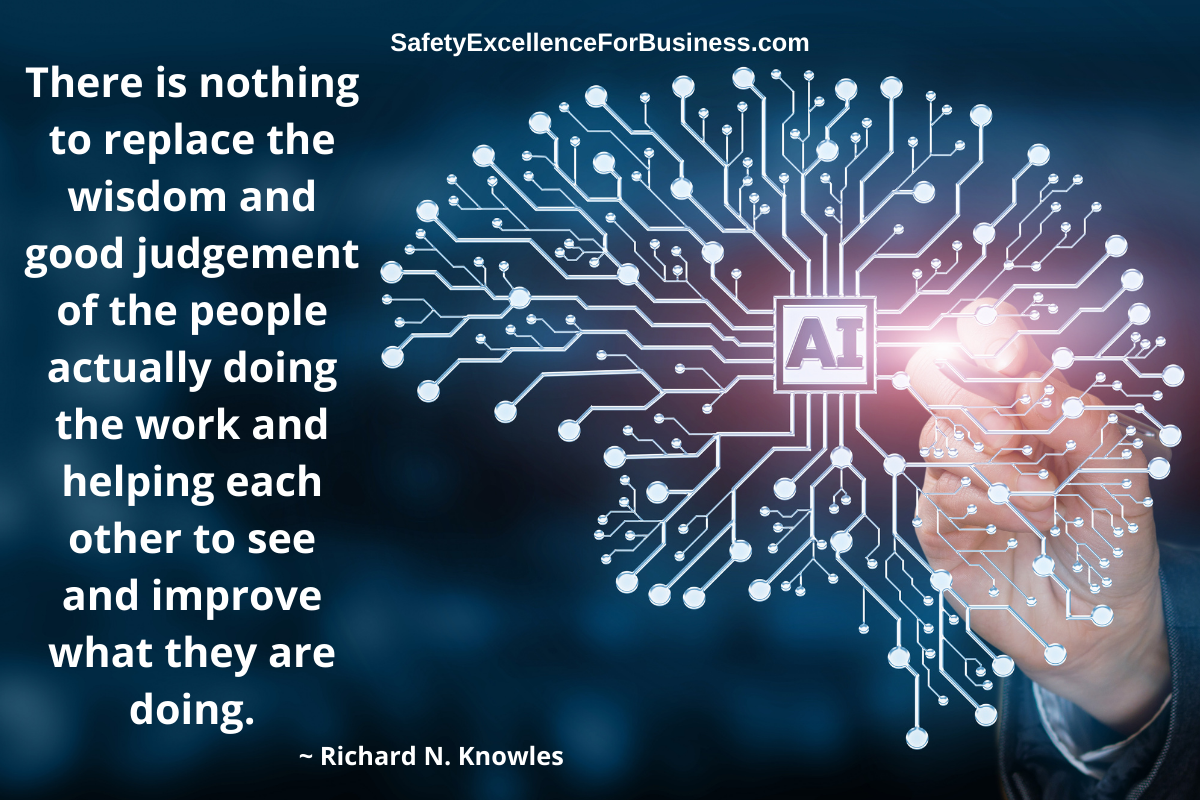
These tools need to be taken with a huge grain of salt. There is nothing to replace the wisdom and good judgement of the people actually doing the work and helping each other to see and improve what they are doing.
These AI tools can help, but they are not the final answer. It is those close to the work who need to make the final decisions. We do not want to automate taking peoples’ brains out of the picture. These AI tools cannot see the actual situation that the person is facing as he/she does their job. Decisions often need to be made as the work unfolds to get the work done right. The gap between work-as-imagined and work-as-done needs to be closed as much as possible so the best procedures and practices can be used to do the work safely.
We need to help each other to rise to be the best we can be. Partnering together, helping each other, talking together about the work and the potential safety challenges are all highly effective ways to improve the total performance in sustainable ways. We should not allow the AI to push the thinking and good judgement of our highly skilled people aside. We can use AI as a supplement and to provide clues about improving the work. But pretending that AI can do our thinking for us is myth.
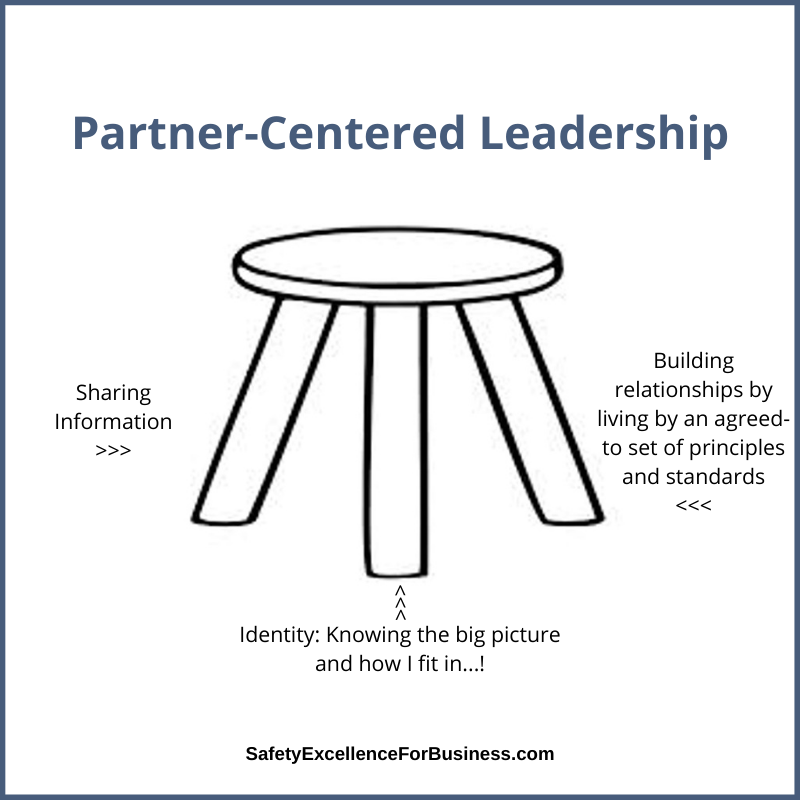
Everyone sharing information about your particular situations, treating each other with respect, telling the truth, making sure that the standards of performance and expectations are clear, helping everyone to see the importance of their work for the success of the whole business are foundational. Treating the people as intelligent, highly skilled and thoughtful will bring out the best in them.
AI can help, but it is not a replacement for the collective intelligence of the people who are dedicated to excellence.
I would be remiss if I did not insert (here), that the process for actually achieving this highly effective communication among and with people is Partner-Centered Leadership. Please call me (716-622-6467) and I’ll show you how easily this framework can be applied to your every-day communications and Leadership.
The Internet of Things (IoT): Another Caution
There are more and more electronic tools becoming available to help us with all sorts of tasks. We see ads for building electronic homes, installing fine security systems and even monitoring the sleeping babies. There are dozens of Apps for our cell phones so we can keep track of things.
Monitoring tools are also becoming available to monitor people as they do their work. It is a good idea to monitor someone who is working alone at a remote location or working alone at night doing security in a big warehouse. Sensors installed across wide locations enable rapid response in the event of an accident or emergency.
Like AI, these can be quite helpful, providing we don’t become too dependent on them. As these tools are developed and deployed, remember that they are put together by people who are making assumptions about their particular use.
Some of this monitoring can be used – drawing from the old time and motion studies from the days of Frederick Taylor in his 1911 book, “Principles of Scientific Management“. There is high value in learning from the past. There is high value in integrating new technologies. Yet striking that right balance is key – and always, always, with the genuine involvement and input of the people who are actually doing the work.
Summary
AI and IoT can be quite useful, but they need to be taken with caution and not allowed to replace the good thinking, planning and actions of our highly skilled, intelligent people. The comments in this newsletter are not luddite, but rather a caution about not throwing away the thinking, creativity and resourcefulness of the people with whom we work. Let’s help people become their best and rise to the top.
 Learning to work more effectively, through our safety work, spread to the whole organization. Each of you reading this newsletter can make a big difference as you engage with the people in your organizations, sharing information, building respect and trust. The impact of your work will spread.
 We each need to take the personal responsibility to try to avoid spreading the virus. With all the pressures, this is not easy. It is best if we each take personal responsibility to social distance and try to avoid spreading the virus. Government edicts really do not cover the details of what we each need to do very well. It is really up to us.
 In this story, a wicked witch puts the princess and the whole kingdom to sleep for 100 years. They all have to wait for the arrival of the prince to kiss the princess and awaken everyone. As children, we all knew this story, but in this new book, Stephen Capizzano shifts the story to thinking about what happens in our organizations.
 When we were able to shed our old habits at our Plant in West Virginia, injury rates dropped by 97%, emissions to air, ground and water as reported to the EPA dropped 95%, productivity rose by 45% and earnings rose by 300%. As I walked the plant for 5 hours each day we were reminding ourselves to shed the old habits and create a much brighter future.
 The COVID-19 pandemic, the return to school questions, the protests and riots in so many of our cities, the bitter political campaign, the demand for using the “correct” words, are driving people crazy. The COVID-19, the questions, the anxieties and concerns, spill into our workplaces causing a lot of uncertainty and stress. We see this happening every day. Our businesses, our schools and hospitals, our governments, and not-for-profits, at all levels, are struggling. Changes and pressures are coming faster and faster.
 In thinking about your own place where you work, what do you suppose it would be like if you did some of these things? Do you think that you could begin talking with others about the COVID-19 challenges and building a more respectful environment? What do you think it would be like if you could openly talk together about the important issues like workable, social distancing and improving the safety of your job?
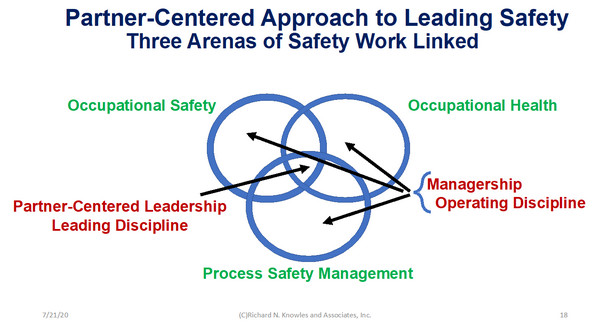
 When I was transferred to the DuPont Belle, West Virginia plant in 1987, the Total Recordable Injury Case Rate (TRC) was about 5.8 and emissions to air, water and ground, as reported in the EPA Toxic Release Inventory (TRI) annual report, was over 6,000,000 pounds/year. Within three years, both of these had dropped by about 95% to a TRC of about 0.3 and a TRI of about 275,000 pounds/year. Emissions to the environment is one way to measure how well the process safety is working; the better the process safety work, the lower the emissions to the environment.
 The process safety management collapsed in January of 2010 with major, accidental releases to the air and river and they had a man get killed with a phosgene release. When the US Chemical Safety Board investigated in late 2010, they reported that while the occupational safety and health performance was the best in the DuPont Company, the process safety management had fallen apart and the plant was not even using the DuPont standard procedures. This was a sad commentary about how far things had fallen.